Multicellularity
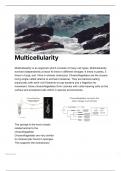
Multicellularity is an organism which consists of many cell types. Multicellularity
evolved independently at least 10 times in different lineages: 6 times in plants, 3
times in fungi, and 1 time in animals (metazoa). Choanoflagellates are the closest
living single-celled relative to animals (metazoa). They are bacteria eating
eukaryotes with actin-rich filaments to trap bacteria and a flagellum for
movement. Some choanoflagellates form colonies with collar bearing cells on the
surface and amoeboid cells within in species environments.
The sponge is the most closely
related animal to the
choanoflagellate.
Choanoflagellates are very similar
to choanocytes found in sponges.
This supports the evolutionary
Multicellularity 1
Multicellularity is an organism which consists of many cell types. Multicellularity
evolved independently at least 10 times in different lineages: 6 times in plants, 3
times in fungi, and 1 time in animals (metazoa). Choanoflagellates are the closest
living single-celled relative to animals (metazoa). They are bacteria eating
eukaryotes with actin-rich filaments to trap bacteria and a flagellum for
movement. Some choanoflagellates form colonies with collar bearing cells on the
surface and amoeboid cells within in species environments.
The sponge is the most closely
related animal to the
choanoflagellate.
Choanoflagellates are very similar
to choanocytes found in sponges.
This supports the evolutionary
Multicellularity 1