@PROFDOCDIGITALLIBRARIES
TEST BANK
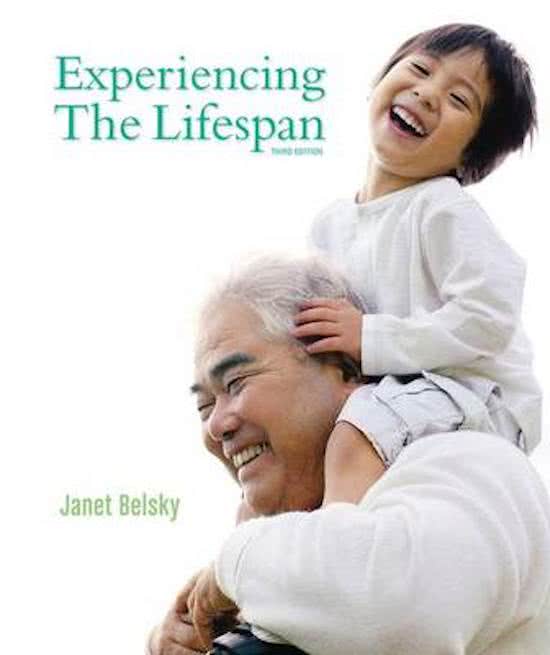
Experiencing the Lifespan Third Edition
Janet Belsky
ST
U
D
YW
BR
IA
N
Page 1
,@PROFDOCDIGITALLIBRARIES
List three normative and three non-normative influences in your life.
Describe (and speculate) on the ways an 80-year-old and a 20-year-old might view the
Great Recession and Obama's presidency.
Joey and Jack are born on the same day in the same hospital. The socioeconomic statusof
Joey's family is higher than average. Jack comes from a poverty-level family. What
differences between Joe and Jack might you predict as they travel through life?
ST
Explain how you might teach table manners to a 4-year-old, using operant conditioning.
Brandi, a college sophomore, seeks help from the counseling center for her extreme
U
shyness and is offered a choice of treatments. She can have sessions with a behavioral
therapist, work with a psychoanalyst, or get therapy from a person who follows the
developmental systems perspective. Explain in a sentence how each treatment would
D
differ from the others.
YW
Dr. Ragan, a behaviorist, is the new director of an organization that prepares people to
return to college after they have dropped out. Dr. Ragan's mission is to design a program
to assist clients in their efforts to successfully reenter school. Using the principles of
traditional behaviorism, modeling, and self-efficacy, spell out some strategies that Dr.
Regan might employ.
BR
Spell out the main similarity and difference between John Bowlby's attachment theory
and traditional psychoanalytic theory.
As a psychologist, you want to determine the heritability (or genetic contribution) to
IA
political attitudes. Describe how you would design your study. What findings would
suggest that political attitudes are highly genetic?
N
Give an example each of evocative and active genetic/environment forces and how they
have shaped the person you are. Then give an example of either an optimum or poor
person-environment fit this semester in your life.
Compare and contrast Erikson and Freud's ideas.
Page 2
,@PROFDOCDIGITALLIBRARIES
Explain Piaget's concepts of assimilation and accommodation and give a concrete
example of those processes.
You are a developmentalist studying the relationship between parenting practices and
children's sociability. Your plan is to watch each family's interactions at home, and then
observe each child's relationships with peers at school. Name your type of measurement
and spell out its advantage and disadvantages.
ST
Melissa and Ramon want to conduct a study to determine if exercise promotes health.
Melissa plans to test this question using a correlational approach, while Ramon decides
to conduct an experiment. Describe what each student's research might look like and
discuss the respective pluses and minuses of each plan.
U
After conducting a cross-sectional study, you find that older workers are more satisfiedwith
their jobs than are younger workers. How should you interpret this finding?
D
List the pluses and minuses of conducting longitudinal research.
YW
Take a specific concept, term, or theory in this chapter and discuss how it applies toyour
own life.
BR
IA
N
Page 3
, @PROFDOCDIGITALLIBRARIES
Answer Key
Here, while answers will vary, normative influences would center on predictable
culturally and biologically shared events, such as going to kindergarten, reaching
puberty, having children, dying, and so forth. In cataloguing non-normative influences,
students should refer to any major unexpected event in their lives.
Students' answers could legitimately vary, but I'd suspect for the 80-year-old, this election
of our first Black president might be an incredible surprise; not so for today's emerging
adults. In contrast, the opposite might be true of the financial crisis: it is likelyto be a
shock for emerging adults, but all too familiar for people who were born during the
ST
Great Depression of the l930s.
At every age, Joey might be healthier; Joey also may end up more well-educated; more
likely to be married, and so forth.
Answers will center on reinforcing the child for sitting still, using a fork, saying “please
pass the peas,” etc.; and ignoring the child when he shows inappropriate behavior. You
U
can also use time out when the child misbehaves.
The behaviorist might focus on getting Brandi in positively reinforcing social situations to
try to extinguish her shyness. The psychoanalyst would encourage Brandi to talk about
D
her early life experiences and get insight into the unconscious roots of her shyness. A
developmental systems proponent would attack the problem on several fronts
—trying out medications and different types of therapy, exploring how everything from
YW
cultural and family values to genetic predispositions might be causing Brandi's
symptoms.
From traditional behaviorism—Reinforce clients step by step for making applications,
going for interviews, either individually or as a group. From modeling—specifically
bring in people who have successfully returned to college years after they dropped out,
to talk to clients; have clients model each other in filling out applications, and so forth,
in group sessions. Self-efficacy interventions—continually bring home the message
BR
“you can succeed” directly and also via using the other techniques mentioned
previously.
Bowlby agreed with the Freudians that our early experiences with caregivers shape our
mental health; but he also believed in a nature explanation of behavior, namely, that the
attachment response is biologically built in to promote species survival.
IA
Here you could conduct a twin study, soliciting a large sample of identical and fraternal
twins and comparing the similarity of “identicals” attitudes on a test of political attitudes
with those of “fraternals.” If the identical twins had much more similar views than the
fraternal twins, your conclusion would be that political attitudes are highly genetically
N
determined. Alternatively, you could select adopted children and compare their political
views with their biological and adoptive parents' views. If you found a high correlation
between adoptees' attitudes and their birth parents views and virtually no similarity
between adoptees' attitudes and their adoptive parents' views, you could make the same
conclusion.
Answers will vary. Evocative influences, however, will relate to how personality traits—
shyness, happiness, kindness, and so forth, naturally affect how other people relate to
that student. In describing active forces, students should talk about talents and interests
that propelled them to actively select environments where they learned to improve at
Page 4
TEST BANK
Experiencing the Lifespan Third Edition
Janet Belsky
ST
U
D
YW
BR
IA
N
Page 1
,@PROFDOCDIGITALLIBRARIES
List three normative and three non-normative influences in your life.
Describe (and speculate) on the ways an 80-year-old and a 20-year-old might view the
Great Recession and Obama's presidency.
Joey and Jack are born on the same day in the same hospital. The socioeconomic statusof
Joey's family is higher than average. Jack comes from a poverty-level family. What
differences between Joe and Jack might you predict as they travel through life?
ST
Explain how you might teach table manners to a 4-year-old, using operant conditioning.
Brandi, a college sophomore, seeks help from the counseling center for her extreme
U
shyness and is offered a choice of treatments. She can have sessions with a behavioral
therapist, work with a psychoanalyst, or get therapy from a person who follows the
developmental systems perspective. Explain in a sentence how each treatment would
D
differ from the others.
YW
Dr. Ragan, a behaviorist, is the new director of an organization that prepares people to
return to college after they have dropped out. Dr. Ragan's mission is to design a program
to assist clients in their efforts to successfully reenter school. Using the principles of
traditional behaviorism, modeling, and self-efficacy, spell out some strategies that Dr.
Regan might employ.
BR
Spell out the main similarity and difference between John Bowlby's attachment theory
and traditional psychoanalytic theory.
As a psychologist, you want to determine the heritability (or genetic contribution) to
IA
political attitudes. Describe how you would design your study. What findings would
suggest that political attitudes are highly genetic?
N
Give an example each of evocative and active genetic/environment forces and how they
have shaped the person you are. Then give an example of either an optimum or poor
person-environment fit this semester in your life.
Compare and contrast Erikson and Freud's ideas.
Page 2
,@PROFDOCDIGITALLIBRARIES
Explain Piaget's concepts of assimilation and accommodation and give a concrete
example of those processes.
You are a developmentalist studying the relationship between parenting practices and
children's sociability. Your plan is to watch each family's interactions at home, and then
observe each child's relationships with peers at school. Name your type of measurement
and spell out its advantage and disadvantages.
ST
Melissa and Ramon want to conduct a study to determine if exercise promotes health.
Melissa plans to test this question using a correlational approach, while Ramon decides
to conduct an experiment. Describe what each student's research might look like and
discuss the respective pluses and minuses of each plan.
U
After conducting a cross-sectional study, you find that older workers are more satisfiedwith
their jobs than are younger workers. How should you interpret this finding?
D
List the pluses and minuses of conducting longitudinal research.
YW
Take a specific concept, term, or theory in this chapter and discuss how it applies toyour
own life.
BR
IA
N
Page 3
, @PROFDOCDIGITALLIBRARIES
Answer Key
Here, while answers will vary, normative influences would center on predictable
culturally and biologically shared events, such as going to kindergarten, reaching
puberty, having children, dying, and so forth. In cataloguing non-normative influences,
students should refer to any major unexpected event in their lives.
Students' answers could legitimately vary, but I'd suspect for the 80-year-old, this election
of our first Black president might be an incredible surprise; not so for today's emerging
adults. In contrast, the opposite might be true of the financial crisis: it is likelyto be a
shock for emerging adults, but all too familiar for people who were born during the
ST
Great Depression of the l930s.
At every age, Joey might be healthier; Joey also may end up more well-educated; more
likely to be married, and so forth.
Answers will center on reinforcing the child for sitting still, using a fork, saying “please
pass the peas,” etc.; and ignoring the child when he shows inappropriate behavior. You
U
can also use time out when the child misbehaves.
The behaviorist might focus on getting Brandi in positively reinforcing social situations to
try to extinguish her shyness. The psychoanalyst would encourage Brandi to talk about
D
her early life experiences and get insight into the unconscious roots of her shyness. A
developmental systems proponent would attack the problem on several fronts
—trying out medications and different types of therapy, exploring how everything from
YW
cultural and family values to genetic predispositions might be causing Brandi's
symptoms.
From traditional behaviorism—Reinforce clients step by step for making applications,
going for interviews, either individually or as a group. From modeling—specifically
bring in people who have successfully returned to college years after they dropped out,
to talk to clients; have clients model each other in filling out applications, and so forth,
in group sessions. Self-efficacy interventions—continually bring home the message
BR
“you can succeed” directly and also via using the other techniques mentioned
previously.
Bowlby agreed with the Freudians that our early experiences with caregivers shape our
mental health; but he also believed in a nature explanation of behavior, namely, that the
attachment response is biologically built in to promote species survival.
IA
Here you could conduct a twin study, soliciting a large sample of identical and fraternal
twins and comparing the similarity of “identicals” attitudes on a test of political attitudes
with those of “fraternals.” If the identical twins had much more similar views than the
fraternal twins, your conclusion would be that political attitudes are highly genetically
N
determined. Alternatively, you could select adopted children and compare their political
views with their biological and adoptive parents' views. If you found a high correlation
between adoptees' attitudes and their birth parents views and virtually no similarity
between adoptees' attitudes and their adoptive parents' views, you could make the same
conclusion.
Answers will vary. Evocative influences, however, will relate to how personality traits—
shyness, happiness, kindness, and so forth, naturally affect how other people relate to
that student. In describing active forces, students should talk about talents and interests
that propelled them to actively select environments where they learned to improve at
Page 4