Forensic Entomology Test questions with verified
answers
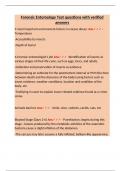
3 most important environment factors in corpse decay: Ans✓✓✓ -
Temperature
-Accessibility by insects
-Depth of burial
A forensic entomologist's job Ans✓✓✓ -Identification of insects at
various stages of their life cycle, such as eggs, larva, and adults.
-Collection and preservation of insects as evidence.
-Determining an estimate for the postmortem interval or PMI (the time
between death and the discovery of the body) using factors such as
insect evidence, weather conditions, location and condition of the
body, etc.
-Testifying in court to explain insect-related evidence found at a crime
scene.
Animals barriers Ans✓✓✓ - birds, mice, rodents, canids, cats, etc
Bloated Stage (Days 2-6) Ans✓✓✓ - Putrefaction, begins during this
stage. -Gasses produced by the metabolic activities of the anaerobic
bacteria cause a slight inflation of the abdomen.
-The carcass may later assume a fully inflated, balloon-like appearance.
, -Adult and larval blowflies in large numbers attracted to fluids seeping
from body, normal soil dwelling fauna depart soil because of seepage of
fluids; some muscid flies and ants which can feed on larvae and retard
maggot activity.
Blow Fly- 70 F amount of time to complete each cycle Ans✓✓✓ egg -
instar 23 hrs
1 instar - 2nd instar 27 hrs
2nd instar - 3rd instar 22 hrs
3rd instar - pupa 130 hrs
pupa - adult fly 143 hrs
Chemical barriers Ans✓✓✓ - embalming agent, insecticides, lime, etc.
Climatic barriers Ans✓✓✓ - heat, cold, wind, rainfall
Common application of entomology Ans✓✓✓ -Determining PMI -
postmortem interval
-Movement of the corpse
-Manner and cause of death
-Association of suspects with the death scene
-Detection of toxins or drugs through analysis of insect larvae
answers
3 most important environment factors in corpse decay: Ans✓✓✓ -
Temperature
-Accessibility by insects
-Depth of burial
A forensic entomologist's job Ans✓✓✓ -Identification of insects at
various stages of their life cycle, such as eggs, larva, and adults.
-Collection and preservation of insects as evidence.
-Determining an estimate for the postmortem interval or PMI (the time
between death and the discovery of the body) using factors such as
insect evidence, weather conditions, location and condition of the
body, etc.
-Testifying in court to explain insect-related evidence found at a crime
scene.
Animals barriers Ans✓✓✓ - birds, mice, rodents, canids, cats, etc
Bloated Stage (Days 2-6) Ans✓✓✓ - Putrefaction, begins during this
stage. -Gasses produced by the metabolic activities of the anaerobic
bacteria cause a slight inflation of the abdomen.
-The carcass may later assume a fully inflated, balloon-like appearance.
, -Adult and larval blowflies in large numbers attracted to fluids seeping
from body, normal soil dwelling fauna depart soil because of seepage of
fluids; some muscid flies and ants which can feed on larvae and retard
maggot activity.
Blow Fly- 70 F amount of time to complete each cycle Ans✓✓✓ egg -
instar 23 hrs
1 instar - 2nd instar 27 hrs
2nd instar - 3rd instar 22 hrs
3rd instar - pupa 130 hrs
pupa - adult fly 143 hrs
Chemical barriers Ans✓✓✓ - embalming agent, insecticides, lime, etc.
Climatic barriers Ans✓✓✓ - heat, cold, wind, rainfall
Common application of entomology Ans✓✓✓ -Determining PMI -
postmortem interval
-Movement of the corpse
-Manner and cause of death
-Association of suspects with the death scene
-Detection of toxins or drugs through analysis of insect larvae