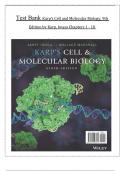
Test Bank Karp’s Cell and Molecular Biology, 9th
Edition by Karp, Iwasa Chapters 1 - 18
,Test Bank for Karp’s Cell and Molecular Biology 9th Edition Karp
Table of Contents:
Chapter 1: Introduction to the Study of Cell and Molecular Biology
Chapter 2: The Chemical Basis of Life
Chapter 3: Bioenergetics, Enzymes, and Metabolism
Chapter 4: The Structure and Function of the Plasma Membrane
Chapter 5: Aerobic Respiration and the Mitochondrion
Chapter 6: Photosynthesis and the Chloroplast
Chapter 7: Interactions between Cells and Their Environment
Chapter 8: Cytoplasmic Membrane Systems: Structure, Function, and
Membrane Trafficking
Chapter 9: The Cytoskeleton and Cell Motility
Chapter 10: The Nature of the Gene and the Genome
Chapter 11: The Central Dogma: DNA to RNA to Protein
Chapter 12: Control of Gene Expression
Chapter 13: DNA Replication and Repair
Chapter 14: Cell Division 6
Chapter 15: Cell Signaling and Signal Transduction: Communication
between Cells
Chapter 16: Cancer
Chapter 17: The Immune Response
Chapter 18: Techniques in Cell and Molecular Biology
,Package Title:
Test BankCourse
Title: Karp9e
Chapter Number:
1
Chapter 1: Introduction to the Study of Cell and Molecular
BiologyKarp’s Cell and Molecular Biology, 9th Edition
Question Type: Multiple Choice
1)Who was the first person to name what he thought were single cells?
a)Leeuwenhoek
b)Hooke
c)Schleiden
d)Schwann
e)Virchow
ANSWER: : b
Difficulty: Easy
Learning Objective: LO 1.1 Identify the three tenets of
cell theory.Section Reference: Section 1.1 The
Discovery of Cells
2)The first compound light microscopes were constructed by the end of the
sixteenth century. Whatcharacteristic defines a compound microscope?
a)It has a moveable stage.
b)It has multiple lenses.
c)Its lens is double the size of simple microscopes.
d)The lens has two different colors.
e)It has two different light sources.
, ANSWER: : b
Difficulty: Easy
Learning Objective: LO 1.1 Identify the three tenets of cell theory.
Section Reference: Section 1.1 The Discovery of Cells
3)Who was the first scientist to examine and describe living cells?
a)Leeuwenhoek
b)Hooke
c)Schleiden
d)Schwann
e)Virchow
ANSWER: : a
Difficulty: Easy
Learning Objective: LO 1.1 Identify the three tenets of
cell theory.Section Reference: Section 1.1 The
Discovery of Cells
Edition by Karp, Iwasa Chapters 1 - 18
,Test Bank for Karp’s Cell and Molecular Biology 9th Edition Karp
Table of Contents:
Chapter 1: Introduction to the Study of Cell and Molecular Biology
Chapter 2: The Chemical Basis of Life
Chapter 3: Bioenergetics, Enzymes, and Metabolism
Chapter 4: The Structure and Function of the Plasma Membrane
Chapter 5: Aerobic Respiration and the Mitochondrion
Chapter 6: Photosynthesis and the Chloroplast
Chapter 7: Interactions between Cells and Their Environment
Chapter 8: Cytoplasmic Membrane Systems: Structure, Function, and
Membrane Trafficking
Chapter 9: The Cytoskeleton and Cell Motility
Chapter 10: The Nature of the Gene and the Genome
Chapter 11: The Central Dogma: DNA to RNA to Protein
Chapter 12: Control of Gene Expression
Chapter 13: DNA Replication and Repair
Chapter 14: Cell Division 6
Chapter 15: Cell Signaling and Signal Transduction: Communication
between Cells
Chapter 16: Cancer
Chapter 17: The Immune Response
Chapter 18: Techniques in Cell and Molecular Biology
,Package Title:
Test BankCourse
Title: Karp9e
Chapter Number:
1
Chapter 1: Introduction to the Study of Cell and Molecular
BiologyKarp’s Cell and Molecular Biology, 9th Edition
Question Type: Multiple Choice
1)Who was the first person to name what he thought were single cells?
a)Leeuwenhoek
b)Hooke
c)Schleiden
d)Schwann
e)Virchow
ANSWER: : b
Difficulty: Easy
Learning Objective: LO 1.1 Identify the three tenets of
cell theory.Section Reference: Section 1.1 The
Discovery of Cells
2)The first compound light microscopes were constructed by the end of the
sixteenth century. Whatcharacteristic defines a compound microscope?
a)It has a moveable stage.
b)It has multiple lenses.
c)Its lens is double the size of simple microscopes.
d)The lens has two different colors.
e)It has two different light sources.
, ANSWER: : b
Difficulty: Easy
Learning Objective: LO 1.1 Identify the three tenets of cell theory.
Section Reference: Section 1.1 The Discovery of Cells
3)Who was the first scientist to examine and describe living cells?
a)Leeuwenhoek
b)Hooke
c)Schleiden
d)Schwann
e)Virchow
ANSWER: : a
Difficulty: Easy
Learning Objective: LO 1.1 Identify the three tenets of
cell theory.Section Reference: Section 1.1 The
Discovery of Cells