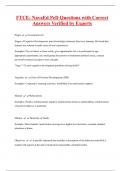
FTCE: NavaEd PeD Questions with Correct
Answers Verified by Experts
Piaget (Constructivist)
Stages of Cognitive Development; prior knowledge (schema); discovery learning. He found that
learners use schema to make sense of new experiences.
Examples: Pre-cut letters to form words, give opportunities for ss to participate in age-
appropriate experiments, use small group discussions to brainstorm political issues, connect
previously learned concepts to new concepts.
*Ages 7-12 most cognitive development (problem-solving skills)*
Vygotsky Zone of Proximal Development (ZPD)
Examples: Cooperative learning activities, Scaffolded, Peer and teacher support.
Skinner Behaviorism
Examples: Positive reinforcement, negative reinforcement (remove undesirables), reinforcement
of positive behavior is preferred.
Maslow Hierarchy of Needs
Example: Meet students' needs before moving on to higher level activities, consider students'
situations at home.
Objectives A specific statement that includes a description of the behaviors and skills a
student will acquire at the end of instruction (measurable, intended result).
,**Teachers can monitor progress and adjust instruction**
1.) Behavior (Bloom's verbs)
2.) Condition (e.g., in 10 minutes, with a calculator, while being monitored).
3.) Criteria (e.g., 4 out of 5 or 80% correct).
Diversity Literature that reflects different cultures (in educational settings and the
workplace), multicultural celebrations, overcoming socioeconomic barriers, avoid stereotypes
and negative representations.
Prior Knowledge: Activating Metacognition, concept maps, KWL chart, picture books,
anticipation guides, ABC brainstorming.
Prior Knowledge: Building Virtual field trips/video clips, field trips, picture books,
visuals, primary source documents/visuals.
Constructivism Old knowledge is a building block upon which students can begin to build
new knowledge.
**teachers can help students make connections between new material and their prior
experiences**
Differentiation Teachers must consider the learner's interest, strengths/weaknesses, and
readiness before planning.
1.) Differentiated Content - Leveled groups, students will analyze poems at varying difficulty
levels.
,2.) Differentiated Process: After a short, whole-group lesson on metaphors, students split up into
small groups.
**teacher-led station**
3.) Differentiated Product: Student choice in how they show mastery. Ex: persuasive essay,
brochure, or podcast.
Types of student data (needs) Standardized test scores (previous year), running records
(reading fluency), formative assessments (observations), survey data (student interests).
Qualitative "Quality" useful for studies at the individual level and finds out the ways in
which people think or feel.
Examples: Surveys, observations, conferences, case studies.
Quantitative Numbers. Information that can be measured and written down with numbers.
Examples: State test scores, reading scores, words per min.
**target specific literary needs of individual students**
Erikson Eight Social Stages. Cooperative Learning and establishing Student Roles.
1.) Trust v. Mistrust
2.) Autonomy v. Shame
3.) Initiative v. Guilt (Purpose)
4.) Industry v. Inferiority (Competence)
5.) Identity v. Identity Diffusion (Fidelity)
, 6.) Intimacy v. Isolation (Love)
7.) Generativity v. Self-Absorption (Care)
8.) Integrity v. Despair (Wisdom)
Bruner Learning is an active process, learners construct new ideas or concepts based on
current/past knowledge.
Examples: Socratic Seminar, Curriculum is a spiral (student build upon prior learning).
Problem-solving skills (inquiry/discover), child's way of viewing the world, and mastery of skills
leads to mastery of more powerful ones.
Stanine Levels Scaling test scores on a 9-point standard scale wth a mean of 5.
Above Average: 7, 8, 9
Average: 4, 5, 6
Below Average: 1, 2, 3
Florida Standards Assessment (FSA) ELA and Math. Levels 1-5 (1 is the lowest).
Classroom management issues First, revisit classroom procedures as a class and practice
them numerous times.
Positive Behavior Support (PBS) A set of research-based strategies used to increase
quality of life and decrease problem behaviors by teaching new skills and making changes in the
student's environment.
Answers Verified by Experts
Piaget (Constructivist)
Stages of Cognitive Development; prior knowledge (schema); discovery learning. He found that
learners use schema to make sense of new experiences.
Examples: Pre-cut letters to form words, give opportunities for ss to participate in age-
appropriate experiments, use small group discussions to brainstorm political issues, connect
previously learned concepts to new concepts.
*Ages 7-12 most cognitive development (problem-solving skills)*
Vygotsky Zone of Proximal Development (ZPD)
Examples: Cooperative learning activities, Scaffolded, Peer and teacher support.
Skinner Behaviorism
Examples: Positive reinforcement, negative reinforcement (remove undesirables), reinforcement
of positive behavior is preferred.
Maslow Hierarchy of Needs
Example: Meet students' needs before moving on to higher level activities, consider students'
situations at home.
Objectives A specific statement that includes a description of the behaviors and skills a
student will acquire at the end of instruction (measurable, intended result).
,**Teachers can monitor progress and adjust instruction**
1.) Behavior (Bloom's verbs)
2.) Condition (e.g., in 10 minutes, with a calculator, while being monitored).
3.) Criteria (e.g., 4 out of 5 or 80% correct).
Diversity Literature that reflects different cultures (in educational settings and the
workplace), multicultural celebrations, overcoming socioeconomic barriers, avoid stereotypes
and negative representations.
Prior Knowledge: Activating Metacognition, concept maps, KWL chart, picture books,
anticipation guides, ABC brainstorming.
Prior Knowledge: Building Virtual field trips/video clips, field trips, picture books,
visuals, primary source documents/visuals.
Constructivism Old knowledge is a building block upon which students can begin to build
new knowledge.
**teachers can help students make connections between new material and their prior
experiences**
Differentiation Teachers must consider the learner's interest, strengths/weaknesses, and
readiness before planning.
1.) Differentiated Content - Leveled groups, students will analyze poems at varying difficulty
levels.
,2.) Differentiated Process: After a short, whole-group lesson on metaphors, students split up into
small groups.
**teacher-led station**
3.) Differentiated Product: Student choice in how they show mastery. Ex: persuasive essay,
brochure, or podcast.
Types of student data (needs) Standardized test scores (previous year), running records
(reading fluency), formative assessments (observations), survey data (student interests).
Qualitative "Quality" useful for studies at the individual level and finds out the ways in
which people think or feel.
Examples: Surveys, observations, conferences, case studies.
Quantitative Numbers. Information that can be measured and written down with numbers.
Examples: State test scores, reading scores, words per min.
**target specific literary needs of individual students**
Erikson Eight Social Stages. Cooperative Learning and establishing Student Roles.
1.) Trust v. Mistrust
2.) Autonomy v. Shame
3.) Initiative v. Guilt (Purpose)
4.) Industry v. Inferiority (Competence)
5.) Identity v. Identity Diffusion (Fidelity)
, 6.) Intimacy v. Isolation (Love)
7.) Generativity v. Self-Absorption (Care)
8.) Integrity v. Despair (Wisdom)
Bruner Learning is an active process, learners construct new ideas or concepts based on
current/past knowledge.
Examples: Socratic Seminar, Curriculum is a spiral (student build upon prior learning).
Problem-solving skills (inquiry/discover), child's way of viewing the world, and mastery of skills
leads to mastery of more powerful ones.
Stanine Levels Scaling test scores on a 9-point standard scale wth a mean of 5.
Above Average: 7, 8, 9
Average: 4, 5, 6
Below Average: 1, 2, 3
Florida Standards Assessment (FSA) ELA and Math. Levels 1-5 (1 is the lowest).
Classroom management issues First, revisit classroom procedures as a class and practice
them numerous times.
Positive Behavior Support (PBS) A set of research-based strategies used to increase
quality of life and decrease problem behaviors by teaching new skills and making changes in the
student's environment.