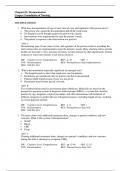
Chapter 03: Documentation
Cooper: Foundation of Nursing
MULTIPLE CHOICE
1. What does documentation of type of care, time of care, and signature of the person prove?
a. The person who signed the documentation did all the work noted.
b. No litigation can be brought against the person who signed.
c. Interventions were implemented to meet the patient’s needs.
d. The patient’s response to the intervention was positive.
ANS: C
Documenting type of care, time of care, and signature of the person results in recording the
interventions that are implemented to meet the patient’s needs. Many charting entries include
health care provider’s visits, presence of family, or interventions by other departments. Patient
response to some interventions is not always positive.
DIF: Cognitive Level: Comprehension REF: p. 40 OBJ: 1
TOP: Documentation KEY: Nursing Process Step: Implementation
MSC: NCLEX: N/A
2. Why is documentation especially significant in managed care?
a. The hospital needs to show that employees care for patients.
b. Institutions are reimbursed only for patient care that is documented.
c. Patients might bring lawsuits if care was not given.
d. Documents may become part of a lawsuit.
ANS: B
Cost reimbursement rates by government plans (Medicare, Medicaid) are based on the
prospective payment system of diagnosis-related groups (DRGs): a system that classifies
patients by age, diagnosis, surgical procedure, and other information with hundreds of
different categories to predict the use of hospital resources, including length of stay, resulting
in a fixed payment amount.
DIF: Cognitive Level: Comprehension REF: p. 41 OBJ: 1
TOP: Documentation KEY: Nursing Process Step: N/A
MSC: NCLEX: N/A
3. The nurse charts only additional treatments done, changes in patient condition, and new
concerns. What is this system of documentation?
a. SOAP
b. Block
c. CBE
d. Focus
ANS: C
Charting additional treatments done, changes in a patient’s condition, and new concerns
during the shift is charting by exception (CBE).
DIF: Cognitive Level: Comprehension REF: pp. 47-48 OBJ: 1 | 5 | 7
TOP: Documentation KEY: Nursing Process Step: N/A
, MSC: NCLEX: N/A
4. What form explains the lapse when events are not consistent with facility or national standards
of expected care?
a. Subjective data
b. Focus chart
c. Incident report
d. Nursing assessment
ANS: C
An incident report is completed when patient care was not consistent with facility or national
standards. The form explains the event, time, extent of injury, and who was notified.
DIF: Cognitive Level: Knowledge REF: p. 49 OBJ: 1 | 7
TOP: Documentation KEY: Nursing Process Step: N/A
MSC: NCLEX: N/A
5. The staff from all disciplines is developing integrated care plans for a projected length of stay
for patients of a specific case type. This is known as a:
a. nursing order.
b. Kardex.
c. nursing care plan.
d. critical pathway.
ANS: D
Critical pathways allow staff from all disciplines to develop integrated care plans for a
projected length of stay for patients of a specific case type.
DIF: Cognitive Level: Knowledge REF: p. 41 OBJ: 8
TOP: Documentation KEY: Nursing Process Step: Implementation
MSC: NCLEX: N/A
6. What makes home health care documentation unique?
a. Some charting is retained at the hospital.
b. The health care provider’s office needs separate charting.
c. Different health care providers need access.
d. The health care provider is the pivotal person in the charting.
ANS: C
Home health care documentation has unique problems because of the need for different health
care workers to access the medical record.
DIF: Cognitive Level: Comprehension REF: p. 55 OBJ: 9
TOP: Documentation KEY: Nursing Process Step: N/A
MSC: NCLEX: N/A
7. What regulates standards for long-term care documentation?
a. OBRA
b. Title XXII
c. Patient problems
d. The care plan
Cooper: Foundation of Nursing
MULTIPLE CHOICE
1. What does documentation of type of care, time of care, and signature of the person prove?
a. The person who signed the documentation did all the work noted.
b. No litigation can be brought against the person who signed.
c. Interventions were implemented to meet the patient’s needs.
d. The patient’s response to the intervention was positive.
ANS: C
Documenting type of care, time of care, and signature of the person results in recording the
interventions that are implemented to meet the patient’s needs. Many charting entries include
health care provider’s visits, presence of family, or interventions by other departments. Patient
response to some interventions is not always positive.
DIF: Cognitive Level: Comprehension REF: p. 40 OBJ: 1
TOP: Documentation KEY: Nursing Process Step: Implementation
MSC: NCLEX: N/A
2. Why is documentation especially significant in managed care?
a. The hospital needs to show that employees care for patients.
b. Institutions are reimbursed only for patient care that is documented.
c. Patients might bring lawsuits if care was not given.
d. Documents may become part of a lawsuit.
ANS: B
Cost reimbursement rates by government plans (Medicare, Medicaid) are based on the
prospective payment system of diagnosis-related groups (DRGs): a system that classifies
patients by age, diagnosis, surgical procedure, and other information with hundreds of
different categories to predict the use of hospital resources, including length of stay, resulting
in a fixed payment amount.
DIF: Cognitive Level: Comprehension REF: p. 41 OBJ: 1
TOP: Documentation KEY: Nursing Process Step: N/A
MSC: NCLEX: N/A
3. The nurse charts only additional treatments done, changes in patient condition, and new
concerns. What is this system of documentation?
a. SOAP
b. Block
c. CBE
d. Focus
ANS: C
Charting additional treatments done, changes in a patient’s condition, and new concerns
during the shift is charting by exception (CBE).
DIF: Cognitive Level: Comprehension REF: pp. 47-48 OBJ: 1 | 5 | 7
TOP: Documentation KEY: Nursing Process Step: N/A
, MSC: NCLEX: N/A
4. What form explains the lapse when events are not consistent with facility or national standards
of expected care?
a. Subjective data
b. Focus chart
c. Incident report
d. Nursing assessment
ANS: C
An incident report is completed when patient care was not consistent with facility or national
standards. The form explains the event, time, extent of injury, and who was notified.
DIF: Cognitive Level: Knowledge REF: p. 49 OBJ: 1 | 7
TOP: Documentation KEY: Nursing Process Step: N/A
MSC: NCLEX: N/A
5. The staff from all disciplines is developing integrated care plans for a projected length of stay
for patients of a specific case type. This is known as a:
a. nursing order.
b. Kardex.
c. nursing care plan.
d. critical pathway.
ANS: D
Critical pathways allow staff from all disciplines to develop integrated care plans for a
projected length of stay for patients of a specific case type.
DIF: Cognitive Level: Knowledge REF: p. 41 OBJ: 8
TOP: Documentation KEY: Nursing Process Step: Implementation
MSC: NCLEX: N/A
6. What makes home health care documentation unique?
a. Some charting is retained at the hospital.
b. The health care provider’s office needs separate charting.
c. Different health care providers need access.
d. The health care provider is the pivotal person in the charting.
ANS: C
Home health care documentation has unique problems because of the need for different health
care workers to access the medical record.
DIF: Cognitive Level: Comprehension REF: p. 55 OBJ: 9
TOP: Documentation KEY: Nursing Process Step: N/A
MSC: NCLEX: N/A
7. What regulates standards for long-term care documentation?
a. OBRA
b. Title XXII
c. Patient problems
d. The care plan