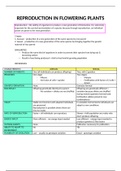
REPRODUCTION IN FLOWERING PLANTS
Reproduction = the ability of organisms to produce a new generation of themselves. It is extremely
important for the survival and evolution of a species because through reproduction, an individual
passes on genes to the next generation.
2 types:
1. Asexual – production of a new generation of the same species by one parent
2. Sexual – production of a new generation of the same species by bringing together the genetic
material of two parent
SIMILARITIES
Produce the same kind of organisms in order to prevent their species from dying out &
becoming extinct
Result in food being produced = vital to feed worlds growing population
DIFFERENCES
CHARACTERISITCS ASEXUAL SEXUAL
NUMBER OF PARENTS One (all individuals can produce offspring) Two, with 2 genders
PROCESSES One stage Two stages
- Mitosis - Meiosis
- No fusion of cells = quicker - Fertilisation with fusion of 2 cells =
slower
GAMETE FORMATION None Gametes formed
END RESULT Offspring genetically identical to parent Offspring are genetically different =
- No variation = alleles are not shuffled variation because alleles are shuffled
during meiosis (gametes formed) and
fertilisation (alleles joined in new
combinations)
VALUE Stable environment well adapted individuals In unstable environments individuals can
are preserved adapt to new conditions
Reproduction is possible where there are
few/no mates
RATE OF REPRODUCTION Faster = all individuals can reproduce Slower = half population are males who
don’t produce offspring
ENERGY INPUT More efficient – no energy input needed Less efficient – energy input needed to
produce gametes & find mates
OUTSIDE AGENTS None Pollinators necessary for pollination
ABILITY TO ADAPT TO No YEs
ENVIROMENT
POSSIBILITY OF EVOLUTION Low – usually no genotype variation Good – genotype variation
, ADVANTAGES & DISADVANTAGES
ASEXUAL SEXUAL
Advantages All individuals can produce offspring = Results in variation:
no expenditure of energy needed to Basis of evolution
find mates Organisms have a better chance of
Process simple & fast (only mitosis) survival in unstable environment
Useful in stable conditions = parent well Can prevent spread of disease – offspring
adapted, offspring will be well adapted may be genetically resistant to disease
Favourable mutation can spread rapidly Reduce the chance of inheriting disease
= population will adapt quickly to new from parent
conditions
Disadvantages No variation in offspring unless there is High expenditure of energy
a mutation = could possibly die out if Reproduction rate is slower – takes time
can’t adapt for gamete production and meeting of
Overcrowding may occur = competition gametes
for food Unfavourable mutations and recessive
genes might be expressed in offspring
Outside agents may be needed in plants
to carry pollen / seeds
How does SR take place?
The diploid parent produces gametes (sex cells) in the gonads (sex organs)
Gametes are haploid as they contain one set/half the number of chromosomes
The male and female gametes are brought together by pollination or mating
The gamete nuclei the fuse = fertilisation
The new cell, the zygote, is diploid as it has 2 sets of chromosomes
The zygote grows by mitotic cell division into a new individual
The gametes
Female gamete is quite large and not motile while the male gamete is small and motile in
animals
In animals, the gamete is known as a sperm and the female, an egg/ovum
In many plants, the male gamete is just a nucleus in a pollen grain while the female gamete
in an egg cell (ovum) in an embryo sac.
Reproduction = the ability of organisms to produce a new generation of themselves. It is extremely
important for the survival and evolution of a species because through reproduction, an individual
passes on genes to the next generation.
2 types:
1. Asexual – production of a new generation of the same species by one parent
2. Sexual – production of a new generation of the same species by bringing together the genetic
material of two parent
SIMILARITIES
Produce the same kind of organisms in order to prevent their species from dying out &
becoming extinct
Result in food being produced = vital to feed worlds growing population
DIFFERENCES
CHARACTERISITCS ASEXUAL SEXUAL
NUMBER OF PARENTS One (all individuals can produce offspring) Two, with 2 genders
PROCESSES One stage Two stages
- Mitosis - Meiosis
- No fusion of cells = quicker - Fertilisation with fusion of 2 cells =
slower
GAMETE FORMATION None Gametes formed
END RESULT Offspring genetically identical to parent Offspring are genetically different =
- No variation = alleles are not shuffled variation because alleles are shuffled
during meiosis (gametes formed) and
fertilisation (alleles joined in new
combinations)
VALUE Stable environment well adapted individuals In unstable environments individuals can
are preserved adapt to new conditions
Reproduction is possible where there are
few/no mates
RATE OF REPRODUCTION Faster = all individuals can reproduce Slower = half population are males who
don’t produce offspring
ENERGY INPUT More efficient – no energy input needed Less efficient – energy input needed to
produce gametes & find mates
OUTSIDE AGENTS None Pollinators necessary for pollination
ABILITY TO ADAPT TO No YEs
ENVIROMENT
POSSIBILITY OF EVOLUTION Low – usually no genotype variation Good – genotype variation
, ADVANTAGES & DISADVANTAGES
ASEXUAL SEXUAL
Advantages All individuals can produce offspring = Results in variation:
no expenditure of energy needed to Basis of evolution
find mates Organisms have a better chance of
Process simple & fast (only mitosis) survival in unstable environment
Useful in stable conditions = parent well Can prevent spread of disease – offspring
adapted, offspring will be well adapted may be genetically resistant to disease
Favourable mutation can spread rapidly Reduce the chance of inheriting disease
= population will adapt quickly to new from parent
conditions
Disadvantages No variation in offspring unless there is High expenditure of energy
a mutation = could possibly die out if Reproduction rate is slower – takes time
can’t adapt for gamete production and meeting of
Overcrowding may occur = competition gametes
for food Unfavourable mutations and recessive
genes might be expressed in offspring
Outside agents may be needed in plants
to carry pollen / seeds
How does SR take place?
The diploid parent produces gametes (sex cells) in the gonads (sex organs)
Gametes are haploid as they contain one set/half the number of chromosomes
The male and female gametes are brought together by pollination or mating
The gamete nuclei the fuse = fertilisation
The new cell, the zygote, is diploid as it has 2 sets of chromosomes
The zygote grows by mitotic cell division into a new individual
The gametes
Female gamete is quite large and not motile while the male gamete is small and motile in
animals
In animals, the gamete is known as a sperm and the female, an egg/ovum
In many plants, the male gamete is just a nucleus in a pollen grain while the female gamete
in an egg cell (ovum) in an embryo sac.