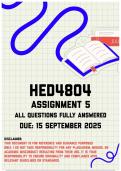
HED4804
Assignment 2
Memo | Due
June 2025
NO PLAGIARISM
[Pick the date]
[Type the company name]
, Exam (elaborations)
HED4804 Assignment 2 Memo | Due June
2025
Course
Philosophy in Education (HED4804)
Institution
University Of South Africa (Unisa)
Book
A Reader in Philosophy of Education
HED4804 Assignment 2 Memo | Due June 2025. 2 Essays provided.
Write a 1000–1500-word essay in which you conceptualise (African)
philosophy of education as the creation of concepts-in-place. In your essay,
you should: Define philosophy and argue why it is important to
philosophise about education in a complex world Discuss the relationship
between place, concepts and philosophy (of education) Conceptualise
philosophy of education as the creation of concepts-in-place based on how
you understand the relationship between place, concepts and philosophy (of
education) Argue how your conceptualization of philosophy of education
enables you to be (come) a responsible and responsive educator in a
complex world.
The Rooted Flourishing: African Philosophy of Education as
the Creation of Concepts-in-Place
In a world increasingly defined by interconnectedness, rapid technological advancement, and
persistent inequalities, the role of education becomes paramount. Yet, what constitutes effective
and ethical education is a question that demands continuous scrutiny and re-evaluation. This
essay proposes to conceptualize (African) philosophy of education as the creation of concepts-in-
place, arguing that such an approach is crucial for navigating the complexities of our
contemporary world and fostering responsible and responsive educators. To achieve this, I will
first define philosophy and articulate its importance in the context of education, particularly in a
complex global landscape. Subsequently, I will delve into the intricate relationship between
place, concepts, and philosophy of education, ultimately building a framework for understanding
philosophy of education as the creation of concepts-in-place. Finally, I will demonstrate how this
conceptualization empowers educators to be both responsible and responsive in their practice.
Assignment 2
Memo | Due
June 2025
NO PLAGIARISM
[Pick the date]
[Type the company name]
, Exam (elaborations)
HED4804 Assignment 2 Memo | Due June
2025
Course
Philosophy in Education (HED4804)
Institution
University Of South Africa (Unisa)
Book
A Reader in Philosophy of Education
HED4804 Assignment 2 Memo | Due June 2025. 2 Essays provided.
Write a 1000–1500-word essay in which you conceptualise (African)
philosophy of education as the creation of concepts-in-place. In your essay,
you should: Define philosophy and argue why it is important to
philosophise about education in a complex world Discuss the relationship
between place, concepts and philosophy (of education) Conceptualise
philosophy of education as the creation of concepts-in-place based on how
you understand the relationship between place, concepts and philosophy (of
education) Argue how your conceptualization of philosophy of education
enables you to be (come) a responsible and responsive educator in a
complex world.
The Rooted Flourishing: African Philosophy of Education as
the Creation of Concepts-in-Place
In a world increasingly defined by interconnectedness, rapid technological advancement, and
persistent inequalities, the role of education becomes paramount. Yet, what constitutes effective
and ethical education is a question that demands continuous scrutiny and re-evaluation. This
essay proposes to conceptualize (African) philosophy of education as the creation of concepts-in-
place, arguing that such an approach is crucial for navigating the complexities of our
contemporary world and fostering responsible and responsive educators. To achieve this, I will
first define philosophy and articulate its importance in the context of education, particularly in a
complex global landscape. Subsequently, I will delve into the intricate relationship between
place, concepts, and philosophy of education, ultimately building a framework for understanding
philosophy of education as the creation of concepts-in-place. Finally, I will demonstrate how this
conceptualization empowers educators to be both responsible and responsive in their practice.