Page |49
Week 4: Intracranial Regulation/Cognition
Weekly Reading: Giddens: Chapter 13 and Chapter 35; Linton & Matteson: Chapter 13 and chapter 23;
381-387, 391-393; 398-404; Silvestri: Pgs. 259-260;473-474; 832-838; 840-841; 847-851; 855; 940-
941; 980; Willihnganz/Clayton: 223-225; 276-281; 289-290; 295-296; 427-429; 432-433
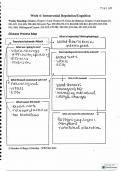
Disease Process Map
ElEmlEmtEmlEmlEtElElEtElElE
- - -
What is happening? (Pathophysiology)
O 4
Transient Ischemic Attack
Y T LY
—i_|
|
. bloodflowLo lorainu
What am | going to see? b ' W\:t-CVV UIQJ'COL
<) 4
) \Q fi;;nafig\ an %0 (A‘ — Wha't lab/diagnostic tests will be ordered? ——
' S U
o1 m,v;N\ e 3 -b\podWs
. 0 O
Nnbus ion.
18 N
_ VECQ\_
% l_‘w S
g A
How is this treated?
What focused assessment will | do? 7
- Nerologyical ‘plood thi nnu/S
vitoLg “Manag ing b/p
d S e ' managing chit wtersl
'Uw"C&’flOLt, changgo
What causes this issue?
‘loocl olofk
MO oused OVt 00
‘dow olodd Frouwd What will | teach the patient/family?
e Cognizing Signe ¢
SYwneptoms "3
ruwtnthowal odueataul
© Hondros College of Nursing — WINTER 2025
Scanned with
{8 CamScanner’|
, Page |50
Disease Process Map
What is happening? (Pathophysiology)
5 Cerebrovascular Accident —L_, brain deprived of ox yxere
i What am | going to see? ) - B Yl(‘V\leDd ,
/ wearnes / nwmloneec —— What lab/diagnostic tests will be ordered? ——
“UISLIVL prolole pig : -
‘dnfcfi‘c,«ufl opeaking ‘m;\f.g ngteats
« dizzinase st eso-lints
' loloocltests
, pal
What focused assessment will | do? v Howisitiistreated?
physi eal Sxam | - uestule changeo
-vttals rourgevy
"Mecu cochon s
\—— What causes this issue?
vmedi ez condihong
4 \)M\-Lda&fhb\ d‘l:d’ [ Whatwill
I teach the patient/family? |
" eX (L0 WML .meogm}gy\g mmpfi)w&
-
‘"modifyi ng U,J:cah\‘ W
“-
P
-
=
&
B
A
_=
-
© Hondros College of Nursing — WINTER 2025
| Scanned with |
& CamScanner’;
, Page |51
When performing a quick assessment on a patient suspected of having a stroke make sure you know the
acronym BE FAST. Complete the table below by identifying what each letter stands for and what you
will be assessing for. (Linton & Matteson p. 414, box 23.1)
What does the letter stand for | What are you assessing for?
B bhiance. loos o}y balo.nce
E Lopo Lost o visienc
F Acee ' Jace drop
» Speeen , olurrecl specche
T A -Unue chdl Sym phoncg stagd
FAST RECOGNITION OF A STROKE
© Hondros College of Nursing — WINTER 2025
Scanned with
/& CamScanner’;
Week 4: Intracranial Regulation/Cognition
Weekly Reading: Giddens: Chapter 13 and Chapter 35; Linton & Matteson: Chapter 13 and chapter 23;
381-387, 391-393; 398-404; Silvestri: Pgs. 259-260;473-474; 832-838; 840-841; 847-851; 855; 940-
941; 980; Willihnganz/Clayton: 223-225; 276-281; 289-290; 295-296; 427-429; 432-433
Disease Process Map
ElEmlEmtEmlEmlEtElElEtElElE
- - -
What is happening? (Pathophysiology)
O 4
Transient Ischemic Attack
Y T LY
—i_|
|
. bloodflowLo lorainu
What am | going to see? b ' W\:t-CVV UIQJ'COL
<) 4
) \Q fi;;nafig\ an %0 (A‘ — Wha't lab/diagnostic tests will be ordered? ——
' S U
o1 m,v;N\ e 3 -b\podWs
. 0 O
Nnbus ion.
18 N
_ VECQ\_
% l_‘w S
g A
How is this treated?
What focused assessment will | do? 7
- Nerologyical ‘plood thi nnu/S
vitoLg “Manag ing b/p
d S e ' managing chit wtersl
'Uw"C&’flOLt, changgo
What causes this issue?
‘loocl olofk
MO oused OVt 00
‘dow olodd Frouwd What will | teach the patient/family?
e Cognizing Signe ¢
SYwneptoms "3
ruwtnthowal odueataul
© Hondros College of Nursing — WINTER 2025
Scanned with
{8 CamScanner’|
, Page |50
Disease Process Map
What is happening? (Pathophysiology)
5 Cerebrovascular Accident —L_, brain deprived of ox yxere
i What am | going to see? ) - B Yl(‘V\leDd ,
/ wearnes / nwmloneec —— What lab/diagnostic tests will be ordered? ——
“UISLIVL prolole pig : -
‘dnfcfi‘c,«ufl opeaking ‘m;\f.g ngteats
« dizzinase st eso-lints
' loloocltests
, pal
What focused assessment will | do? v Howisitiistreated?
physi eal Sxam | - uestule changeo
-vttals rourgevy
"Mecu cochon s
\—— What causes this issue?
vmedi ez condihong
4 \)M\-Lda&fhb\ d‘l:d’ [ Whatwill
I teach the patient/family? |
" eX (L0 WML .meogm}gy\g mmpfi)w&
-
‘"modifyi ng U,J:cah\‘ W
“-
P
-
=
&
B
A
_=
-
© Hondros College of Nursing — WINTER 2025
| Scanned with |
& CamScanner’;
, Page |51
When performing a quick assessment on a patient suspected of having a stroke make sure you know the
acronym BE FAST. Complete the table below by identifying what each letter stands for and what you
will be assessing for. (Linton & Matteson p. 414, box 23.1)
What does the letter stand for | What are you assessing for?
B bhiance. loos o}y balo.nce
E Lopo Lost o visienc
F Acee ' Jace drop
» Speeen , olurrecl specche
T A -Unue chdl Sym phoncg stagd
FAST RECOGNITION OF A STROKE
© Hondros College of Nursing — WINTER 2025
Scanned with
/& CamScanner’;