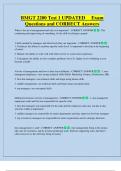
BMGT 2200 Test 1 UPDATED Exam
Questions and CORRECT Answers
What is the art of management and why is it important? - CORRECT ANSWER - The
conducting and supervising of something, it's the skill of relating to people
3 skills needed by managers and what levels they are important - CORRECT ANSWER -
1. Technical: the ability to. perform specific tasks (level 1) important to develop at the beginning
of career
2. Human: the ability to work well with others (level 2), comes from experience
3. Conceptual: the ability to solve complex problems (level 3), higher level of thinking as you
become a leader
4 levels of management and how is there focus different - CORRECT ANSWER - 1. non-
managerial employees: very strong technical skills (R&D, Marketing, Finance, Productions, HR)
2. first-line managers: use technical skills and begin using human skills
3. middle management: use technical skills and begin using conceptual skills
4. top managers: use conceptual skills
Difference between 4 levels of management - CORRECT ANSWER - 1. non-managerial
employees (rank and file) are responsible for specific tasks
2. first-line managers are responsible for the rank and file employees and carry out day to day
activities within a department
3. middle managers are responsible for major departments and may supervise first-line managers
4. top (executive) managers are responsible for entire organization and its strategic direction
line-management vs staff - CORRECT ANSWER - line management bring in the money,
take care of customers, and do revenue producing work. Staff are supporting roles, but there's
often crossover as the staff may bring in money
,Informational Management Role - CORRECT ANSWER - Monitors and disseminates
information. Keeps current on professional issues, understands internal and external factors that
impact the organization. Acts as a spokesperson for the organization or work unit.
Interpersonal Management Role - CORRECT ANSWER - Networks internally and
externally acting as a liaison. Serves on committees and works with professional associations.
Decisional Management Role - CORRECT ANSWER - -Entrepreneur: Initiate
improvement projects; identify new ideas, delegate idea responsibility to others
-Disturbance Handler: Take corrective action during conflicts or crises; resolve disputes among
subordinates
-Resource Allocator: Decide who gets resources; schedule, budget, set priorities
-Negotiator: Represent team or department's interests; represent department during negotiation of
budgets, union contracts, purchases
4 Functions of Management - CORRECT ANSWER - 1. Planning
2. Organizing
3. Leading
4. Controlling
Managers vs. Leaders - CORRECT ANSWER - Managers: make decisions, assign tasks,
allocate resources, solve problems, do things right
Leaders: motivate and inspire, provide
vision, collaborate with others, do the RIGHT thing
Challenges for Managers today - CORRECT ANSWER - peer conflicts, productivity,
diversity, firing employees, lack of communication, technology changes
, Classical Viewpoint: Scientific Management - CORRECT ANSWER - emphasized the
scientific study of work methods to improve the productivity of individual workers
Classical Viewpoint: Administrative Management - CORRECT ANSWER - - Concerned
with managing the total organization
Behavioral Viewpoint: Human Relations Movement - CORRECT ANSWER -a
management approach that advocates the idea that supervisors should receive behavioral training
to manage subordinates in ways that elicit their cooperation and increase their productivity
Behavioral Viewpoint: Behavior Science Approach - CORRECT ANSWER - relies on
scientific research for developing theory to provide practical management tools
Contemporary Perspective: System Viewpoint - CORRECT ANSWER - set of interrelated
parts that function as a whole to achieve a common purchase; subsystems are parts of the system
that are all interconnected
4 parts: inputs, transformational process, outputs, feedback
Contemporary Perspective: Open versus closed systems - CORRECT ANSWER - amount
of influence of the environment on a system; applied to organizations, open systems are often
considered the ideal in that they adapt constantly to the environment, yet some degree of
"closedness" may be desirable to avoid losing coherence, boundaries, and identity.
Contemporary Perspective: complexity theory - CORRECT ANSWER - -the ultimate open
system
-recognizes that all complex systems are networks of many interdependent parts that interact
with each other according to certain simple rules
Contingency Viewpoint: evidence-based management - CORRECT ANSWER -
translating principles based on best evidence into organizational practice, bringing rationality to
the decision-making process
Questions and CORRECT Answers
What is the art of management and why is it important? - CORRECT ANSWER - The
conducting and supervising of something, it's the skill of relating to people
3 skills needed by managers and what levels they are important - CORRECT ANSWER -
1. Technical: the ability to. perform specific tasks (level 1) important to develop at the beginning
of career
2. Human: the ability to work well with others (level 2), comes from experience
3. Conceptual: the ability to solve complex problems (level 3), higher level of thinking as you
become a leader
4 levels of management and how is there focus different - CORRECT ANSWER - 1. non-
managerial employees: very strong technical skills (R&D, Marketing, Finance, Productions, HR)
2. first-line managers: use technical skills and begin using human skills
3. middle management: use technical skills and begin using conceptual skills
4. top managers: use conceptual skills
Difference between 4 levels of management - CORRECT ANSWER - 1. non-managerial
employees (rank and file) are responsible for specific tasks
2. first-line managers are responsible for the rank and file employees and carry out day to day
activities within a department
3. middle managers are responsible for major departments and may supervise first-line managers
4. top (executive) managers are responsible for entire organization and its strategic direction
line-management vs staff - CORRECT ANSWER - line management bring in the money,
take care of customers, and do revenue producing work. Staff are supporting roles, but there's
often crossover as the staff may bring in money
,Informational Management Role - CORRECT ANSWER - Monitors and disseminates
information. Keeps current on professional issues, understands internal and external factors that
impact the organization. Acts as a spokesperson for the organization or work unit.
Interpersonal Management Role - CORRECT ANSWER - Networks internally and
externally acting as a liaison. Serves on committees and works with professional associations.
Decisional Management Role - CORRECT ANSWER - -Entrepreneur: Initiate
improvement projects; identify new ideas, delegate idea responsibility to others
-Disturbance Handler: Take corrective action during conflicts or crises; resolve disputes among
subordinates
-Resource Allocator: Decide who gets resources; schedule, budget, set priorities
-Negotiator: Represent team or department's interests; represent department during negotiation of
budgets, union contracts, purchases
4 Functions of Management - CORRECT ANSWER - 1. Planning
2. Organizing
3. Leading
4. Controlling
Managers vs. Leaders - CORRECT ANSWER - Managers: make decisions, assign tasks,
allocate resources, solve problems, do things right
Leaders: motivate and inspire, provide
vision, collaborate with others, do the RIGHT thing
Challenges for Managers today - CORRECT ANSWER - peer conflicts, productivity,
diversity, firing employees, lack of communication, technology changes
, Classical Viewpoint: Scientific Management - CORRECT ANSWER - emphasized the
scientific study of work methods to improve the productivity of individual workers
Classical Viewpoint: Administrative Management - CORRECT ANSWER - - Concerned
with managing the total organization
Behavioral Viewpoint: Human Relations Movement - CORRECT ANSWER -a
management approach that advocates the idea that supervisors should receive behavioral training
to manage subordinates in ways that elicit their cooperation and increase their productivity
Behavioral Viewpoint: Behavior Science Approach - CORRECT ANSWER - relies on
scientific research for developing theory to provide practical management tools
Contemporary Perspective: System Viewpoint - CORRECT ANSWER - set of interrelated
parts that function as a whole to achieve a common purchase; subsystems are parts of the system
that are all interconnected
4 parts: inputs, transformational process, outputs, feedback
Contemporary Perspective: Open versus closed systems - CORRECT ANSWER - amount
of influence of the environment on a system; applied to organizations, open systems are often
considered the ideal in that they adapt constantly to the environment, yet some degree of
"closedness" may be desirable to avoid losing coherence, boundaries, and identity.
Contemporary Perspective: complexity theory - CORRECT ANSWER - -the ultimate open
system
-recognizes that all complex systems are networks of many interdependent parts that interact
with each other according to certain simple rules
Contingency Viewpoint: evidence-based management - CORRECT ANSWER -
translating principles based on best evidence into organizational practice, bringing rationality to
the decision-making process