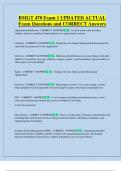
BMGT 470 Exam 1 UPDATED ACTUAL
Exam Questions and CORRECT Answers
Organizational Behavior - CORRECT ANSWER - A social science that describes,
explains, and tries to predicts human behavior in organizational contexts.
Corollary - CORRECT ANSWER - Employees are retained and promoted based upon the
value that they generate for the organization
Diversity - CORRECT ANSWER - Embracing the differences everyone brings to the table
whether it's someone's race, age, ethnicity, religion, gender, sexual orientation, physical ability or
other aspects of social identity.
Equity - CORRECT ANSWER - Treating everyone fairly and providing equal
opportunities
Inclusion - CORRECT ANSWER - Respecting everyone's voice and creating a culture
where people from all backgrounds feel encouraged to express their ideas and perspectives
ESG - CORRECT ANSWER - A set of aspects including environmental issues, social
issues and corporate governance that can be considered in investing.
-Cannot be measured.
Data analysis - CORRECT ANSWER - Process of inspecting, cleansing, transforming, and
modelling data with the goal of discovering useful information, informing conclusions, and
supporting decision-making.
Evidence Based Management (EBM) - CORRECT ANSWER - Translating principles
based upon the best available scientific evidence into organizational practices and making
decisions through the conscientious, explicit and judicious use of such evidence.
, Key factors of EBM - CORRECT ANSWER - Learning cause and effect relationships.
Isolating variations that affect desired outcomes.
Reducing the overuse, under use, and misuse of specific practices.
Building decision supports to promote practices that evidence validates.
Creating a culture of evidence-based decision making and research participation.
Contingency Mindset - CORRECT ANSWER - There is rarely one way to act, and the
best course will result from many interacting forces
Stakeholders - CORRECT ANSWER - the people whose interests are affected by an
organization's activities
Key managerial general work activities - CORRECT ANSWER - 1.Managing human
capital, i.e. staffing, motivating, leading, firing, etc.
2.Managing decision-making processes, i.e. data analysis, data gathering, research, etc.
3.Managing tools and technology, i.e. production, operations, IT
4. Managing administrative activities, i.e. budgeting, financial mgmt., control, etc.
5. Managing strategy/innovation, i.e. future planning, product development, strategic decisions,
etc.
6. Managing the task environment, i.e. public relations, marketing, regulatory, etc.
Exam Questions and CORRECT Answers
Organizational Behavior - CORRECT ANSWER - A social science that describes,
explains, and tries to predicts human behavior in organizational contexts.
Corollary - CORRECT ANSWER - Employees are retained and promoted based upon the
value that they generate for the organization
Diversity - CORRECT ANSWER - Embracing the differences everyone brings to the table
whether it's someone's race, age, ethnicity, religion, gender, sexual orientation, physical ability or
other aspects of social identity.
Equity - CORRECT ANSWER - Treating everyone fairly and providing equal
opportunities
Inclusion - CORRECT ANSWER - Respecting everyone's voice and creating a culture
where people from all backgrounds feel encouraged to express their ideas and perspectives
ESG - CORRECT ANSWER - A set of aspects including environmental issues, social
issues and corporate governance that can be considered in investing.
-Cannot be measured.
Data analysis - CORRECT ANSWER - Process of inspecting, cleansing, transforming, and
modelling data with the goal of discovering useful information, informing conclusions, and
supporting decision-making.
Evidence Based Management (EBM) - CORRECT ANSWER - Translating principles
based upon the best available scientific evidence into organizational practices and making
decisions through the conscientious, explicit and judicious use of such evidence.
, Key factors of EBM - CORRECT ANSWER - Learning cause and effect relationships.
Isolating variations that affect desired outcomes.
Reducing the overuse, under use, and misuse of specific practices.
Building decision supports to promote practices that evidence validates.
Creating a culture of evidence-based decision making and research participation.
Contingency Mindset - CORRECT ANSWER - There is rarely one way to act, and the
best course will result from many interacting forces
Stakeholders - CORRECT ANSWER - the people whose interests are affected by an
organization's activities
Key managerial general work activities - CORRECT ANSWER - 1.Managing human
capital, i.e. staffing, motivating, leading, firing, etc.
2.Managing decision-making processes, i.e. data analysis, data gathering, research, etc.
3.Managing tools and technology, i.e. production, operations, IT
4. Managing administrative activities, i.e. budgeting, financial mgmt., control, etc.
5. Managing strategy/innovation, i.e. future planning, product development, strategic decisions,
etc.
6. Managing the task environment, i.e. public relations, marketing, regulatory, etc.