100% satisfaction guarantee Immediately available after payment Both online and in PDF No strings attached 4.6 TrustPilot
logo-home
Exam (elaborations)

GED math 1 practice exam guide questions with correct detailed answers.

Rating
-
Sold
-
Pages
6
Grade
A+
Uploaded on
28-05-2025
Written in
2024/2025

P stands for parentheses. You must first simplify any expressions that appear inside parentheses. E is for exponents. Evaluate all exponents in the expression. M stands for multiplication, and D stands for division. Multiply and divide from left to right within the expression. A means addition, and S means subtraction. This is the last step in the process. Add and subtract from left to right within the expression. If you need a better memory cue than the abbreviation, PEMDAS, think about the sentence "Please Excuse My Dear Aunt Sally." Use it to help remember the order of operations. - correct answer The Distributive Property you used can be written in the form of two general equations: y × (a + b) = y × a + y × b, and y × (a − b) = y × a − y × b. If you multiply the sum or the difference of two or more values by a common number, you get the same result as when you multiply each value within the parentheses separately. The Distributive Property can be used to simplify mathematical expressions. Let's use the expression (32 + 56) as an example. If a number exactly divides both numbers in the expression, you can pull that number out of the parentheses. For example, (32 + 56) = (16 × 2 + 28 × 2) = 2 × (16 + 28). In the equation above, 2 is a factor of 32 and 56. Similarly, 4 is a factor of both 32 and 56. So we can simplify the expression further as: (32 + 56) = (4 × 8 + 4 × 14) = 4 × (8 + 14). Again, the number 2 is a common factor of 8 and 14. So the expression can be simplified further: 4 × (8 + 14) = 4 × 2 × - correct answer magine you're making one sandwich for yourself and two more sandwiches for your brothers. To make each sandwich, you need two slices of bread, one slice of cheese, and four slices of tomato. How can you determine how much of each ingredient you need to make all three sandwiches? The Distributive Property The ingredients that you need for 1 sandwich can be written as the expression (2 + 1 + 4). So, to make 3 sandwiches, you need 3 × (2 + 1 + 4). Now multiply 3 by each number inside the parentheses: = 3 × 2 + 3 × 1 + 3 × 4 = 6 + 3 + 12. You just used the Distributive Property. To make 3 sandwiches, you need 3 × 2 = 6 slices of bread, 3 × 1 = 3 slices of cheese, and 3 × 4 = 12 slices of tomato. Now you know the ingredients needed for three sandwiches: 6 slices of bread, 3 slices of cheese, and 12 slices of tomato. - correct answer Greatest Common Factor You can apply the Distributive Property to the sum of a group of numbers only if there is at least one whole number (other than 1) that divides all the numbers in the sum evenly. Such a number is called a common factor. For example, the sum (18 + 19) cannot be simplified by applying the Distributive Property because 18 and 19 do not have a common factor (other than 1): (18 + 19) = 1 × (18 + 19). On the other hand, as you saw in the previous example, the numbers in the expression (32 + 56) have three common factors: 2, 4, and 8. The largest number that evenly divides each number in a set is called the greatest common factor (GCF) of that set of numbers. Referring to the previous example, we can say that the GCF of 32 and 56 is 8. Observe that after pulling out the greatest common factor, 8, the numbers left inside the parentheses, 4 and 7, have no common factor. - correct answer Let's look at some examples of finding the GCF, beginning with the GCF of the expression (20 + 16). The numbers 20 and 16 are both divisible by 2: (20 + 16) = 2 × (10 + 8). Although 2 is a factor of 20 and 16, the numbers in the expression (10 + 8) still have a common factor. So, 2 is not the GCF of 20 and 16. Again, 2 is a common factor of 10 and 8. Pulling 2 out of the parentheses, we get: 2 × (10 + 8) = 2 × 2 × (5 + 4) = 4 × (5 + 4). At this stage, the remaining numbers, 5 and 4, do not have a common factor. So 4 is the GCF of the expression (20 + 16). In the same way, we can find the GCF of expressions with more than two numbers. Let's find the GCF of (12 + 24 + 18). We can start by pulling the common factor 3 out of the sum: (12 + 24 + 18) = 3 × (4 + 8 + 6). The numbers inside the parentheses still have a common factor, 2. If we take 2 out of the parentheses, we get: 3 × (4 + 8 + 6) = 3 × 2 × (2 + 4 + 3) = - correct answer We often apply GCFs in everyday situations, such as the sandwich example we looked at earlier. For one sandwich, you need 2 slices of bread, 1 slice of cheese, and 4 slices of tomato. So you need (2 + 1 + 4) slices in all. Suppose you have 12 slices of bread, 6 slices of cheese, and 24 slices of tomato. What is the maximum number of sandwiches you can make without leaving any ingredients unused? You can write the total number of slices as (12 + 6 + 24). You want each sandwich to have the same number of slices of bread, cheese, and tomato. So, you have to find a factor that divides 12, 6, and 24. To find the maximum number of sandwiches you can make, you have to find the greatest common factor of 12, 6, and 24. Each of these numbers is divisible by 2 and 3. So we can write: (12 + 6 + 24) = 2 × 3 × (2 + 1 + 4) = 6 × (2 + 1 + 4). The maximum number of sandwiches you can make is the GCF, 6. Notice that the numbers le - correct answer Least Common Multiple (LCM) Earlier you saw that to find the amount of ingredients needed for three sandwiches, you had to multiply each ingredient by 3. The numbers for the amounts of each ingredient (6, 3, and 12) that you found after multiplying are all multiples of three. To find the multiples of a number, count by that number. For example, to find the multiples of 4, count by 4s. Try counting the multiples of 4: 4, 8, 12, 16, 20, ... . Now let's list the multiples of 4 and the multiples of 6 together. First list the multiples of 4: 4, 8, 12, 16, 20, 24, 28, 32, 36, ... . Then list the multiples of 6: 6, 12, 18, 24, 30, 36, 48, 54, ... . Notice that the numbers 12, 24, and 36 occur in both sets of multiples. In other words, these numbers are common multiples of 4 and 6. The smallest number in the set of common multiples is called the least common multiple (LCM) of the two numbers. So, the LCM of 4 and 6 is 12. - correct answer If you look carefully at the factors and multiples we've worked with so far, you'll see patterns that you can use to solve problems. Let's solve a few more examples to find some of these rules. First we'll find the greatest common factors of these sums of numbers: (6 + 9 + 12), (25 + 10), and (7 + 14). We can factor the three sums like this: (6 + 9 + 12) = (3× 2 + 3 × 3 + 3 × 4) = 3 × (2 + 3 + 4) (25 + 10) = (5 × 5 + 5 × 2) = 5 × (5 + 2) (7 + 14) = (7 × 1 + 7 × 2) = 7 × (1 + 2) In the first and second groups, the common factors are 3 and 5, respectively. Both 3 and 5 are smaller than any of the numbers in the given sums. In the third example, the common factor 7 is equal to the smallest number in the sum. So we can write this rule for common factors: Common factors of a group of numbers are always less than or equal to the smallest number in the group. - correct answer We don't need to graph proportional relationships to compare them. Knowing the unit rates is sufficient to compare proportional relationships. The procedure for finding the unit rate depends on the form a relationship is given in. The value of n is the unit rate for an equation in the following form. y = nx For example, in the equation in figure 1, the value of n is 4. So, the unit rate of the relationship is 4. For a graphed relationship, the slope of the line gives us the unit rate. Figure 2 is a graph that shows a line with a slope of 4. Therefore, the unit rate for this relationship is also 4. For a relationship given in a table, the unit rate is the change in the dependent values over the change in

Show more Read less
Institution
GED MATH
Course
GED MATH

Content preview

GED math 1

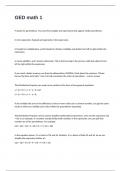
P stands for parentheses. You must first simplify any expressions that appear inside parentheses.


E is for exponents. Evaluate all exponents in the expression.


M stands for multiplication, and D stands for division. Multiply and divide from left to right within the
expression.


A means addition, and S means subtraction. This is the last step in the process. Add and subtract from
left to right within the expression.


If you need a better memory cue than the abbreviation, PEMDAS, think about the sentence "Please
Excuse My Dear Aunt Sally." Use it to help remember the order of operations. - correct answer


The Distributive Property you used can be written in the form of two general equations:

y × (a + b) = y × a + y × b, and

y × (a − b) = y × a − y × b.


If you multiply the sum or the difference of two or more values by a common number, you get the same
result as when you multiply each value within the parentheses separately.


The Distributive Property can be used to simplify mathematical expressions. Let's use the expression (32
+ 56) as an example. If a number exactly divides both numbers in the expression, you can pull that
number out of the parentheses. For example,

(32 + 56) = (16 × 2 + 28 × 2) = 2 × (16 + 28).


In the equation above, 2 is a factor of 32 and 56. Similarly, 4 is a factor of both 32 and 56. So we can
simplify the expression further as:

(32 + 56) = (4 × 8 + 4 × 14) = 4 × (8 + 14).

, Again, the number 2 is a common factor of 8 and 14. So the expression can be simplified further:

4 × (8 + 14) = 4 × 2 × - correct answer


magine you're making one sandwich for yourself and two more sandwiches for your brothers. To make
each sandwich, you need two slices of bread, one slice of cheese, and four slices of tomato. How can you
determine how much of each ingredient you need to make all three sandwiches?


The Distributive Property

The ingredients that you need for 1 sandwich can be written as the expression (2 + 1 + 4).


So, to make 3 sandwiches, you need 3 × (2 + 1 + 4).


Now multiply 3 by each number inside the parentheses:


=3×2+3×1+3×4

= 6 + 3 + 12.


You just used the Distributive Property. To make 3 sandwiches, you need 3 × 2 = 6 slices of bread, 3 × 1 =
3 slices of cheese, and 3 × 4 = 12 slices of tomato. Now you know the ingredients needed for three
sandwiches: 6 slices of bread, 3 slices of cheese, and 12 slices of tomato. - correct answer


Greatest Common Factor

You can apply the Distributive Property to the sum of a group of numbers only if there is at least one
whole number (other than 1) that divides all the numbers in the sum evenly. Such a number is called a
common factor.


For example, the sum (18 + 19) cannot be simplified by applying the Distributive Property because 18
and 19 do not have a common factor (other than 1): (18 + 19) = 1 × (18 + 19).


On the other hand, as you saw in the previous example, the numbers in the expression (32 + 56) have
three common factors: 2, 4, and 8.

Written for

Institution
GED MATH
Course
GED MATH

Document information

Uploaded on
May 28, 2025
Number of pages
6
Written in
2024/2025
Type
Exam (elaborations)
Contains
Questions & answers

Subjects

Get to know the seller

Seller avatar
Reputation scores are based on the amount of documents a seller has sold for a fee and the reviews they have received for those documents. There are three levels: Bronze, Silver and Gold. The better the reputation, the more your can rely on the quality of the sellers work.
RealGrades Nursing
View profile
Follow You need to be logged in order to follow users or courses
Sold
170
Member since
2 year
Number of followers
52
Documents
11733
Last sold
1 month ago

4.0

26 reviews

5
12
4
5
3
7
2
1
1
1

Recently viewed by you

Why students choose Stuvia

Created by fellow students, verified by reviews

Quality you can trust: written by students who passed their tests and reviewed by others who've used these notes.

Didn't get what you expected? Choose another document

No worries! You can instantly pick a different document that better fits what you're looking for.

Pay as you like, start learning right away

No subscription, no commitments. Pay the way you're used to via credit card and download your PDF document instantly.

Student with book image

“Bought, downloaded, and aced it. It really can be that simple.”

Alisha Student

Frequently asked questions