
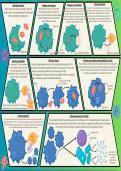
Activation phase: Antigen processing: Antigen presentation: Clonal selection:
Within the cell, the processed antigens A helper T (TH) cell participates in the next stage of
When a cell of the immune system engulfs an The phagosome fuses with a lysosome,
combine with class II MHC proteins. This the humoral immune response. This TH cell has T-cell
antigen. Here, a macrophage engulfs a pathogen which contains digestive enzymes. The
complex is displayed on the macrophage’s ..receptors that can bind to both the class II MHC ....
(with its antigen) by phagocytosis. enzymes (lysozymes) break down the engulfed ......protein and this particular presented antigen. This
plasma membrane. This display is known as
particle into fragments in a phenomenon antigen presentation, and the macrophages are ........binding triggers the macrophage to release the
called antigen processing. considered antigen-presenting cells. ..........cytokine interleukin-1, which activates the TH cell.
fragments
TH
class II
phagosome lysosome MHC protein processed antigen interleukin-1 cytokines
Antigen expansion: Effector phase: Antigen processing & presentation (part 2):
The activated TH cell now releases This phase stage begins with a B cell (also called a B lymphocyte). This The internalised vesicle fuses with a lysosome, which contains digestive
its own cytokines, which stimulate ..B cell has membrane-bound IgM receptors that are specific for the same enzymes (lysozymes). The lysozymes digest the antigen, processing it into
the cell to proliferate. The cell fragments. The processed antigen is then attached to class II MHC
....antigen as originally engulfed by the macrophage. An IgM
proliferates to form a clone of TH cells, molecules and displayed on the surface of the B cell.
.......(immunoglobulin M) receptor binds to the antigen, and the cell engulfs
all with the same T-cell receptors.
.........the complex by receptor-mediated endocytosis.
Immunoglobulin M (IgM)
B cell receptors
processed
antigens
TH cyto
k
TH
ine
s
s
ne
TH
clo
TH
These receptors are specific for the antigenic TH
TH TH lysosome
determinant of the original processed antigen.
Clonal selection: Clonal expansion of B cells:
A TH cell from the clone of cells in the activation phase can now bind to the antigen The activated B lymphocyte now releases its own cytokines, which stimulate the cell to create plasma
displayed by the B cell. The T-cell receptor specifically recognises the antigen on the
class II MHC protein. Upon binding, the TH cell releases cytokines that stimulate the
cells (that produce the specific antibody for the same antigen as originally engulfed by the macrophage)
B cell to divide and create a clone of identical cells via mitosis. and memory cells (that remain circulating in the blood for a long period of time).
memory cell
TH plasma cells
ocytes
es
ok
in ph antibodies for the
c yt m
y
s same antigen as
ne
Bl
originally
clo
engulfed by the
macrophage
Within the cell, the processed antigens A helper T (TH) cell participates in the next stage of
When a cell of the immune system engulfs an The phagosome fuses with a lysosome,
combine with class II MHC proteins. This the humoral immune response. This TH cell has T-cell
antigen. Here, a macrophage engulfs a pathogen which contains digestive enzymes. The
complex is displayed on the macrophage’s ..receptors that can bind to both the class II MHC ....
(with its antigen) by phagocytosis. enzymes (lysozymes) break down the engulfed ......protein and this particular presented antigen. This
plasma membrane. This display is known as
particle into fragments in a phenomenon antigen presentation, and the macrophages are ........binding triggers the macrophage to release the
called antigen processing. considered antigen-presenting cells. ..........cytokine interleukin-1, which activates the TH cell.
fragments
TH
class II
phagosome lysosome MHC protein processed antigen interleukin-1 cytokines
Antigen expansion: Effector phase: Antigen processing & presentation (part 2):
The activated TH cell now releases This phase stage begins with a B cell (also called a B lymphocyte). This The internalised vesicle fuses with a lysosome, which contains digestive
its own cytokines, which stimulate ..B cell has membrane-bound IgM receptors that are specific for the same enzymes (lysozymes). The lysozymes digest the antigen, processing it into
the cell to proliferate. The cell fragments. The processed antigen is then attached to class II MHC
....antigen as originally engulfed by the macrophage. An IgM
proliferates to form a clone of TH cells, molecules and displayed on the surface of the B cell.
.......(immunoglobulin M) receptor binds to the antigen, and the cell engulfs
all with the same T-cell receptors.
.........the complex by receptor-mediated endocytosis.
Immunoglobulin M (IgM)
B cell receptors
processed
antigens
TH cyto
k
TH
ine
s
s
ne
TH
clo
TH
These receptors are specific for the antigenic TH
TH TH lysosome
determinant of the original processed antigen.
Clonal selection: Clonal expansion of B cells:
A TH cell from the clone of cells in the activation phase can now bind to the antigen The activated B lymphocyte now releases its own cytokines, which stimulate the cell to create plasma
displayed by the B cell. The T-cell receptor specifically recognises the antigen on the
class II MHC protein. Upon binding, the TH cell releases cytokines that stimulate the
cells (that produce the specific antibody for the same antigen as originally engulfed by the macrophage)
B cell to divide and create a clone of identical cells via mitosis. and memory cells (that remain circulating in the blood for a long period of time).
memory cell
TH plasma cells
ocytes
es
ok
in ph antibodies for the
c yt m
y
s same antigen as
ne
Bl
originally
clo
engulfed by the
macrophage


