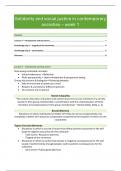
Solidarity and social justice in contemporary
societies – week 1
Content
Lecture 1 – introduction and key terms .......................................................................................... 1
Knowledge clip 1 – tragedy of the commons ................................................................................... 4
Knowledge clip 2 – social policy .................................................................................................... 5
Glossary ...................................................................................................................................... 6
Lecture 1 – introduction and key terms
Discussing contested concepts
• Value-leadenness → Reflection
• Multi-perspectivity → Open-mindedness & perspective taking
Group discussions & dialogues ≠ Polarizing debates
• Safe environment to speak your mind
• Respect & curiosity for different opinions
• On content; not on person
Social inequality
“The uneven allocation of burdens and valued resources across members of a society
based on their group membership in combination with the undervaluation of these
members of society based on their group membership.” (Yerkes & Bal, 2022, p. 4)
Social dilemma
Situations in which individuals are better off if they do not act cooperatively, but
everybody is better off if everyone cooperates compared to the situation in which no one
cooperates
Types of social dilemmas
• Situations in which a course of action that offers positive outcomes for the self
leads to negative outcomes for the collective
- Take-some / Resource dilemma
- Tragedy of the commons
• Situations in which an action that results in negative consequences for the self
would, if performed by enough people, lead to positive consequences for the
collective
- Give-some / Public good dilemma
, • Retrenchment & Fragmentation of welfare state → Emphasis on individual
responsibility as opposed to welfare state support
Homo economicus
• Rational Choice Theory
- People are rational beings, weighing costs and benefits and striving for
maximum net benefit
• Theory of Evolution
- Natural selection: There are hereditary traits with blind variation and
differences in fitness of the variants of these traits → Descent with
modification / survival of the fittest
- Humans are basically self-interested
Natural selection favors self-interest
à These models cannot adequately account for human cooperation…
RCT favors self-interest: Prisoner’s Dilemma
Perspective-taking & Empathy
• Control: “Try to be as objective as possible about what had happened to the
person interviewed and how it had affected his or her life”
• Imagine-other: “Try to imagine how the person being interviewed feels about
what has happened and how this affected his or her life”
• Imagine-self: “Try to imagine how you yourself would feel if you were
experiencing what has happened to the person being interviewed and how this
experience would affect your life”
societies – week 1
Content
Lecture 1 – introduction and key terms .......................................................................................... 1
Knowledge clip 1 – tragedy of the commons ................................................................................... 4
Knowledge clip 2 – social policy .................................................................................................... 5
Glossary ...................................................................................................................................... 6
Lecture 1 – introduction and key terms
Discussing contested concepts
• Value-leadenness → Reflection
• Multi-perspectivity → Open-mindedness & perspective taking
Group discussions & dialogues ≠ Polarizing debates
• Safe environment to speak your mind
• Respect & curiosity for different opinions
• On content; not on person
Social inequality
“The uneven allocation of burdens and valued resources across members of a society
based on their group membership in combination with the undervaluation of these
members of society based on their group membership.” (Yerkes & Bal, 2022, p. 4)
Social dilemma
Situations in which individuals are better off if they do not act cooperatively, but
everybody is better off if everyone cooperates compared to the situation in which no one
cooperates
Types of social dilemmas
• Situations in which a course of action that offers positive outcomes for the self
leads to negative outcomes for the collective
- Take-some / Resource dilemma
- Tragedy of the commons
• Situations in which an action that results in negative consequences for the self
would, if performed by enough people, lead to positive consequences for the
collective
- Give-some / Public good dilemma
, • Retrenchment & Fragmentation of welfare state → Emphasis on individual
responsibility as opposed to welfare state support
Homo economicus
• Rational Choice Theory
- People are rational beings, weighing costs and benefits and striving for
maximum net benefit
• Theory of Evolution
- Natural selection: There are hereditary traits with blind variation and
differences in fitness of the variants of these traits → Descent with
modification / survival of the fittest
- Humans are basically self-interested
Natural selection favors self-interest
à These models cannot adequately account for human cooperation…
RCT favors self-interest: Prisoner’s Dilemma
Perspective-taking & Empathy
• Control: “Try to be as objective as possible about what had happened to the
person interviewed and how it had affected his or her life”
• Imagine-other: “Try to imagine how the person being interviewed feels about
what has happened and how this affected his or her life”
• Imagine-self: “Try to imagine how you yourself would feel if you were
experiencing what has happened to the person being interviewed and how this
experience would affect your life”