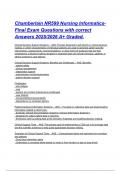
Chamberlain NR599 Nursing Informatics-
Final Exam Questions with correct
Answers 2025/2026 A+ Graded.
Clinical Decision Support Systems - ANS -Process designed to aid directly in clinical decision
making, in which characteristics of individual patients are used to generate patient specific
interventions, assessments, recommendations, or other forms of guidance that are then
presented to a decision-making recipient or recipients that can include clinicians, patients, or
others involved in care delivery.
Clinical Decision Support Systems: Benefits and Challenges - ANS -Benefits:
- patient safety
- clinical management
- diagnostics support
- administrator function/automation
- patient decision support
Challenges:
- alert fatigue
- cost
- system and content maintenance challenges
- user distrust
- transportability/interoperability
- dependency on computer literacy
Patient-Centered Information Systems - ANS -- Focused on collecting data and disseminating
information related to direct care.
- Example: Clinical Documentation Systems ("Clinical Information Systems").
- Designed to collect patient data in real time.
- Enhances care by putting data at the clinician's fingertips and enabling decision making.
Clinical Support Tools - ANS -The primary goal of implementing a CDS tool is to leverage data
and the scientific evidence to help guide appropriate decision making.
Examples of Clinical Support Tools - ANS -- Computerized alerts and reminders for providers
and patients
- Drug-drug interaction alerts
- Underdose or overdose alerts based on renal or liver function or age or drug levels
, - Actionable clinical guidelines
- Condition-specific order sets
- Focused patient data reports and summaries
- Diagnostic support
- Contextually relevant reference information
Workflow - ANS -- The action of execution of a series of tasks in a prescribed sequence.
- A progression of steps (tasks, events, interactions) that constitute a work process, involve two
or more persons, and create or add value to the organization's activities.
Workflow Analysis - ANS -The observation and documentation of workflow to better understand
what is happening in the current environment and how it can be altered.
Data Mining - ANS -A method in computer science that is used to discover patterns and trends
within large data sets.
Point-of-Care (POC) Technology - ANS -- Allows for testing and diagnosis at the patient's side
and can be conducted anywhere the patient is, such as the home, physician office, ambulance,
or hospital bedside.
- Allows for quick, on-the-spot testing with immediately available results
Point-of-Care (POC) Technology- Biologic devices - ANS -Examples: vaccines, blood or blood
components, gene therapy, allergenics
Point-of-Care (POC) Technology- Biometric devices - ANS -- Based on technology that can
identify a person using their unique facial characteristics, fingerprints, DNA, or iris/retinal
pattern.
- Example: fingerprint scanner
Point-of-Care (POC) Technology- Haptic devices - ANS -- Transmit tactile information using
sensations such a vibration, touch, and force feedback.
- Example: ultrasound?
Risk Mitigation - ANS -- A strategy to prepare for and lessen the effects of threats faced by a
business.
- The overall process of identifying, assessing, and controlling risk within a company or
organization.
Bioethics - ANS -- The study of ethics related to issues that arise in health care.
- Takes on relevant ethical problems experienced by healthcare providers in the provision of
care to individuals and groups.
Fundamental Background of Bioethics - ANS -- The nature and needs of humans as living,
thinking beings
Final Exam Questions with correct
Answers 2025/2026 A+ Graded.
Clinical Decision Support Systems - ANS -Process designed to aid directly in clinical decision
making, in which characteristics of individual patients are used to generate patient specific
interventions, assessments, recommendations, or other forms of guidance that are then
presented to a decision-making recipient or recipients that can include clinicians, patients, or
others involved in care delivery.
Clinical Decision Support Systems: Benefits and Challenges - ANS -Benefits:
- patient safety
- clinical management
- diagnostics support
- administrator function/automation
- patient decision support
Challenges:
- alert fatigue
- cost
- system and content maintenance challenges
- user distrust
- transportability/interoperability
- dependency on computer literacy
Patient-Centered Information Systems - ANS -- Focused on collecting data and disseminating
information related to direct care.
- Example: Clinical Documentation Systems ("Clinical Information Systems").
- Designed to collect patient data in real time.
- Enhances care by putting data at the clinician's fingertips and enabling decision making.
Clinical Support Tools - ANS -The primary goal of implementing a CDS tool is to leverage data
and the scientific evidence to help guide appropriate decision making.
Examples of Clinical Support Tools - ANS -- Computerized alerts and reminders for providers
and patients
- Drug-drug interaction alerts
- Underdose or overdose alerts based on renal or liver function or age or drug levels
, - Actionable clinical guidelines
- Condition-specific order sets
- Focused patient data reports and summaries
- Diagnostic support
- Contextually relevant reference information
Workflow - ANS -- The action of execution of a series of tasks in a prescribed sequence.
- A progression of steps (tasks, events, interactions) that constitute a work process, involve two
or more persons, and create or add value to the organization's activities.
Workflow Analysis - ANS -The observation and documentation of workflow to better understand
what is happening in the current environment and how it can be altered.
Data Mining - ANS -A method in computer science that is used to discover patterns and trends
within large data sets.
Point-of-Care (POC) Technology - ANS -- Allows for testing and diagnosis at the patient's side
and can be conducted anywhere the patient is, such as the home, physician office, ambulance,
or hospital bedside.
- Allows for quick, on-the-spot testing with immediately available results
Point-of-Care (POC) Technology- Biologic devices - ANS -Examples: vaccines, blood or blood
components, gene therapy, allergenics
Point-of-Care (POC) Technology- Biometric devices - ANS -- Based on technology that can
identify a person using their unique facial characteristics, fingerprints, DNA, or iris/retinal
pattern.
- Example: fingerprint scanner
Point-of-Care (POC) Technology- Haptic devices - ANS -- Transmit tactile information using
sensations such a vibration, touch, and force feedback.
- Example: ultrasound?
Risk Mitigation - ANS -- A strategy to prepare for and lessen the effects of threats faced by a
business.
- The overall process of identifying, assessing, and controlling risk within a company or
organization.
Bioethics - ANS -- The study of ethics related to issues that arise in health care.
- Takes on relevant ethical problems experienced by healthcare providers in the provision of
care to individuals and groups.
Fundamental Background of Bioethics - ANS -- The nature and needs of humans as living,
thinking beings