

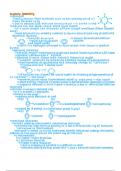
romatic Chemistry
Benzene É
cyclic planar flat molecule with no bits sticking out of it c H
has formula 646
due to de localised electron structure all c c bonds in the c f n't
are the same have molecule
same bond length
c c bond length lies between 154 pm single bond and134pmdoubt
ond
lone electrons in p orbitals combine to form a delocalised ring of electron
skeletal formula
Kekutés structure shows de localised electron
alternating double
and singlebonds
system
there is a hydrogen attached to each carbon not shown in skeletal
or mul
Benzene stability
kekutés model alternatingsingleand doublebonds cyclonexa 1,35 trien
Benzene delocalised e system
Benzene is more stable than ke ku le's theoretical model
compare stability bycomparingenthalpychange ofhydrogenation
hydrogenationofcyclohexane has enthalpy change of 120 KJ mo l l
cyclohexane has 1 doublebond
be.gl
Hz
if benzene has 3bonds we would expect an enthalpyofhydrogenationof
X 120KIMOL l 360 KIMOL
however actual value experimentalvalue is 208kt mo l l far lower
moreenergyrequired to break bonds in benzene than cyclonexa 1,3Strien
suggestsbenzene is more stable stability is due to delocalisedelectro
tructure
Arenes contain a benzenering
a k a aromatic compounds
namedin two ways
naming with benzene at end
e.gl Br 102
bromobenze
I
1,2dimethylbenzene Nitrobenzene
named as if phenyl is a functionalgroup Colts
be.gl YH YH2
phenol phenylamine
reactions of arenes
arenes undergoelectrophilic substitution reactions
benzene has high electron density as it has a delocalisedringof electrons
attractive to electrophiles
i benzene is stable so unlike traditionalalkenes
theydonotundergoelectrophil
ddition as this would disrupt the stable ring of electrons
2mechanisms
Friedel Crafts Acylation
I Nitration Reaction
Friedel Crafts Acylation
dueto stabilityof benzene it isdifficultto react
involvesadding an acylgroup Rco onto a benzene molecule weaken
Benzene É
cyclic planar flat molecule with no bits sticking out of it c H
has formula 646
due to de localised electron structure all c c bonds in the c f n't
are the same have molecule
same bond length
c c bond length lies between 154 pm single bond and134pmdoubt
ond
lone electrons in p orbitals combine to form a delocalised ring of electron
skeletal formula
Kekutés structure shows de localised electron
alternating double
and singlebonds
system
there is a hydrogen attached to each carbon not shown in skeletal
or mul
Benzene stability
kekutés model alternatingsingleand doublebonds cyclonexa 1,35 trien
Benzene delocalised e system
Benzene is more stable than ke ku le's theoretical model
compare stability bycomparingenthalpychange ofhydrogenation
hydrogenationofcyclohexane has enthalpy change of 120 KJ mo l l
cyclohexane has 1 doublebond
be.gl
Hz
if benzene has 3bonds we would expect an enthalpyofhydrogenationof
X 120KIMOL l 360 KIMOL
however actual value experimentalvalue is 208kt mo l l far lower
moreenergyrequired to break bonds in benzene than cyclonexa 1,3Strien
suggestsbenzene is more stable stability is due to delocalisedelectro
tructure
Arenes contain a benzenering
a k a aromatic compounds
namedin two ways
naming with benzene at end
e.gl Br 102
bromobenze
I
1,2dimethylbenzene Nitrobenzene
named as if phenyl is a functionalgroup Colts
be.gl YH YH2
phenol phenylamine
reactions of arenes
arenes undergoelectrophilic substitution reactions
benzene has high electron density as it has a delocalisedringof electrons
attractive to electrophiles
i benzene is stable so unlike traditionalalkenes
theydonotundergoelectrophil
ddition as this would disrupt the stable ring of electrons
2mechanisms
Friedel Crafts Acylation
I Nitration Reaction
Friedel Crafts Acylation
dueto stabilityof benzene it isdifficultto react
involvesadding an acylgroup Rco onto a benzene molecule weaken


