
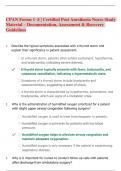
CPAN Forms 1–4 | Certified Post Anesthesia Nurse Study
Material – Documentation, Assessment & Recovery
Guidelines
1. Describe the typical symptoms associated with a thyroid storm and
explain their significance in patient assessment.
In a thyroid storm, patients often exhibit excitement, hypothermia,
and bradycardia, indicating severe distress.
A thyroid storm typically presents with fever, tachycardia, and
cutaneous vasodilation, indicating a hypermetabolic state.
Symptoms of a thyroid storm include bradycardia and
vasoconstriction, suggesting a state of shock.
A thyroid storm is characterized by hypothermia, somnolence, and
bradycardia, which are signs of a metabolic crisis.
2. Why is the administration of humidified oxygen prioritized for a patient
with slight upper airway congestion following surgery?
Humidified oxygen is used to treat bronchospasm in patients.
Humidified oxygen is primarily for patients with low blood
pressure.
Humidified oxygen helps to alleviate airway congestion and
maintain adequate oxygenation.
Humidified oxygen is only necessary if the patient is experiencing
respiratory distress.
3. Why is it important for nurses to conduct follow-up calls with patients
after discharge from ambulatory surgery?
,It ensures that patients are readmitted if complications arise.
It allows nurses to address patient concerns and ensure proper
recovery.
, It helps in transferring care to other healthcare providers.
It is primarily for marketing the surgical program.
4. What electrolyte imbalance is commonly associated with digoxin toxicity
that can lead to PVCs?
Hyponatremia
Hypokalemia
Hypernatremia
Hyperkalemia
5. Describe why a 3-year-old patient might exhibit inconsolable behavior
upon waking in the PACU.
This behavior is often due to separation anxiety, which is
common in toddlers.
This behavior reflects passive resistance to medical staff.
This behavior shows frustration due to lack of privacy.
This behavior indicates the child is experiencing pain from surgery.
6. Discuss the relationship between digoxin and potassium levels in the
context of cardiac arrhythmias.
Digoxin toxicity is solely related to sodium levels in the body.
High potassium levels are beneficial in preventing PVCs in patients
taking digoxin.
Digoxin can cause increased risk of PVCs when potassium levels
are low, as hypokalemia enhances digoxin's effects on the heart.
Digoxin has no effect on potassium levels and does not influence
arrhythmias.
Material – Documentation, Assessment & Recovery
Guidelines
1. Describe the typical symptoms associated with a thyroid storm and
explain their significance in patient assessment.
In a thyroid storm, patients often exhibit excitement, hypothermia,
and bradycardia, indicating severe distress.
A thyroid storm typically presents with fever, tachycardia, and
cutaneous vasodilation, indicating a hypermetabolic state.
Symptoms of a thyroid storm include bradycardia and
vasoconstriction, suggesting a state of shock.
A thyroid storm is characterized by hypothermia, somnolence, and
bradycardia, which are signs of a metabolic crisis.
2. Why is the administration of humidified oxygen prioritized for a patient
with slight upper airway congestion following surgery?
Humidified oxygen is used to treat bronchospasm in patients.
Humidified oxygen is primarily for patients with low blood
pressure.
Humidified oxygen helps to alleviate airway congestion and
maintain adequate oxygenation.
Humidified oxygen is only necessary if the patient is experiencing
respiratory distress.
3. Why is it important for nurses to conduct follow-up calls with patients
after discharge from ambulatory surgery?
,It ensures that patients are readmitted if complications arise.
It allows nurses to address patient concerns and ensure proper
recovery.
, It helps in transferring care to other healthcare providers.
It is primarily for marketing the surgical program.
4. What electrolyte imbalance is commonly associated with digoxin toxicity
that can lead to PVCs?
Hyponatremia
Hypokalemia
Hypernatremia
Hyperkalemia
5. Describe why a 3-year-old patient might exhibit inconsolable behavior
upon waking in the PACU.
This behavior is often due to separation anxiety, which is
common in toddlers.
This behavior reflects passive resistance to medical staff.
This behavior shows frustration due to lack of privacy.
This behavior indicates the child is experiencing pain from surgery.
6. Discuss the relationship between digoxin and potassium levels in the
context of cardiac arrhythmias.
Digoxin toxicity is solely related to sodium levels in the body.
High potassium levels are beneficial in preventing PVCs in patients
taking digoxin.
Digoxin can cause increased risk of PVCs when potassium levels
are low, as hypokalemia enhances digoxin's effects on the heart.
Digoxin has no effect on potassium levels and does not influence
arrhythmias.


