MBZ – juni 2025 1
TABLE OF CONTENTS
THE CHEMISTRY OF LIVING THINGS 2
STRUCTURE AND FUNCTION OF CELLS 8
FROM CELLS TO ORGAN SYSTEMS 16
THE SKELETON 21
THE MUSCULAR SYSTEM 26
THE ENDOCRINE SYSTEM 32
BLOOD 40
HEART AND BLOOD VESSELS 47
THE IMMUNE SYSTEM AND MECHANISMS OF DEFENSE 59
THE URINARY SYSTEM 69
THE RESPIRATORY SYSTEM 78
REPRODUCTIVE SYSTEMS 86
THE DIGESTIVE SYSTEM 95
CELL REPRODUCTION AND DIFFERENTIATION 108
CANCER 116
DEVELOPMENT AND AGING 123
,MBZ – juni 2025 2
THE CHEMISTRY OF LIVING THINGS
LIFE DEPENDS ON WATER
Our body is made up of 60% water, making it essential for human life
Some characteristics of why water is so important for living organisms:
- Water is a very good solvent
- It remains a liquid at normal temperatures
- It can absorb and retain heat energy well
- The evaporation of water uses heat energy
- Water participates in many essential biochemical reactions
WATER AS THE BIOLOGICAL SOLVENT
Water is the ideal solvent in living organisms because it is a polar liquid at body temperature
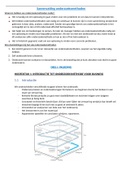
- Table salt (sodium chloride, NaCl) dissolves in water because individual
ions are pulled from the salt crystal and immediately surrounded by
polar water molecules, forming a cluster around each ion, preventing
them from rejoining into a salt crystal
- Water molecules orient themselves around the ions so that opposite
charges attract
• The negative chloride ions (Cl⁻) are surrounded by the positive
hydrogen ends of water molecules; hydrogen atoms (H)
• The positive sodium ions (Na⁺) are surrounded by the negative
oxygen ends of water molecules; oxygen atoms (O)
Hydrophilic molecules Hydrophobic molecules
= polar molecules that are attracted to water and = non-polar, neutral molecules that do not easily
interact easily with it interact with water and generally do not dissolve in it
(e.g. oil)
WATER IS LIQUID AT BODY TEMPERATURE
- Water is liquid between 0 and 100 degrees Celsius due to hydrogen bonds between water molecules:
• At body temperature, enough heat energy is present to temporarily break some weak hydrogen bonds
between water molecules
• New hydrogen bonds quickly form with nearby molecules, creating a constantly shifting network of
connections, though the bonding seems random
• This is why it is a good substance for transporting dissolved substances from one place to another
- Below 0°C, water forms ice as there is not enough heat energy to break hydrogen bonds between water
molecules, so the water molecules orient themselves in a stable, unchanging crystal structure; ice
- Above 100°C, all hydrogen bonds break, and water molecules escape as gas; water vapor
,MBZ – juni 2025 3
WATER HELPS REGULATE BODY TEMPERATURE
- Water can absorb a large amount of heat-energy with only a small increase in temperature, preventing
large temperature fluctuations in the body when excess heat is produced
- Water retains heat to prevent excessive heat loss (e.g. in cold environments), which helps prevent rapid
changes in body temperature during changes in metabolism or the environment
- Metabolism generates heat, often more than needed to maintain a constant body temperature, so
evaporative cooling (sweating) is essential for survival
THE IMPORTANCE OF HYDROGEN IONS
ACIDS DONATE HYDROGEN-IONS, BASES ACCEPT THEM
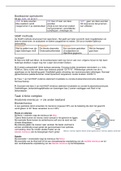
Sometimes, hydrogen-oxygen bonds in water break into
hydrogen ions (H⁺) and hydroxide ions (OH⁻)
ð In pure water, this rarely happens, but acids and bases
affect H⁺ concentration
• Acids donate H⁺ ions and make a solution more
acidic (e.g. vinegar, coffee, soda)
• Bases absorb H⁺ ions, making a solution more basic
(e.g. baking soda, cleaning agents)
• Acids and bases neutralize each other (e.g. baking
soda counteracting stomach acid)
• The pH scale measures H⁺ concentration in a
solution:
§ High pH = fewer H⁺ ions (basic/alkaline
solution)
§ Low pH = more H⁺ ions (acidic solution)
§ Blood has a pH of 7.4, which must remain
stable, as fluctuations can disrupt chemical
reactions, transport processes, and damage proteins and cell structures, so maintaining pH
balance is crucial for homeostasis and proper body function.
BUFFERS MINIMIZE pH CHANGES
A buffer is a substance that minimizes pH changes when an acid or base is added to a solution, and they are
essential for maintaining pH homeostasis in body fluids like blood and urine
- Buffers consist of related molecule pairs with opposing effects:
• The acidic form can donate an H⁺ ion
• The basic form can accept and absorb an H⁺ ion
- How buffers work:
• If an acid is added (increasing H⁺ concentration), the basic form of the buffer pair accepts some H⁺
ions, minimizing pH drop
• If a base is added (removing too many H⁺ ions), the acidic form of the buffer pair releases H⁺ ions,
minimizing pH rise
• Buffer pairs act like sponges, absorbing excess H⁺ when needed and releasing it when necessary
One of the most important buffers in the blood is the bicarbonate/carbonic acid system:
- In an acidic environment, bicarbonate (HCO₃⁻) binds to H⁺ to form carbonic acid (H₂CO₃): HCO₃⁻ + H⁺ →
H₂CO₃
- In a basic environment, carbonic acid (H₂CO₃) releases H⁺, stabilizing pH: H₂CO₃ → HCO₃⁻ + H⁺
- This system is continuously active, maintaining a chemical equilibrium: HCO₃⁻ + H⁺ ↔ H₂CO₃
- The more buffers present in a body fluid, the more stable the pH remains
ORGANIC MOLECULES OF LIVING ORGANISMS
, MBZ – juni 2025 4
Organic molecules are molecules that contain carbon and other elements, held together by covalent bonds
- Carbon is the most important building block of all organic molecules because of the many ways in which it
can form strong covalent bonds with other atoms
- There is almost no limit to the size of organic molecules that are made of carbon
• Some, called macromolecules, consist of thousands or even millions of smaller molecules
MACROMOLECULES
= organic molecules that consist of thousands or even millions of smaller molecules
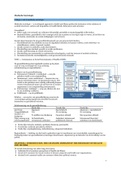
- These are synthesized and broken down in the cell through two processes
Dehydration synthesis Hydrolysis
= smaller molecules or subunits are connected to = process in which macromolecules are broken down
each other via covalent bonds to form chains when with each broken covalent bond between
- Each time a subunit is added, the equivalent of a subunits in the chain, the equivalent of a water
water molecule is removed molecule is added
- This building process requires energy - This breakdown releases stored energy
- This is the opposite of dehydration synthesis.
We distinguish 4 classes of macromolecules: carbohydrates, lipids, proteins, and nucleic acids
CARBOHYDRATES
= Cn(H20)n
- Carbohydrates have a backbone of carbon atoms to which hydrogen and oxygen are attached in the same
ratio as in water (2 to 1)
- Most living organisms use carbohydrates as a source of energy, and plants use at least one carbohydrate
(cellulose) as structural support
MONOSACCHARIDES
= simple sugars, the simplest form of carbohydrate, with relatively simple structures consisting of carbon,
hydrogen, and oxygen in a ratio of 1-2-1
- Glucose
- Fructose
- Galactose
- Ribose
- Deoxyribose
OLIGOSACCHARIDES
= short chains of monosaccharides connected to each other by dehydration synthesis
- Disaccharides are chains of 2 monosaccharides that are connected:
TABLE OF CONTENTS
THE CHEMISTRY OF LIVING THINGS 2
STRUCTURE AND FUNCTION OF CELLS 8
FROM CELLS TO ORGAN SYSTEMS 16
THE SKELETON 21
THE MUSCULAR SYSTEM 26
THE ENDOCRINE SYSTEM 32
BLOOD 40
HEART AND BLOOD VESSELS 47
THE IMMUNE SYSTEM AND MECHANISMS OF DEFENSE 59
THE URINARY SYSTEM 69
THE RESPIRATORY SYSTEM 78
REPRODUCTIVE SYSTEMS 86
THE DIGESTIVE SYSTEM 95
CELL REPRODUCTION AND DIFFERENTIATION 108
CANCER 116
DEVELOPMENT AND AGING 123
,MBZ – juni 2025 2
THE CHEMISTRY OF LIVING THINGS
LIFE DEPENDS ON WATER
Our body is made up of 60% water, making it essential for human life
Some characteristics of why water is so important for living organisms:
- Water is a very good solvent
- It remains a liquid at normal temperatures
- It can absorb and retain heat energy well
- The evaporation of water uses heat energy
- Water participates in many essential biochemical reactions
WATER AS THE BIOLOGICAL SOLVENT
Water is the ideal solvent in living organisms because it is a polar liquid at body temperature
- Table salt (sodium chloride, NaCl) dissolves in water because individual
ions are pulled from the salt crystal and immediately surrounded by
polar water molecules, forming a cluster around each ion, preventing
them from rejoining into a salt crystal
- Water molecules orient themselves around the ions so that opposite
charges attract
• The negative chloride ions (Cl⁻) are surrounded by the positive
hydrogen ends of water molecules; hydrogen atoms (H)
• The positive sodium ions (Na⁺) are surrounded by the negative
oxygen ends of water molecules; oxygen atoms (O)
Hydrophilic molecules Hydrophobic molecules
= polar molecules that are attracted to water and = non-polar, neutral molecules that do not easily
interact easily with it interact with water and generally do not dissolve in it
(e.g. oil)
WATER IS LIQUID AT BODY TEMPERATURE
- Water is liquid between 0 and 100 degrees Celsius due to hydrogen bonds between water molecules:
• At body temperature, enough heat energy is present to temporarily break some weak hydrogen bonds
between water molecules
• New hydrogen bonds quickly form with nearby molecules, creating a constantly shifting network of
connections, though the bonding seems random
• This is why it is a good substance for transporting dissolved substances from one place to another
- Below 0°C, water forms ice as there is not enough heat energy to break hydrogen bonds between water
molecules, so the water molecules orient themselves in a stable, unchanging crystal structure; ice
- Above 100°C, all hydrogen bonds break, and water molecules escape as gas; water vapor
,MBZ – juni 2025 3
WATER HELPS REGULATE BODY TEMPERATURE
- Water can absorb a large amount of heat-energy with only a small increase in temperature, preventing
large temperature fluctuations in the body when excess heat is produced
- Water retains heat to prevent excessive heat loss (e.g. in cold environments), which helps prevent rapid
changes in body temperature during changes in metabolism or the environment
- Metabolism generates heat, often more than needed to maintain a constant body temperature, so
evaporative cooling (sweating) is essential for survival
THE IMPORTANCE OF HYDROGEN IONS
ACIDS DONATE HYDROGEN-IONS, BASES ACCEPT THEM
Sometimes, hydrogen-oxygen bonds in water break into
hydrogen ions (H⁺) and hydroxide ions (OH⁻)
ð In pure water, this rarely happens, but acids and bases
affect H⁺ concentration
• Acids donate H⁺ ions and make a solution more
acidic (e.g. vinegar, coffee, soda)
• Bases absorb H⁺ ions, making a solution more basic
(e.g. baking soda, cleaning agents)
• Acids and bases neutralize each other (e.g. baking
soda counteracting stomach acid)
• The pH scale measures H⁺ concentration in a
solution:
§ High pH = fewer H⁺ ions (basic/alkaline
solution)
§ Low pH = more H⁺ ions (acidic solution)
§ Blood has a pH of 7.4, which must remain
stable, as fluctuations can disrupt chemical
reactions, transport processes, and damage proteins and cell structures, so maintaining pH
balance is crucial for homeostasis and proper body function.
BUFFERS MINIMIZE pH CHANGES
A buffer is a substance that minimizes pH changes when an acid or base is added to a solution, and they are
essential for maintaining pH homeostasis in body fluids like blood and urine
- Buffers consist of related molecule pairs with opposing effects:
• The acidic form can donate an H⁺ ion
• The basic form can accept and absorb an H⁺ ion
- How buffers work:
• If an acid is added (increasing H⁺ concentration), the basic form of the buffer pair accepts some H⁺
ions, minimizing pH drop
• If a base is added (removing too many H⁺ ions), the acidic form of the buffer pair releases H⁺ ions,
minimizing pH rise
• Buffer pairs act like sponges, absorbing excess H⁺ when needed and releasing it when necessary
One of the most important buffers in the blood is the bicarbonate/carbonic acid system:
- In an acidic environment, bicarbonate (HCO₃⁻) binds to H⁺ to form carbonic acid (H₂CO₃): HCO₃⁻ + H⁺ →
H₂CO₃
- In a basic environment, carbonic acid (H₂CO₃) releases H⁺, stabilizing pH: H₂CO₃ → HCO₃⁻ + H⁺
- This system is continuously active, maintaining a chemical equilibrium: HCO₃⁻ + H⁺ ↔ H₂CO₃
- The more buffers present in a body fluid, the more stable the pH remains
ORGANIC MOLECULES OF LIVING ORGANISMS
, MBZ – juni 2025 4
Organic molecules are molecules that contain carbon and other elements, held together by covalent bonds
- Carbon is the most important building block of all organic molecules because of the many ways in which it
can form strong covalent bonds with other atoms
- There is almost no limit to the size of organic molecules that are made of carbon
• Some, called macromolecules, consist of thousands or even millions of smaller molecules
MACROMOLECULES
= organic molecules that consist of thousands or even millions of smaller molecules
- These are synthesized and broken down in the cell through two processes
Dehydration synthesis Hydrolysis
= smaller molecules or subunits are connected to = process in which macromolecules are broken down
each other via covalent bonds to form chains when with each broken covalent bond between
- Each time a subunit is added, the equivalent of a subunits in the chain, the equivalent of a water
water molecule is removed molecule is added
- This building process requires energy - This breakdown releases stored energy
- This is the opposite of dehydration synthesis.
We distinguish 4 classes of macromolecules: carbohydrates, lipids, proteins, and nucleic acids
CARBOHYDRATES
= Cn(H20)n
- Carbohydrates have a backbone of carbon atoms to which hydrogen and oxygen are attached in the same
ratio as in water (2 to 1)
- Most living organisms use carbohydrates as a source of energy, and plants use at least one carbohydrate
(cellulose) as structural support
MONOSACCHARIDES
= simple sugars, the simplest form of carbohydrate, with relatively simple structures consisting of carbon,
hydrogen, and oxygen in a ratio of 1-2-1
- Glucose
- Fructose
- Galactose
- Ribose
- Deoxyribose
OLIGOSACCHARIDES
= short chains of monosaccharides connected to each other by dehydration synthesis
- Disaccharides are chains of 2 monosaccharides that are connected: