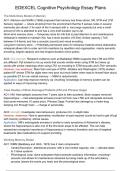
EDEXCEL Cognitive Psychology Essay Plans
The Multi-Store Model of Memory
AO1: Atkinson and Shiffrin (1968) proposed that memory has three stores: SR, STM and LTM
Sensory register → where all stimuli from the environment that the 5 senses notes in several
memories are stored (1 for each of the 5 senses) with a very large capacity but only a small
amount of info is attended to and has a very brief duration (up to 2s).
Short-term memory store → Temporary store for info that is paid attention to and maintenance
rehearsal is needed to maintain info; has a short duration (18-30s); limited capacity ( 7±2/
between 5-9 items) and has a acoustic (sound) and visual encoding.
Long-term memory store → Potentially permanent store for rehearsal material where elaborative
rehearsal allows info to enter and info maintains by repetition and organisation. mainly semantic
encoding, largest capacity and has longest duration (mins-years).
AO3: One strength: Research evidence such as Baddeley(1966b) supports that LTM and STM
are different. Ppl tended to mix up words that sounds similar when using STM but mixes up
words with similar meanings when using LTM, so encoding in STM=acoustic and LTM= semantic.
However, one weakness: More than one type of STM –Shallice and Washington (1970) studied
patient KF whose STM for digits were very poor but much better when read to himself than aloud,
so possible ST for non-verbal memory → MSM is reductionistic.
Application: Can help improve memory via ‘chunking’ knowledge of memory system can be
applied to ways of improving memory.
Case Studies of Brain-Damaged Patients (HM and Phineas Gage)
AO1: HM: Had epileptic seizures from 7 years (due to bike accident). Brain surgery removed
hippocampus → had anterograde amnesia (could not form new LTM) and retrograde amnesia
(lost some memories 10 years prior). Phineas Gage: Frontal lobe damage by a metre-long
tamping iron through brain → change in personality.
AO3: strength: investigates rare behaviours; produces rich, in-depth data
However, weakness: Hard to generalise; recollection of past required (could be hard to get off ppl
with memory problems); ethical issues.
Application: HM’s anterograde amnesia is similar to early symptoms of Alzheimer’s disease,
where the hippocampus is also one of the first brain areas to be affected. This can help
researchers recognise importance of hippocampus in memory formation and use of targeted
treatments (like medications) to support encoding.
Working Memory Model:
AO1: WMM (Baddeley and Hitch, 1974) has 4 main components:
- Central Executive: ‘attentional process’ with a very limited capacity, role → allocate tasks
to 3 slave systems
- Phonological Loop: slave subsystem that processes audiotory information, encoding=
acoustic and allows for maintenance rehearsal by being made up of the articulatory
process (stores the words you hear) and the phonological store.
The Multi-Store Model of Memory
AO1: Atkinson and Shiffrin (1968) proposed that memory has three stores: SR, STM and LTM
Sensory register → where all stimuli from the environment that the 5 senses notes in several
memories are stored (1 for each of the 5 senses) with a very large capacity but only a small
amount of info is attended to and has a very brief duration (up to 2s).
Short-term memory store → Temporary store for info that is paid attention to and maintenance
rehearsal is needed to maintain info; has a short duration (18-30s); limited capacity ( 7±2/
between 5-9 items) and has a acoustic (sound) and visual encoding.
Long-term memory store → Potentially permanent store for rehearsal material where elaborative
rehearsal allows info to enter and info maintains by repetition and organisation. mainly semantic
encoding, largest capacity and has longest duration (mins-years).
AO3: One strength: Research evidence such as Baddeley(1966b) supports that LTM and STM
are different. Ppl tended to mix up words that sounds similar when using STM but mixes up
words with similar meanings when using LTM, so encoding in STM=acoustic and LTM= semantic.
However, one weakness: More than one type of STM –Shallice and Washington (1970) studied
patient KF whose STM for digits were very poor but much better when read to himself than aloud,
so possible ST for non-verbal memory → MSM is reductionistic.
Application: Can help improve memory via ‘chunking’ knowledge of memory system can be
applied to ways of improving memory.
Case Studies of Brain-Damaged Patients (HM and Phineas Gage)
AO1: HM: Had epileptic seizures from 7 years (due to bike accident). Brain surgery removed
hippocampus → had anterograde amnesia (could not form new LTM) and retrograde amnesia
(lost some memories 10 years prior). Phineas Gage: Frontal lobe damage by a metre-long
tamping iron through brain → change in personality.
AO3: strength: investigates rare behaviours; produces rich, in-depth data
However, weakness: Hard to generalise; recollection of past required (could be hard to get off ppl
with memory problems); ethical issues.
Application: HM’s anterograde amnesia is similar to early symptoms of Alzheimer’s disease,
where the hippocampus is also one of the first brain areas to be affected. This can help
researchers recognise importance of hippocampus in memory formation and use of targeted
treatments (like medications) to support encoding.
Working Memory Model:
AO1: WMM (Baddeley and Hitch, 1974) has 4 main components:
- Central Executive: ‘attentional process’ with a very limited capacity, role → allocate tasks
to 3 slave systems
- Phonological Loop: slave subsystem that processes audiotory information, encoding=
acoustic and allows for maintenance rehearsal by being made up of the articulatory
process (stores the words you hear) and the phonological store.