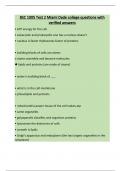
BSC 1005 Test 2 Miami Dade college questions with
verified answers
• ATP energy for the cell
• eukaryotic and prokaryotic one has a nucleus doesn't
• nucleus is factor rhybosones factor of proteins
• building blocks of cells are atoms
o atoms assemble and become molecules
♣ lipids and proteins (are made of atoms)
• water is building block of ___
• what is in the cell membrane
o phosolipids and proteins
• mitochondria power house of the cell makes atp
• same organelles
• golyaparatis classifies and organizes proteins
• lysosomes the destrories of cells
• smooth is lipids
• Golgi's apparatus and endoplasm (the two largest organelles in the
cytoplasm)
, • transform proteins and lipids
• function of carbs in the cell is energy to the cell
• function of lipids in the cell is store energy and more importantly
memory
• function of the proteins enzymes speeds up reaction
• function of Dna is to store information libary of the cell
• diffusion is a form of passive transport th Ans✓✓✓
Active
transport Ans✓✓✓ the opposite of passive transport. This type of
transport describes the movement of molecules from low
concentration to high concentration (i.e. against the concentration
gradient). This process requires energy, usually in the form of ATP. This
process also uses a transport protein.
Eukaryotes Ans✓✓✓ complex organism with a nucleus, only plant type
has cell wall, no surface projection & has organelles enclosed by a
membrane.
Factors
that
affect
diffusion
verified answers
• ATP energy for the cell
• eukaryotic and prokaryotic one has a nucleus doesn't
• nucleus is factor rhybosones factor of proteins
• building blocks of cells are atoms
o atoms assemble and become molecules
♣ lipids and proteins (are made of atoms)
• water is building block of ___
• what is in the cell membrane
o phosolipids and proteins
• mitochondria power house of the cell makes atp
• same organelles
• golyaparatis classifies and organizes proteins
• lysosomes the destrories of cells
• smooth is lipids
• Golgi's apparatus and endoplasm (the two largest organelles in the
cytoplasm)
, • transform proteins and lipids
• function of carbs in the cell is energy to the cell
• function of lipids in the cell is store energy and more importantly
memory
• function of the proteins enzymes speeds up reaction
• function of Dna is to store information libary of the cell
• diffusion is a form of passive transport th Ans✓✓✓
Active
transport Ans✓✓✓ the opposite of passive transport. This type of
transport describes the movement of molecules from low
concentration to high concentration (i.e. against the concentration
gradient). This process requires energy, usually in the form of ATP. This
process also uses a transport protein.
Eukaryotes Ans✓✓✓ complex organism with a nucleus, only plant type
has cell wall, no surface projection & has organelles enclosed by a
membrane.
Factors
that
affect
diffusion