Bsc 1005 Biomes questions with verified answers
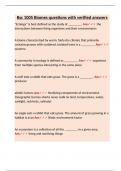
"Ecology" is best defined as the study of ________. Ans✓✓✓ the
interactions between living organisms and their environments
A biome characterized by warm, fairly dry climate that primarily
contains grasses with scattered, isolated trees is a ________. Ans✓✓✓
savanna
A community in ecology is defined as ________. Ans✓✓✓ organisms
from multiple species interacting in the same place
A wolf eats a rabbit that eats grass. The grass is a ________. Ans✓✓✓
producer
abiotic factors Ans✓✓✓ Nonliving components of environment.
(Geographic barries-sharks never walk on land, temperature, water,
sunlight, nutrients, salinaty)
An eagle eats a rabbit that eats grass. The amount of grass growing in a
habitat is a/an Ans✓✓✓ Biotic environment factor
An ecosystem is a collection of all the ________ in a given area.
Ans✓✓✓ living and nonliving things
, biotic factors Ans✓✓✓ All the living organisms that inhabit an
environment (competation, predation, disease)
Chaparral Ans✓✓✓ A scrubland biome of dense, spiny evergreen
shrubs found at midlatitudes along coasts where cold ocean currents
circulate offshore; characterized by mild, rainy winters and long, hot,
dry summers.
Climate Ans✓✓✓ Occurs over a long period of time and change repidly
due to anthropogenic climate change
Cold desert Ans✓✓✓ low annual precipitation frequently in the form
of snow, high daytime temps in summer, around freezing in winter, low
plant diversity
Elevation Ans✓✓✓ Adiabatic cooling -increasing elevation leads to
10°C drop for every 1,000m.
Rain shadow - warm, moist air flows up mountainsand cools, releasing
precipitation, leeward side allows drier air to descend forming area
where precipitation is noticeably less.
Forest value Ans✓✓✓ • Plants play a critical role in the water cycle,
storing water in their bodies and transpiring it back to the atmosphere
• Desertification: Without forests, water patterns change, making local
areas drier
"Ecology" is best defined as the study of ________. Ans✓✓✓ the
interactions between living organisms and their environments
A biome characterized by warm, fairly dry climate that primarily
contains grasses with scattered, isolated trees is a ________. Ans✓✓✓
savanna
A community in ecology is defined as ________. Ans✓✓✓ organisms
from multiple species interacting in the same place
A wolf eats a rabbit that eats grass. The grass is a ________. Ans✓✓✓
producer
abiotic factors Ans✓✓✓ Nonliving components of environment.
(Geographic barries-sharks never walk on land, temperature, water,
sunlight, nutrients, salinaty)
An eagle eats a rabbit that eats grass. The amount of grass growing in a
habitat is a/an Ans✓✓✓ Biotic environment factor
An ecosystem is a collection of all the ________ in a given area.
Ans✓✓✓ living and nonliving things
, biotic factors Ans✓✓✓ All the living organisms that inhabit an
environment (competation, predation, disease)
Chaparral Ans✓✓✓ A scrubland biome of dense, spiny evergreen
shrubs found at midlatitudes along coasts where cold ocean currents
circulate offshore; characterized by mild, rainy winters and long, hot,
dry summers.
Climate Ans✓✓✓ Occurs over a long period of time and change repidly
due to anthropogenic climate change
Cold desert Ans✓✓✓ low annual precipitation frequently in the form
of snow, high daytime temps in summer, around freezing in winter, low
plant diversity
Elevation Ans✓✓✓ Adiabatic cooling -increasing elevation leads to
10°C drop for every 1,000m.
Rain shadow - warm, moist air flows up mountainsand cools, releasing
precipitation, leeward side allows drier air to descend forming area
where precipitation is noticeably less.
Forest value Ans✓✓✓ • Plants play a critical role in the water cycle,
storing water in their bodies and transpiring it back to the atmosphere
• Desertification: Without forests, water patterns change, making local
areas drier