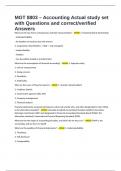
MGT 8803 – Accounting Actual study set
with Questions and correct/verified
Answers
What are the two forms of businesses and their characteristics? - ANSW-1. Proprietorship & Partnership
- Unlimited liability
- No taxation on business but only owners
2. Corporation (shareholders -> BoD -> top managers)
- Limited liability
- Taxation
- Can be publicly traded or privately held
What are the assumptions of financial accounting? - ANSW-1. Separate entity
2. Unit of measurement
3. Going concern
4. Periodicity
5. Materiality
Who are the users of financial reports? - ANSW-1. Investors (shareholders)
2. Creditors (banks)
3. Government agencies (SEC, IRS)
4. Company management
5. Financial analysts
Financial statements are governed based on what rule and by who, and often designated to who? What
is the alternative standard? - ANSW-Generally Accepted Accounting Principles (GAAP) by Securities
Exchange Commission (SEC) and designated to Financial Accounting Standards Board (FASB). The
alternative standard is International Financial Reporting Standards (IFRS).
What are the two types of accounting principles, and which do we focus on? - ANSW-GAAP vs tax
accounting, and we focus on GAAP.
What are the qualities of financial statements? - ANSW-1. Understandability
2. Timeliness
3. Full disclosure
4. Comparability
, 5. Objectivity
6. Decision relevance
Which quality do we not have in financial statements? - ANSW-Accuracy - because there is so much
judgement and estimates involve in financial reporting. At best we talk about objectivity and freedom
from bias.
What are the types of financial statements? - ANSW-1. Balance sheet
2. Income statement
3. Statement of cash flows
What is the accounting equation and what do the terms represent? - ANSW-A = L + OE
1. Assets are the resources of the company
2. Liabilities are the sources of funding provided by the creditors and represent the creditors' claims
3. Owner's Equity are the sources of funding provided by the owners and represent the owners' claims
What is the use of balance sheet? - ANSW-To measure the financial position of the company at a point in
time.
What are assets and types of assets? - ANSW-Resources owned or rights to receive resources.
1. Physical (cash, buildings, inventory, equipment)
2. Intangible (copyrights, patents, trademarks)
3. Legal rights (to receive payment)
What are the commonly known asset accounts? - ANSW-1. Cash
2. Accounts receivable and notes receivable
3. Inventory
4. Investments (stocks/bonds in other companies)
5. Buildings and equipment
6. Copyrights, patents
How is the order of assets presented on the balance sheet? - ANSW-In the order of liquidity
What are the types of valuation and which principle should we follow and why? - ANSW-1. Historical cost
2. Sales value
3. Replacement cost
4. General price-level adjusted cost
We should follow the cost principle, where assets are valued at their historical cost as it is most objective
(with tradeoff for decision relevance).
with Questions and correct/verified
Answers
What are the two forms of businesses and their characteristics? - ANSW-1. Proprietorship & Partnership
- Unlimited liability
- No taxation on business but only owners
2. Corporation (shareholders -> BoD -> top managers)
- Limited liability
- Taxation
- Can be publicly traded or privately held
What are the assumptions of financial accounting? - ANSW-1. Separate entity
2. Unit of measurement
3. Going concern
4. Periodicity
5. Materiality
Who are the users of financial reports? - ANSW-1. Investors (shareholders)
2. Creditors (banks)
3. Government agencies (SEC, IRS)
4. Company management
5. Financial analysts
Financial statements are governed based on what rule and by who, and often designated to who? What
is the alternative standard? - ANSW-Generally Accepted Accounting Principles (GAAP) by Securities
Exchange Commission (SEC) and designated to Financial Accounting Standards Board (FASB). The
alternative standard is International Financial Reporting Standards (IFRS).
What are the two types of accounting principles, and which do we focus on? - ANSW-GAAP vs tax
accounting, and we focus on GAAP.
What are the qualities of financial statements? - ANSW-1. Understandability
2. Timeliness
3. Full disclosure
4. Comparability
, 5. Objectivity
6. Decision relevance
Which quality do we not have in financial statements? - ANSW-Accuracy - because there is so much
judgement and estimates involve in financial reporting. At best we talk about objectivity and freedom
from bias.
What are the types of financial statements? - ANSW-1. Balance sheet
2. Income statement
3. Statement of cash flows
What is the accounting equation and what do the terms represent? - ANSW-A = L + OE
1. Assets are the resources of the company
2. Liabilities are the sources of funding provided by the creditors and represent the creditors' claims
3. Owner's Equity are the sources of funding provided by the owners and represent the owners' claims
What is the use of balance sheet? - ANSW-To measure the financial position of the company at a point in
time.
What are assets and types of assets? - ANSW-Resources owned or rights to receive resources.
1. Physical (cash, buildings, inventory, equipment)
2. Intangible (copyrights, patents, trademarks)
3. Legal rights (to receive payment)
What are the commonly known asset accounts? - ANSW-1. Cash
2. Accounts receivable and notes receivable
3. Inventory
4. Investments (stocks/bonds in other companies)
5. Buildings and equipment
6. Copyrights, patents
How is the order of assets presented on the balance sheet? - ANSW-In the order of liquidity
What are the types of valuation and which principle should we follow and why? - ANSW-1. Historical cost
2. Sales value
3. Replacement cost
4. General price-level adjusted cost
We should follow the cost principle, where assets are valued at their historical cost as it is most objective
(with tradeoff for decision relevance).