
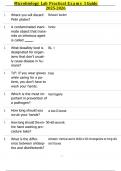
Microbiology Lab Practical E x a m s 1 Guide
2025-2026
1. Where you will discard Biohazard bucket
Petri plates?
2. A contaminated inani- fomite
mate object that trans-
mits an infectious agent
is called .
3. What biosafety level is BSL -1
designated for organ-
isms that don't usual-
ly cause disease in hu-
mans?
4. T/F: If you wear gloves False
while caring for a pa-
tient, you don't have to
wash your hands.
5. Which is the most im- Hand hygiene
portant in prevention of
a pathogen?
6. How long should you at least 20 seconds
scrub your hands?
7. How long should the en- 50-60 seconds
tire hand washing pro-
cedure take?
8. What is the differ- Antiseptic: chemical used to inhibit or kill microorganisms on living cells
ence between antisep- and tissues
tics and disinfectants?
, Microbiology Lab Practical E x a m s 1 Guide
2025-2026
Disinfectant: physical or chemical agents to inhibit or destroy microor-
ganisms on inanimate objects
9. Why do we classify or- minimize risk associated with handling
ganisms according to
biosafety levels?
10. What biosafety levels do 1, 2
we use in the microbi-
ology lab at Parker Uni-
versity?
11. Give an example of a e. coli
biosafety level 1 organ-
ism
12. Give an example of ebola
biosafety level 4 organ-
ism
13. What are some key enhanced PPE
safety measures imple- access controls
mented in BSL-2 labora- specific training
tories?
14. What does PPE stand personal protective equipment
for?
15. What are the different Direct: skin-to-skin, body fluids, sexual, transplacental
modes of transmission
of disease-causing or- Indirect: respiratory (droplet/aerosol), fecal-oral, fomite (inanimate ob-
ganisms? ject)
Other: vector (arthropods, insects)
, Microbiology Lab Practical E x a m s 1 Guide
2025-2026
16. What is the most effec- hand washing
tive method to prevent
disease transmission?
17. The microorganism that C) facultative anaerobe
can live with or without
oxygen and produce
turbidity in the broth
medium is a .
A) obligate aerobe
B) obligate anaerobe
C) facultative anaerobe
D) aerotolerant
18. For how long broth and D) 24 to 48 hours
agar plates are incubat-
ed?
A) one week
B) 4 days
C) 5 days
D) 24 to 48 hours
19. At what temperature A) 37 C
broth and agar plates
containing bacteria are
incubated?
A) 37 C
B) 25 C
C) 50 C
D) 100 C
20. A) obligate aerobe
, Microbiology Lab Practical E x a m s 1 Guide
2025-2026
In a broth medium or-
ganism has formed pel-
licale. Which type of the
organism will show this
growth pattern?
A) obligate aerobe
B) obligate anaerobe
C) Facultative anaerobe
D) Aerotolerant anaer-
obe
21. How can you assess D) All of the above
whether there is growth
in a broth medium?
A) by the presence of
pellicle
B) by the presence of
turbidity
C) by the presence of
sediment
D) All of the above
22. What is the importance Prevents contamination of work area, worker, and cultures with microor-
of using aseptic tech- ganisms
nique?
23. Describe a broth medi- Solution containing nutrients required by microorganisms for growth
um
24. What is the name of Agar
the solidifying agent
used most successfully
2025-2026
1. Where you will discard Biohazard bucket
Petri plates?
2. A contaminated inani- fomite
mate object that trans-
mits an infectious agent
is called .
3. What biosafety level is BSL -1
designated for organ-
isms that don't usual-
ly cause disease in hu-
mans?
4. T/F: If you wear gloves False
while caring for a pa-
tient, you don't have to
wash your hands.
5. Which is the most im- Hand hygiene
portant in prevention of
a pathogen?
6. How long should you at least 20 seconds
scrub your hands?
7. How long should the en- 50-60 seconds
tire hand washing pro-
cedure take?
8. What is the differ- Antiseptic: chemical used to inhibit or kill microorganisms on living cells
ence between antisep- and tissues
tics and disinfectants?
, Microbiology Lab Practical E x a m s 1 Guide
2025-2026
Disinfectant: physical or chemical agents to inhibit or destroy microor-
ganisms on inanimate objects
9. Why do we classify or- minimize risk associated with handling
ganisms according to
biosafety levels?
10. What biosafety levels do 1, 2
we use in the microbi-
ology lab at Parker Uni-
versity?
11. Give an example of a e. coli
biosafety level 1 organ-
ism
12. Give an example of ebola
biosafety level 4 organ-
ism
13. What are some key enhanced PPE
safety measures imple- access controls
mented in BSL-2 labora- specific training
tories?
14. What does PPE stand personal protective equipment
for?
15. What are the different Direct: skin-to-skin, body fluids, sexual, transplacental
modes of transmission
of disease-causing or- Indirect: respiratory (droplet/aerosol), fecal-oral, fomite (inanimate ob-
ganisms? ject)
Other: vector (arthropods, insects)
, Microbiology Lab Practical E x a m s 1 Guide
2025-2026
16. What is the most effec- hand washing
tive method to prevent
disease transmission?
17. The microorganism that C) facultative anaerobe
can live with or without
oxygen and produce
turbidity in the broth
medium is a .
A) obligate aerobe
B) obligate anaerobe
C) facultative anaerobe
D) aerotolerant
18. For how long broth and D) 24 to 48 hours
agar plates are incubat-
ed?
A) one week
B) 4 days
C) 5 days
D) 24 to 48 hours
19. At what temperature A) 37 C
broth and agar plates
containing bacteria are
incubated?
A) 37 C
B) 25 C
C) 50 C
D) 100 C
20. A) obligate aerobe
, Microbiology Lab Practical E x a m s 1 Guide
2025-2026
In a broth medium or-
ganism has formed pel-
licale. Which type of the
organism will show this
growth pattern?
A) obligate aerobe
B) obligate anaerobe
C) Facultative anaerobe
D) Aerotolerant anaer-
obe
21. How can you assess D) All of the above
whether there is growth
in a broth medium?
A) by the presence of
pellicle
B) by the presence of
turbidity
C) by the presence of
sediment
D) All of the above
22. What is the importance Prevents contamination of work area, worker, and cultures with microor-
of using aseptic tech- ganisms
nique?
23. Describe a broth medi- Solution containing nutrients required by microorganisms for growth
um
24. What is the name of Agar
the solidifying agent
used most successfully


