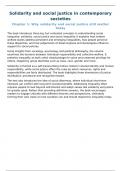
Solidarity and social justice in contemporary
societies
Chapter 1: Why solidarity and social justice still matter
today
The book introduces three key but contested concepts in understanding social
inequality: solidarity, social justice and social inequality. It explores how modern
welfare states address persistent and emerging inequalities, how people perceive
these disparities, and how judgements of deservingness and stereotypes influence
support for social policies.
Using insights from sociology, psychology and political philosophy, the volume
examines the tensions between individual responsibility and collective welfare. It
presents inequality as both unfair disadvantage for some and unearned privilege for
others, shaped by group identities such as class, race, gender and more.
Solidarity is framed as a self-transcending motive rooted in shared identity and mutual
responsibility, while social justice offers the rules by which resources, rights and
responsibilities are fairly distributed. The book highlights three dimensions of justice:
distributive, procedural and recognition-based.
The text also introduces the idea of social dilemmas, where individual short-term
interests can conflict with long-term societal benefits. Addressing inequality often
requires people to look beyond self-interest and adopt values like solidarity and justice
for greater good. Rather than providing definitive answers, the book encourages
readers to engage critically with different theories and perspectives, ultimately
forming their own views on how societies can and should respond to inequality today.
, Chapter 2: Who we are and who we choose to help (or not)
INTRODUCTION
Achieving social change often involves encouraging people to support disadvantaged
groups (e.g., women, minorities) to which they do not belong. However, this is often
met with indifference, resistance, or hostility. While individual factors like personality
or prejudice might explain these reactions, broader identity and group factors are also
influential. People identify not just as individuals but also as members of social
groups, distinguishing between ingroups (those they belong to) and outgroups (those
they do not). This group-based perspective helps explain why people are more likely
to support some groups over others. Using Social Identity Theory (SIT), the chapter
explores how social identities affect people's attitudes toward other groups,
particularly in terms of fostering intergroup solidarity or animosity. The chapter
concludes by suggesting strategies that use social identities to reduce animosity,
increase receptivity to social change, and promote political action on behalf of
disadvantaged groups.
A BRIEF INTRODUCTION TO SOCIAL IDENTITY THOERY
Early theories of prejudice focused on personality traits and individual needs, but
there is now greater recognition of the role social identity plays in intergroup relations.
Henri Tajfel and John Turner’s Social Identity Theory (SIT) posits that a person’s self-
concept can range from interpersonal (personal identity) to intergroup (social
identity). A social identity is defined by the groups a person belongs to, and how they
emotionally and evaluatively relate to those groups. The salience of these identities—
how much a person is thinking of themselves as a group member—affects interactions
with others, often leading to biases between ingroups ('us') and outgroups ('them').
People are motivated to maintain a positive image of their ingroup, often through
ingroup favoritism (e.g., allocating rewards or being more cooperative with ingroup
members) or outgroup derogation (e.g., devaluing outgroups to boost the ingroup’s
status). These dynamics contribute to intergroup bias and animosity, which are key
issues to address in reducing prejudice and fostering social change.
HOW CAN SOCIAL IDENTITIES ENCOURAGE INTERGROUP ANIMOSITY AND RESISTANCE
TO SOCIAL CHANGE?
Outgroup derogation and intergroup animosity serve important functions in protecting
group identities. These behaviors help maintain the ingroup's status and defend
against perceived threats from outgroups. Social identity threats arise when the value
or image of a group is challenged, motivating individuals to protect their group
identity through hostility toward outgroups. Key types of social identity threats
include:
societies
Chapter 1: Why solidarity and social justice still matter
today
The book introduces three key but contested concepts in understanding social
inequality: solidarity, social justice and social inequality. It explores how modern
welfare states address persistent and emerging inequalities, how people perceive
these disparities, and how judgements of deservingness and stereotypes influence
support for social policies.
Using insights from sociology, psychology and political philosophy, the volume
examines the tensions between individual responsibility and collective welfare. It
presents inequality as both unfair disadvantage for some and unearned privilege for
others, shaped by group identities such as class, race, gender and more.
Solidarity is framed as a self-transcending motive rooted in shared identity and mutual
responsibility, while social justice offers the rules by which resources, rights and
responsibilities are fairly distributed. The book highlights three dimensions of justice:
distributive, procedural and recognition-based.
The text also introduces the idea of social dilemmas, where individual short-term
interests can conflict with long-term societal benefits. Addressing inequality often
requires people to look beyond self-interest and adopt values like solidarity and justice
for greater good. Rather than providing definitive answers, the book encourages
readers to engage critically with different theories and perspectives, ultimately
forming their own views on how societies can and should respond to inequality today.
, Chapter 2: Who we are and who we choose to help (or not)
INTRODUCTION
Achieving social change often involves encouraging people to support disadvantaged
groups (e.g., women, minorities) to which they do not belong. However, this is often
met with indifference, resistance, or hostility. While individual factors like personality
or prejudice might explain these reactions, broader identity and group factors are also
influential. People identify not just as individuals but also as members of social
groups, distinguishing between ingroups (those they belong to) and outgroups (those
they do not). This group-based perspective helps explain why people are more likely
to support some groups over others. Using Social Identity Theory (SIT), the chapter
explores how social identities affect people's attitudes toward other groups,
particularly in terms of fostering intergroup solidarity or animosity. The chapter
concludes by suggesting strategies that use social identities to reduce animosity,
increase receptivity to social change, and promote political action on behalf of
disadvantaged groups.
A BRIEF INTRODUCTION TO SOCIAL IDENTITY THOERY
Early theories of prejudice focused on personality traits and individual needs, but
there is now greater recognition of the role social identity plays in intergroup relations.
Henri Tajfel and John Turner’s Social Identity Theory (SIT) posits that a person’s self-
concept can range from interpersonal (personal identity) to intergroup (social
identity). A social identity is defined by the groups a person belongs to, and how they
emotionally and evaluatively relate to those groups. The salience of these identities—
how much a person is thinking of themselves as a group member—affects interactions
with others, often leading to biases between ingroups ('us') and outgroups ('them').
People are motivated to maintain a positive image of their ingroup, often through
ingroup favoritism (e.g., allocating rewards or being more cooperative with ingroup
members) or outgroup derogation (e.g., devaluing outgroups to boost the ingroup’s
status). These dynamics contribute to intergroup bias and animosity, which are key
issues to address in reducing prejudice and fostering social change.
HOW CAN SOCIAL IDENTITIES ENCOURAGE INTERGROUP ANIMOSITY AND RESISTANCE
TO SOCIAL CHANGE?
Outgroup derogation and intergroup animosity serve important functions in protecting
group identities. These behaviors help maintain the ingroup's status and defend
against perceived threats from outgroups. Social identity threats arise when the value
or image of a group is challenged, motivating individuals to protect their group
identity through hostility toward outgroups. Key types of social identity threats
include: