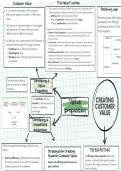
Customer Value The Value Function
The customer value function reflects the way in which attributes of the Positioning map
it is a customer’s assessment of the company’s
offering translate to subjective benefits and costs for target customers:
offering with respect to its ability to fulfill certain Attributes defining the company’s offering
needs Positioning maps reflect buyer
Relative importance of these attributes for target
Offering’s performance on these attributes perception of an offering’s
Two aspects of value merit attention: it is intangible performance relative to that o
and idiosyncratic (the same offering can have 4 aspects of the value function merit attention :
Reference-Point Dependence: consumers often do not have well-articulated the competition
different value for different customers)
preferences and that their evaluations of market offerings depend on the
decision context
An offering’s value is determined by the fit between its Loss aversion: people value the positive (gains) and negative (losses) deviations
attributes and the needs of the target customers: from the reference point in a different fashion, placing more weight on losses
Functional value: offering’s performance than gains
Psychological value Diminishing marginal value: after a certain point improving the offering’s
performance will produce marginally diminishing increases in the subjective
Monetary value: offering’s price, fees, discounts,
valuation of the offering. The value function is concave
and rebates Effort optimization: The goal of minimizing decision effort entices buyers to
follow shortcuts, or heuristics, that aim to circumvent cognitive effort, albeit at the
expense of choice accuracy: Satisficing
The value that an offering Developing a
aims to create for its target Value
customers
Proposition
*only attributes that are
relevant to customer needs can Value CREATING
create a competitive CUSTOMER
advantage proposition VALUE
Developing a
competitive
advantage
Offering’s competitive advantage is defined by two
factors:
Strategies for Creating THE BIG PICTURE
Superior Customer Value An offering’s value proposition delineates
Points of difference: attributes that are important
the value— defined by the specific benefits
for target customers and on which the company’s Improve the offering’s performance on a
and costs—that target customers will receive
offering is perceived to be different given attribute
from the offering.
The customer value function reflects the way in which attributes of the Positioning map
it is a customer’s assessment of the company’s
offering translate to subjective benefits and costs for target customers:
offering with respect to its ability to fulfill certain Attributes defining the company’s offering
needs Positioning maps reflect buyer
Relative importance of these attributes for target
Offering’s performance on these attributes perception of an offering’s
Two aspects of value merit attention: it is intangible performance relative to that o
and idiosyncratic (the same offering can have 4 aspects of the value function merit attention :
Reference-Point Dependence: consumers often do not have well-articulated the competition
different value for different customers)
preferences and that their evaluations of market offerings depend on the
decision context
An offering’s value is determined by the fit between its Loss aversion: people value the positive (gains) and negative (losses) deviations
attributes and the needs of the target customers: from the reference point in a different fashion, placing more weight on losses
Functional value: offering’s performance than gains
Psychological value Diminishing marginal value: after a certain point improving the offering’s
performance will produce marginally diminishing increases in the subjective
Monetary value: offering’s price, fees, discounts,
valuation of the offering. The value function is concave
and rebates Effort optimization: The goal of minimizing decision effort entices buyers to
follow shortcuts, or heuristics, that aim to circumvent cognitive effort, albeit at the
expense of choice accuracy: Satisficing
The value that an offering Developing a
aims to create for its target Value
customers
Proposition
*only attributes that are
relevant to customer needs can Value CREATING
create a competitive CUSTOMER
advantage proposition VALUE
Developing a
competitive
advantage
Offering’s competitive advantage is defined by two
factors:
Strategies for Creating THE BIG PICTURE
Superior Customer Value An offering’s value proposition delineates
Points of difference: attributes that are important
the value— defined by the specific benefits
for target customers and on which the company’s Improve the offering’s performance on a
and costs—that target customers will receive
offering is perceived to be different given attribute
from the offering.