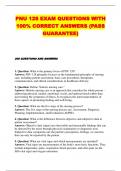
PNU 128 EXAM QUESTIONS WITH
100% CORRECT ANSWERS (PASS
GUARANTEE)
200 QUESTIONS AND ANSWERS
1. Question: What is the primary focus of PNU 128?
Answer: PNU 128 primarily focuses on the fundamental principles of nursing
care, including patient assessment, basic care procedures, therapeutic
communication, and ethical considerations in healthcare delivery.
2. Question: Define "holistic nursing care."
Answer: Holistic nursing care is an approach that considers the whole person -
addressing physical, mental, emotional, social, and spiritual needs rather than
just treating the symptoms of illness. It recognizes the interconnectedness of
these aspects in promoting healing and well-being.
3. Question: What are the five steps of the nursing process?
Answer: The five steps of the nursing process are: Assessment, Diagnosis,
Planning, Implementation, and Evaluation (ADPIE).
4. Question: What is the difference between objective and subjective data in
patient assessment?
Answer: Objective data (signs) are observable and measurable findings that can
be detected by the nurse through physical examination or diagnostic tests.
Subjective data (symptoms) are the patient's perceptions, feelings, or concerns
that can only be reported by the patient.
5. Question: What are vital signs and which measurements are included?
Answer: Vital signs are measurements of the body's most basic functions. They
include temperature, pulse, respiration, blood pressure, and often pain (as the
fifth vital sign) and oxygen saturation.
,6. Question: What is the normal range for adult body temperature in Celsius?
Answer: The normal range for adult body temperature is 36.5-37.5°C (97.7-
99.5°F).
7. Question: What does the abbreviation "TPR" stand for in nursing?
Answer: TPR stands for Temperature, Pulse, and Respiration - three of the four
traditional vital signs.
8. Question: What is the normal resting heart rate range for adults?
Answer: The normal resting heart rate for adults is 60-100 beats per minute.
9. Question: Define "tachycardia" and "bradycardia."
Answer: Tachycardia refers to an abnormally rapid heart rate (over 100 beats
per minute in adults), while bradycardia refers to an abnormally slow heart rate
(below 60 beats per minute in adults).
10. Question: What is the normal respiratory rate range for adults?
Answer: The normal respiratory rate for adults is 12-20 breaths per minute.
Section 2: Patient Assessment
11. Question: What are the two components of a comprehensive patient
assessment?
Answer: The two components are the health history (interview) and the
physical examination.
12. Question: List four methods used during physical assessment.
Answer: The four methods used during physical assessment are inspection,
palpation, percussion, and auscultation.
13. Question: In what order should these four physical assessment methods
generally be performed?
Answer: The general order is inspection first, followed by percussion,
palpation, and auscultation. However, this may vary depending on the body
system being assessed.
14. Question: What is the purpose of percussion in physical assessment?
Answer: Percussion involves tapping on the body surface to produce sounds
that provide information about the underlying structures, such as determining if
tissues are filled with air, fluid, or solid material.
15. Question: What is auscultation used to assess?
Answer: Auscultation involves listening to sounds produced by the body using
, a stethoscope. It is used to assess heart sounds, lung sounds, bowel sounds, and
vascular sounds.
16. Question: Define "crepitus" and how it is detected.
Answer: Crepitus is a crackling or grating sensation felt under the skin,
typically caused by air in tissues, fractured bone fragments rubbing together, or
dry joint surfaces moving against each other. It is detected through palpation.
17. Question: What is the Glasgow Coma Scale used to assess?
Answer: The Glasgow Coma Scale (GCS) is used to assess the level of
consciousness by evaluating eye opening, verbal response, and motor response.
18. Question: What are the three components assessed in the Glasgow Coma
Scale?
Answer: The three components assessed in the Glasgow Coma Scale are eye
opening response, verbal response, and motor response.
19. Question: What is the significance of capillary refill time?
Answer: Capillary refill time assesses peripheral perfusion and cardiovascular
status. It measures how quickly blood returns to tissue after pressure is applied
and released.
20. Question: What is a normal capillary refill time?
Answer: Normal capillary refill time is less than 3 seconds in adults and
children (some sources specify less than 2 seconds).
Section 3: Nursing Diagnosis and Planning
21. Question: What is a nursing diagnosis?
Answer: A nursing diagnosis is a clinical judgment about individual, family, or
community responses to actual or potential health problems/life processes that
provides the basis for selection of nursing interventions.
22. Question: What organization develops and approves standardized nursing
diagnostic terminology?
Answer: NANDA International (North American Nursing Diagnosis
Association) develops and approves standardized nursing diagnostic
terminology.
23. Question: What are the three components of a properly formatted nursing
diagnosis statement using PES format?
Answer: The three components are: Problem (P), Etiology (E), and
Signs/Symptoms (S).
100% CORRECT ANSWERS (PASS
GUARANTEE)
200 QUESTIONS AND ANSWERS
1. Question: What is the primary focus of PNU 128?
Answer: PNU 128 primarily focuses on the fundamental principles of nursing
care, including patient assessment, basic care procedures, therapeutic
communication, and ethical considerations in healthcare delivery.
2. Question: Define "holistic nursing care."
Answer: Holistic nursing care is an approach that considers the whole person -
addressing physical, mental, emotional, social, and spiritual needs rather than
just treating the symptoms of illness. It recognizes the interconnectedness of
these aspects in promoting healing and well-being.
3. Question: What are the five steps of the nursing process?
Answer: The five steps of the nursing process are: Assessment, Diagnosis,
Planning, Implementation, and Evaluation (ADPIE).
4. Question: What is the difference between objective and subjective data in
patient assessment?
Answer: Objective data (signs) are observable and measurable findings that can
be detected by the nurse through physical examination or diagnostic tests.
Subjective data (symptoms) are the patient's perceptions, feelings, or concerns
that can only be reported by the patient.
5. Question: What are vital signs and which measurements are included?
Answer: Vital signs are measurements of the body's most basic functions. They
include temperature, pulse, respiration, blood pressure, and often pain (as the
fifth vital sign) and oxygen saturation.
,6. Question: What is the normal range for adult body temperature in Celsius?
Answer: The normal range for adult body temperature is 36.5-37.5°C (97.7-
99.5°F).
7. Question: What does the abbreviation "TPR" stand for in nursing?
Answer: TPR stands for Temperature, Pulse, and Respiration - three of the four
traditional vital signs.
8. Question: What is the normal resting heart rate range for adults?
Answer: The normal resting heart rate for adults is 60-100 beats per minute.
9. Question: Define "tachycardia" and "bradycardia."
Answer: Tachycardia refers to an abnormally rapid heart rate (over 100 beats
per minute in adults), while bradycardia refers to an abnormally slow heart rate
(below 60 beats per minute in adults).
10. Question: What is the normal respiratory rate range for adults?
Answer: The normal respiratory rate for adults is 12-20 breaths per minute.
Section 2: Patient Assessment
11. Question: What are the two components of a comprehensive patient
assessment?
Answer: The two components are the health history (interview) and the
physical examination.
12. Question: List four methods used during physical assessment.
Answer: The four methods used during physical assessment are inspection,
palpation, percussion, and auscultation.
13. Question: In what order should these four physical assessment methods
generally be performed?
Answer: The general order is inspection first, followed by percussion,
palpation, and auscultation. However, this may vary depending on the body
system being assessed.
14. Question: What is the purpose of percussion in physical assessment?
Answer: Percussion involves tapping on the body surface to produce sounds
that provide information about the underlying structures, such as determining if
tissues are filled with air, fluid, or solid material.
15. Question: What is auscultation used to assess?
Answer: Auscultation involves listening to sounds produced by the body using
, a stethoscope. It is used to assess heart sounds, lung sounds, bowel sounds, and
vascular sounds.
16. Question: Define "crepitus" and how it is detected.
Answer: Crepitus is a crackling or grating sensation felt under the skin,
typically caused by air in tissues, fractured bone fragments rubbing together, or
dry joint surfaces moving against each other. It is detected through palpation.
17. Question: What is the Glasgow Coma Scale used to assess?
Answer: The Glasgow Coma Scale (GCS) is used to assess the level of
consciousness by evaluating eye opening, verbal response, and motor response.
18. Question: What are the three components assessed in the Glasgow Coma
Scale?
Answer: The three components assessed in the Glasgow Coma Scale are eye
opening response, verbal response, and motor response.
19. Question: What is the significance of capillary refill time?
Answer: Capillary refill time assesses peripheral perfusion and cardiovascular
status. It measures how quickly blood returns to tissue after pressure is applied
and released.
20. Question: What is a normal capillary refill time?
Answer: Normal capillary refill time is less than 3 seconds in adults and
children (some sources specify less than 2 seconds).
Section 3: Nursing Diagnosis and Planning
21. Question: What is a nursing diagnosis?
Answer: A nursing diagnosis is a clinical judgment about individual, family, or
community responses to actual or potential health problems/life processes that
provides the basis for selection of nursing interventions.
22. Question: What organization develops and approves standardized nursing
diagnostic terminology?
Answer: NANDA International (North American Nursing Diagnosis
Association) develops and approves standardized nursing diagnostic
terminology.
23. Question: What are the three components of a properly formatted nursing
diagnosis statement using PES format?
Answer: The three components are: Problem (P), Etiology (E), and
Signs/Symptoms (S).