CPA - FAR (F1)
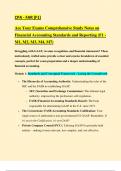
Ace Your Exams Comprehensive Study Notes on
Financial Accounting Standards and Reporting (F1 -
M1, M2, M3, M4, M7)
Struggling with GAAP, revenue recognition, and financial statements? These
meticulously crafted notes provide a clear and concise breakdown of essential
concepts, perfect for exam preparation and a deeper understanding of
financial accounting.
Module 1: Standards and Conceptual Framework - Laying the Groundwork
The Hierarchy of Accounting Authority: Understanding the roles of the
SEC and the FASB in establishing GAAP.
o SEC (Securities and Exchange Commission): The ultimate legal
authority, empowering the profession's self-regulation.
o FASB (Financial Accounting Standards Board): The body
responsible for determining GAAP in the U.S. since 1973.
The Cornerstone: FASB Accounting Standards Codification: Your
single source of authoritative non-governmental US GAAP. Remember: If
it's not in the Codification, it's not GAAP!
Private Company Council (PCC): Tailoring GAAP for privately held
entities – making it more relevant, less complex, and cost-effective.
, Statement of Financial Accounting Concepts (SFAC): The philosophical
bedrock of all FASB pronouncements, providing the fundamental reasoning
behind accounting principles for both businesses and non-profits.
The Core Objective of Financial Reporting: Providing useful financial
information to primary users for making resource allocation decisions.
Who are the Primary Users? Investors, creditors, and lenders – the key
decision-makers.
What Information Do Primary Users Need? A breakdown of the essential
elements:
1. Entity's resources
2. Claims against the entity
3. Changes in resources and claims
4. Management and governance's stewardship responsibilities
The Fundamental Qualitative Characteristics of Useful Information:
o Relevance: Information with predictive value, confirmatory value,
and materiality.
o Faithful Representation: Information that is complete, neutral, and
free from material error.
Enhancing Qualitative Characteristics (Remember: Crystal
Understands The Variables):**
o Comparability
o Understandability
o Timeliness
o Verifiability
The Practical Constraint: Cost vs. Benefit: The cost of providing financial
information must justify the benefits derived from it.
The Essential Financial Statements (The Big Five):
Ace Your Exams Comprehensive Study Notes on
Financial Accounting Standards and Reporting (F1 -
M1, M2, M3, M4, M7)
Struggling with GAAP, revenue recognition, and financial statements? These
meticulously crafted notes provide a clear and concise breakdown of essential
concepts, perfect for exam preparation and a deeper understanding of
financial accounting.
Module 1: Standards and Conceptual Framework - Laying the Groundwork
The Hierarchy of Accounting Authority: Understanding the roles of the
SEC and the FASB in establishing GAAP.
o SEC (Securities and Exchange Commission): The ultimate legal
authority, empowering the profession's self-regulation.
o FASB (Financial Accounting Standards Board): The body
responsible for determining GAAP in the U.S. since 1973.
The Cornerstone: FASB Accounting Standards Codification: Your
single source of authoritative non-governmental US GAAP. Remember: If
it's not in the Codification, it's not GAAP!
Private Company Council (PCC): Tailoring GAAP for privately held
entities – making it more relevant, less complex, and cost-effective.
, Statement of Financial Accounting Concepts (SFAC): The philosophical
bedrock of all FASB pronouncements, providing the fundamental reasoning
behind accounting principles for both businesses and non-profits.
The Core Objective of Financial Reporting: Providing useful financial
information to primary users for making resource allocation decisions.
Who are the Primary Users? Investors, creditors, and lenders – the key
decision-makers.
What Information Do Primary Users Need? A breakdown of the essential
elements:
1. Entity's resources
2. Claims against the entity
3. Changes in resources and claims
4. Management and governance's stewardship responsibilities
The Fundamental Qualitative Characteristics of Useful Information:
o Relevance: Information with predictive value, confirmatory value,
and materiality.
o Faithful Representation: Information that is complete, neutral, and
free from material error.
Enhancing Qualitative Characteristics (Remember: Crystal
Understands The Variables):**
o Comparability
o Understandability
o Timeliness
o Verifiability
The Practical Constraint: Cost vs. Benefit: The cost of providing financial
information must justify the benefits derived from it.
The Essential Financial Statements (The Big Five):