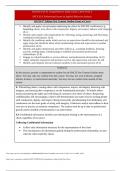
Portfolio Part B: Comprehensive Study Guide: Check Point 3
SPCE 619: Professional Issues in Applied Behavior Analysis
BACB 6th Edition Test Content Outline Items to Cover
Identify and apply core principles underlying the ethics for BACB® certificants (e.g.
benefiting others; treat others with compassion, dignity, and respect; behave with integrity).
(E-1)
Identify and comply with requirements for collecting, using, protecting, and disclosing
confidential information. (E-4)
Identify the conditions under which services or supervision should be discontinued and
apply steps that should be taken when transitioning clients and supervisees to another
professional. (E-6)
Identify and apply interpersonal and other skills (e.g., accepting feedback, listening
actively, seeking input, collaborating) to establish and maintain professional
relationships. (E-8)
Engage in cultural humility in service delivery and professional relationships. (E-9)
Apply culturally responsive and inclusive service and supervision activities. (E-10)
Identify and integrate relevant cultural variables in the assessment process (F-2)
Outline22
In this section, provide a comprehensive outline for the BACB Test Content Outline items
above. You may only use content from this course. You may use your textbook, assigned
articles, lectures, or instructional materials. You may not use content from outside of this
course.
E. 1 Benefiting others, treating others with compassion, respect, and dignity, behaving with
integrity, and ensuring their competency are the fundamental principles. To benefit others
means prioritizing the rights and well-being of customers over those of others. Respecting
confidentiality and encouraging a client's self-determination are made clear by treating people
with compassion, dignity, and respect. Being trustworthy and abstaining from dishonesty and
carelessness are the main goals of acting with integrity. A behavior analyst must adhere to their
own area of practice to maintain competence. The analyst must be up to date on professional
growth and be mindful of mistreatment in an intervention.
E.4 Confidential information includes any information relating to the representation of a
client, regardless of its source.
Collecting Confidential Information
Collect only information necessary for the representation of the client
This encompasses all information gained during the professional relationship, not just
what the client explicitly shares.
This study source was downloaded by 100000898960505 from CourseHero.com on 05-15-2025 21:41:31 GMT -05:00
https://www.coursehero.com/file/242822721/SPCE-619-Comprehensive-Study-Guide-Part-3docx/
, Using Confidential Information
Use the information solely for the benefit of the client and in the context of their
representation.
Ensure that the use of information does not create conflict of interest.
Protecting Confidential Information
Implement reasonable measures to protect the information from unauthorized access,
such as encryption and secure storage
Limit access to the information to those who need it for the representation
Disclosing Confidential Information
Obtain explicit consent from the client before disclosing any confidential information.
Disclose information only when required by law or court order, or to prevent certain
death or substantial bodily harm.
In some cases, disclosure is implied authorized to carry out the representation.
E.6 Terminating services or supervision is a difficult decision that needs to be carefully
thought out in several aspects. Prioritizing the client's or supervisee's welfare is crucial while
making such a decision to facilitate an effortless transition to another expert.
It may be appropriate to stop providing services or supervision in a number of situations.
When the supervisee or customer has accomplished their objectives and no longer needs
continuous assistance, this is one example. This could happen after a client has reached a
targeted level of functioning, learned new coping mechanisms, or effectively handled their
presenting issue. In these situations, it's critical to acknowledge the client's accomplishments
and the constructive changes they've made, acknowledge their development, and talk about the
prospect of ending the relationship.
When the client or supervisee is no longer gaining anything from the current intervention, that
is another reason to stop providing services or supervision. This could happen if the client is
not actively participating in the therapy process, has reached an end point in their progress, or
is resistant to change. Alternative solutions, such modifying the treatment plan or using novel
procedures, might need to be investigated in these circumstances. Referring to another expert
who could be more suited to handle their particular issues could be helpful if their
requirements are not being satisfied within the present framework.
Following a defined procedure is essential when ending supervision or services in order to
reduce disturbance and guarantee the continued wellbeing of the supervisee or customer.
Notifying the client or supervisee of the choice to end the relationship is the first step.
Recognizing their emotions and offering reassurance should be done in a kind and encouraging
way. To provide openness and transparency, it is also critical to address any worries or
inquiries the customer or supervisee may have, as well as to go over the rationale behind the
decision.
Creating a transition strategy is the second step. The actions that will be performed to
This study source was downloaded by 100000898960505 from CourseHero.com on 05-15-2025 21:41:31 GMT -05:00
https://www.coursehero.com/file/242822721/SPCE-619-Comprehensive-Study-Guide-Part-3docx/
SPCE 619: Professional Issues in Applied Behavior Analysis
BACB 6th Edition Test Content Outline Items to Cover
Identify and apply core principles underlying the ethics for BACB® certificants (e.g.
benefiting others; treat others with compassion, dignity, and respect; behave with integrity).
(E-1)
Identify and comply with requirements for collecting, using, protecting, and disclosing
confidential information. (E-4)
Identify the conditions under which services or supervision should be discontinued and
apply steps that should be taken when transitioning clients and supervisees to another
professional. (E-6)
Identify and apply interpersonal and other skills (e.g., accepting feedback, listening
actively, seeking input, collaborating) to establish and maintain professional
relationships. (E-8)
Engage in cultural humility in service delivery and professional relationships. (E-9)
Apply culturally responsive and inclusive service and supervision activities. (E-10)
Identify and integrate relevant cultural variables in the assessment process (F-2)
Outline22
In this section, provide a comprehensive outline for the BACB Test Content Outline items
above. You may only use content from this course. You may use your textbook, assigned
articles, lectures, or instructional materials. You may not use content from outside of this
course.
E. 1 Benefiting others, treating others with compassion, respect, and dignity, behaving with
integrity, and ensuring their competency are the fundamental principles. To benefit others
means prioritizing the rights and well-being of customers over those of others. Respecting
confidentiality and encouraging a client's self-determination are made clear by treating people
with compassion, dignity, and respect. Being trustworthy and abstaining from dishonesty and
carelessness are the main goals of acting with integrity. A behavior analyst must adhere to their
own area of practice to maintain competence. The analyst must be up to date on professional
growth and be mindful of mistreatment in an intervention.
E.4 Confidential information includes any information relating to the representation of a
client, regardless of its source.
Collecting Confidential Information
Collect only information necessary for the representation of the client
This encompasses all information gained during the professional relationship, not just
what the client explicitly shares.
This study source was downloaded by 100000898960505 from CourseHero.com on 05-15-2025 21:41:31 GMT -05:00
https://www.coursehero.com/file/242822721/SPCE-619-Comprehensive-Study-Guide-Part-3docx/
, Using Confidential Information
Use the information solely for the benefit of the client and in the context of their
representation.
Ensure that the use of information does not create conflict of interest.
Protecting Confidential Information
Implement reasonable measures to protect the information from unauthorized access,
such as encryption and secure storage
Limit access to the information to those who need it for the representation
Disclosing Confidential Information
Obtain explicit consent from the client before disclosing any confidential information.
Disclose information only when required by law or court order, or to prevent certain
death or substantial bodily harm.
In some cases, disclosure is implied authorized to carry out the representation.
E.6 Terminating services or supervision is a difficult decision that needs to be carefully
thought out in several aspects. Prioritizing the client's or supervisee's welfare is crucial while
making such a decision to facilitate an effortless transition to another expert.
It may be appropriate to stop providing services or supervision in a number of situations.
When the supervisee or customer has accomplished their objectives and no longer needs
continuous assistance, this is one example. This could happen after a client has reached a
targeted level of functioning, learned new coping mechanisms, or effectively handled their
presenting issue. In these situations, it's critical to acknowledge the client's accomplishments
and the constructive changes they've made, acknowledge their development, and talk about the
prospect of ending the relationship.
When the client or supervisee is no longer gaining anything from the current intervention, that
is another reason to stop providing services or supervision. This could happen if the client is
not actively participating in the therapy process, has reached an end point in their progress, or
is resistant to change. Alternative solutions, such modifying the treatment plan or using novel
procedures, might need to be investigated in these circumstances. Referring to another expert
who could be more suited to handle their particular issues could be helpful if their
requirements are not being satisfied within the present framework.
Following a defined procedure is essential when ending supervision or services in order to
reduce disturbance and guarantee the continued wellbeing of the supervisee or customer.
Notifying the client or supervisee of the choice to end the relationship is the first step.
Recognizing their emotions and offering reassurance should be done in a kind and encouraging
way. To provide openness and transparency, it is also critical to address any worries or
inquiries the customer or supervisee may have, as well as to go over the rationale behind the
decision.
Creating a transition strategy is the second step. The actions that will be performed to
This study source was downloaded by 100000898960505 from CourseHero.com on 05-15-2025 21:41:31 GMT -05:00
https://www.coursehero.com/file/242822721/SPCE-619-Comprehensive-Study-Guide-Part-3docx/