©EVERLY 2025 ALL RIGHTS RESERVED
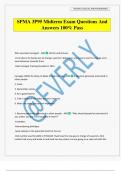
SPMA 3P21 MIDTERM Exam Questions
And Answers 100% Pass
The Strategic Process (6 steps) - ANS 1. Clarification of corporate mission, goals and values.
2. Analysis of the organization's external competitive environment to identify strengths,
weaknesses, opportunities and threats (a SWOT analysis)
3. Analysis of the organization's internal operating environment to identify strengths and
weaknesses (again using a SWOT analysis).
4. Selection of strategies that build on the organization's strengths and correct weaknesses, to
take advantage of external opportunities and counter-external threats.
5. Strategy implementation
6. Strategy evaluation with corrective feedback to the implementation phase.
Porter's Theory - ANS Porter suggests that when positioning itself relative to competitors in
an industry, an organization can only outperform its rivals in two fundamental ways: By
operational effectiveness and by strategic positioning
Operational effectiveness: Means performing similar activities better than rivals perform them
, ©EVERLY 2025 ALL RIGHTS RESERVED
Strategic Positioning: Refers to performing different activities from rivals or performing similar
activities in different ways.
Resource-Based Theory (RVB) - ANS - Resource-baed theory is about managing all of the
value-creating capabilities of an organization... tangible and intangible.
- Internal resources such as patents, copyrights, proprietary technologies
- Resource-based theory looks at people as human beings, and as the priority in a successful
organization.
- ORGANIZATIONAL CULTURE makes people stay within the organization.
- Must manage the resource of "people" correctly as it is an organizations competitive
advantage.
HRM Aims (7 aims) - ANS 1. Selective recruitment.
2. Developing a decentralized organization which supports self-managed teams (job design and
orientation).
3. Providing employment security.
4. Providing high rewards relative to other organizations, but based on performance.
5. Extensive training.
6. Sharing information.
SPMA 3P21 MIDTERM Exam Questions
And Answers 100% Pass
The Strategic Process (6 steps) - ANS 1. Clarification of corporate mission, goals and values.
2. Analysis of the organization's external competitive environment to identify strengths,
weaknesses, opportunities and threats (a SWOT analysis)
3. Analysis of the organization's internal operating environment to identify strengths and
weaknesses (again using a SWOT analysis).
4. Selection of strategies that build on the organization's strengths and correct weaknesses, to
take advantage of external opportunities and counter-external threats.
5. Strategy implementation
6. Strategy evaluation with corrective feedback to the implementation phase.
Porter's Theory - ANS Porter suggests that when positioning itself relative to competitors in
an industry, an organization can only outperform its rivals in two fundamental ways: By
operational effectiveness and by strategic positioning
Operational effectiveness: Means performing similar activities better than rivals perform them
, ©EVERLY 2025 ALL RIGHTS RESERVED
Strategic Positioning: Refers to performing different activities from rivals or performing similar
activities in different ways.
Resource-Based Theory (RVB) - ANS - Resource-baed theory is about managing all of the
value-creating capabilities of an organization... tangible and intangible.
- Internal resources such as patents, copyrights, proprietary technologies
- Resource-based theory looks at people as human beings, and as the priority in a successful
organization.
- ORGANIZATIONAL CULTURE makes people stay within the organization.
- Must manage the resource of "people" correctly as it is an organizations competitive
advantage.
HRM Aims (7 aims) - ANS 1. Selective recruitment.
2. Developing a decentralized organization which supports self-managed teams (job design and
orientation).
3. Providing employment security.
4. Providing high rewards relative to other organizations, but based on performance.
5. Extensive training.
6. Sharing information.