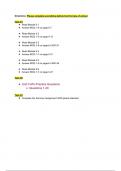
Directions: Please complete everything before the first day of school
Task #1
❖ Read Module 0.1
❖ Answer MCQ 1-5 on page 0-7
❖ Read Module 0.2
❖ Answer MCQ 1-5 on page 0-13
❖ Read Module 0.3
❖ Answer MCQ 1-8 on pages 0-20/0-21
❖ Read Module 0.4
❖ Answer MCQ 1-7 on page 0-31
❖ Read Module 0.5
❖ Answer MCQ 1-5 on pages 0-38/0-39
❖ Read Module 0.6
❖ Answer MCQ 1-7 on page 0-47
Task #2
❖ Unit 0 AP® Practice Questions
➢ Questions 1-20
Task #3
❖ Complete the Summer Assignment 2025 packet attached
, ©
Be
d fo
rd,
01_myersAPpsychology4e_28116_ch00_002_051_2pp.indd 2
Fr
ee
m
an
&
W
or
th
Pu
bl
is
he
rs
.F
or
re
vi
ew
pu
rp
os
es
on
ly
.D
o
no
td
is
tri
UNIT
bu
te
.
0
, An Introduction to Psychology
Science Practices:
.
te
Research Methods and
bu
tri
is
td
no
Data Interpretation
o
.D
ly
on
A
es
s you will learn through this course, psychology is the science of behavior MODULES
os
and mental processes. What do psychologists do? You might think that
rp
0.1 / The Scientific Attitude, Crit
pu
they offer counseling, analyze personality, give out child-raising advice, Thinking, and Developing
examine crime scenes, and testify in court. Do they? Yes — and much mormore. ew Arguments
vi
Consider some of psychology’s questions that you may wonder about: 0.2 / The Need for Psychologica
re
Science
or
• Have you ever awakened from a nightmare and wondered why you had such a
.F
0.3 / The Scientific Method and
crazy dream? Why do we dream?
rs
Description
he
• Have you ever played peekaboo with a 6-month-old and wondered why the
0.4 / Correlation and Experimen
is
baby finds your disappearing/reappearing act so delightful? What do babies
bl
0.5 / Research Design and Ethic
Pu
perceive and think?
Psychology
th
• Have you ever wondered what fosters school and work success? Does inborn
or
0.6 / Statistical Reasoning in Ev
intelligence explain why some people get richer, think more creatively, or
W
Life
&
relate more sensitively? Or does gritty effort and a belief in the power of
an
persistence matter more?
m
ee
• Have you ever become depressed or anxious and wondered whether you’ll ever
Fr
feel “normal”? What triggers our bad moods — and our good ones? What’s
d,
the line between a rroutine mood swing and a psychological disorder?
r
d fo
Psychology seeks to answer such questions about us all — how and why we think,
Be
feel, and act as we do. But as a science, psychology does more than speculate: It UNIT
0
©
uses research and interpretation of the resulting data to separate uninformed Overview
Video
opinions from examined conclusions.
Oli Scarff/Getty Images
Leo, aged 9 months, wears a Geodesic Sensor Net as he prepares to take part in an experiment at the Birkbeck Babylab Centre for Brain and Cognitive Development, in Lon
England. The experiment uses an electroencephalogram (EEG) to study brain activity whilst the baby examines different objects of varying complexity. The scientists use var
experiments to test the babies’ physical or cognitive responses with sensors including: eye-tracking, brain activation, and motion capture.
01_myersAPpsychology4e_28116_ch00_002_051_2pp.indd 3
, Module 0.1 The Scientific Attitude, Critical
Thinking, and Developing
AP ® Exam Tip
Arguments
There are four science practices
that all students should develop
throughout the AP® Psychology
course: Concept Application,
Research Methods & Design,
Data Interpretation, and Argumen- LEARNING TARGETS
.
tation. Look for the helpful
te
0.1-1 Explain how psychology is a science.
bu
AP ® Science Practice
tri
0.1-2 Describe the three key elements of the scientific attitude and how they
is
features that are incorporated support scientific inquiry.
td
throughout the units in this text.
no
Transferring these skills to the 0.1-3 Explain how critical thinking feeds a scientific attitude, and smarter thinking
AP® Psychology Exam will be key for everyday life.
o
.D
to your success.
ly
on
AP ® Science Practice Psychology Is a Science
es
os
Research
rp
0.1-1 How is psychology a science?
pu
Because the empirical approach
is so foundational to psychology,
we will provide research tips ew
Underlying all science is, first, a passion for exploring and understanding without mislead
vi
(such as this one) throughout ing or being misled. Some questions (Is (Is there life after death?
death?) are beyond science. Answering
re
the modules in this text. This
them in any way requires a leap of faith. With many other ideas (Can some people demonstrat
will allow you to learn about and
or
understand research terminology extrasensory perception [ESP]?
[ESP]?),), the proof is in the pudding. Let the facts speak for them
.F
in the context of psychological selves. In other words, rely on empiricism.
rs
theories and concepts. Make no Magician James Randi (1928–2020) used an empirical approach, or an evidence-based
he
mistake, research methods and
method that draws on observation and experimentation, when testing those claiming to se
is
design will be an important part of
bl
the AP® exam! glowing auras around people’s bodies:
Pu
Randi: Do you see an aura around my head?
th
or
Aura seer: Yes, indeed.
W
Randi: Can you still see the aura if I put this magazine in front of my face?
&
Aura seer: Of course.
an
m
Randi: Then if I were to step behind a wall barely taller than I am, you could determine m
ee
location from the aura visible above my head, right?
Fr
Randi once told me [DM] that no aura seer had yet agreed to take this simple test.
rd,
fo
Key Elements of the Scientific Attitude
d
Be
©
0.1-2 What are the three key elements of the scientific attitude and how do they
support scientific inquiry?
Alan Diaz/AP Photo
No matter how sensible-seeming or how wild an idea is, the smart thinker asks: Does i
work? When put to the test, do the data support its predictions? When subjected to scru
tiny, crazy-sounding ideas sometimes find support. More often, science is self-cleansing
The Amazing Randi The late Right ideas stick around. Wrong ideas head to the waste heap, where they’re discarded atop
magician James Randi was an previous claims of miracle cancer cures and out-of-body travels into centuries past. To sif
enthusiastic skeptic. During his life,
he tested and debunked supposed
reality from fantasy and fact from fiction requires a scientific attitude: being skeptical but no
psychic phenomena. cynical, open-minded but not gullible.
0-4 Unit 0 An Introduction to Psychology Science Practices: Research Methods and Data Interpretation
01_myersAPpsychology4e_28116_ch00_002_051_2pp.indd 4
Task #1
❖ Read Module 0.1
❖ Answer MCQ 1-5 on page 0-7
❖ Read Module 0.2
❖ Answer MCQ 1-5 on page 0-13
❖ Read Module 0.3
❖ Answer MCQ 1-8 on pages 0-20/0-21
❖ Read Module 0.4
❖ Answer MCQ 1-7 on page 0-31
❖ Read Module 0.5
❖ Answer MCQ 1-5 on pages 0-38/0-39
❖ Read Module 0.6
❖ Answer MCQ 1-7 on page 0-47
Task #2
❖ Unit 0 AP® Practice Questions
➢ Questions 1-20
Task #3
❖ Complete the Summer Assignment 2025 packet attached
, ©
Be
d fo
rd,
01_myersAPpsychology4e_28116_ch00_002_051_2pp.indd 2
Fr
ee
m
an
&
W
or
th
Pu
bl
is
he
rs
.F
or
re
vi
ew
pu
rp
os
es
on
ly
.D
o
no
td
is
tri
UNIT
bu
te
.
0
, An Introduction to Psychology
Science Practices:
.
te
Research Methods and
bu
tri
is
td
no
Data Interpretation
o
.D
ly
on
A
es
s you will learn through this course, psychology is the science of behavior MODULES
os
and mental processes. What do psychologists do? You might think that
rp
0.1 / The Scientific Attitude, Crit
pu
they offer counseling, analyze personality, give out child-raising advice, Thinking, and Developing
examine crime scenes, and testify in court. Do they? Yes — and much mormore. ew Arguments
vi
Consider some of psychology’s questions that you may wonder about: 0.2 / The Need for Psychologica
re
Science
or
• Have you ever awakened from a nightmare and wondered why you had such a
.F
0.3 / The Scientific Method and
crazy dream? Why do we dream?
rs
Description
he
• Have you ever played peekaboo with a 6-month-old and wondered why the
0.4 / Correlation and Experimen
is
baby finds your disappearing/reappearing act so delightful? What do babies
bl
0.5 / Research Design and Ethic
Pu
perceive and think?
Psychology
th
• Have you ever wondered what fosters school and work success? Does inborn
or
0.6 / Statistical Reasoning in Ev
intelligence explain why some people get richer, think more creatively, or
W
Life
&
relate more sensitively? Or does gritty effort and a belief in the power of
an
persistence matter more?
m
ee
• Have you ever become depressed or anxious and wondered whether you’ll ever
Fr
feel “normal”? What triggers our bad moods — and our good ones? What’s
d,
the line between a rroutine mood swing and a psychological disorder?
r
d fo
Psychology seeks to answer such questions about us all — how and why we think,
Be
feel, and act as we do. But as a science, psychology does more than speculate: It UNIT
0
©
uses research and interpretation of the resulting data to separate uninformed Overview
Video
opinions from examined conclusions.
Oli Scarff/Getty Images
Leo, aged 9 months, wears a Geodesic Sensor Net as he prepares to take part in an experiment at the Birkbeck Babylab Centre for Brain and Cognitive Development, in Lon
England. The experiment uses an electroencephalogram (EEG) to study brain activity whilst the baby examines different objects of varying complexity. The scientists use var
experiments to test the babies’ physical or cognitive responses with sensors including: eye-tracking, brain activation, and motion capture.
01_myersAPpsychology4e_28116_ch00_002_051_2pp.indd 3
, Module 0.1 The Scientific Attitude, Critical
Thinking, and Developing
AP ® Exam Tip
Arguments
There are four science practices
that all students should develop
throughout the AP® Psychology
course: Concept Application,
Research Methods & Design,
Data Interpretation, and Argumen- LEARNING TARGETS
.
tation. Look for the helpful
te
0.1-1 Explain how psychology is a science.
bu
AP ® Science Practice
tri
0.1-2 Describe the three key elements of the scientific attitude and how they
is
features that are incorporated support scientific inquiry.
td
throughout the units in this text.
no
Transferring these skills to the 0.1-3 Explain how critical thinking feeds a scientific attitude, and smarter thinking
AP® Psychology Exam will be key for everyday life.
o
.D
to your success.
ly
on
AP ® Science Practice Psychology Is a Science
es
os
Research
rp
0.1-1 How is psychology a science?
pu
Because the empirical approach
is so foundational to psychology,
we will provide research tips ew
Underlying all science is, first, a passion for exploring and understanding without mislead
vi
(such as this one) throughout ing or being misled. Some questions (Is (Is there life after death?
death?) are beyond science. Answering
re
the modules in this text. This
them in any way requires a leap of faith. With many other ideas (Can some people demonstrat
will allow you to learn about and
or
understand research terminology extrasensory perception [ESP]?
[ESP]?),), the proof is in the pudding. Let the facts speak for them
.F
in the context of psychological selves. In other words, rely on empiricism.
rs
theories and concepts. Make no Magician James Randi (1928–2020) used an empirical approach, or an evidence-based
he
mistake, research methods and
method that draws on observation and experimentation, when testing those claiming to se
is
design will be an important part of
bl
the AP® exam! glowing auras around people’s bodies:
Pu
Randi: Do you see an aura around my head?
th
or
Aura seer: Yes, indeed.
W
Randi: Can you still see the aura if I put this magazine in front of my face?
&
Aura seer: Of course.
an
m
Randi: Then if I were to step behind a wall barely taller than I am, you could determine m
ee
location from the aura visible above my head, right?
Fr
Randi once told me [DM] that no aura seer had yet agreed to take this simple test.
rd,
fo
Key Elements of the Scientific Attitude
d
Be
©
0.1-2 What are the three key elements of the scientific attitude and how do they
support scientific inquiry?
Alan Diaz/AP Photo
No matter how sensible-seeming or how wild an idea is, the smart thinker asks: Does i
work? When put to the test, do the data support its predictions? When subjected to scru
tiny, crazy-sounding ideas sometimes find support. More often, science is self-cleansing
The Amazing Randi The late Right ideas stick around. Wrong ideas head to the waste heap, where they’re discarded atop
magician James Randi was an previous claims of miracle cancer cures and out-of-body travels into centuries past. To sif
enthusiastic skeptic. During his life,
he tested and debunked supposed
reality from fantasy and fact from fiction requires a scientific attitude: being skeptical but no
psychic phenomena. cynical, open-minded but not gullible.
0-4 Unit 0 An Introduction to Psychology Science Practices: Research Methods and Data Interpretation
01_myersAPpsychology4e_28116_ch00_002_051_2pp.indd 4