100% satisfaction guarantee Immediately available after payment Both online and in PDF No strings attached 4.2 TrustPilot
logo-home
Exam (elaborations)

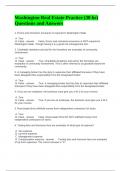
Washington Real Estate Practice (30 hr) Questions and Answers

Rating
-
Sold
-
Pages
17
Grade
A+
Uploaded on
14-05-2025
Written in
2024/2025

Washington Real Estate Practice (30 hr) Questions and Answers 1. Errors and omissions insurance is required in Washington State. A. True B. False False. Errors and omissions insurance is NOT required in Washington State. Though having it is a good risk management tool. 2. Charitable donations and aid for the homeless are examples of community involvement. A. True B. False True. Charitable donations and aid for the homeless are examples of community involvement. This is often referred to as goodwill toward the community. 3. A managing broker has the duty to supervise their affiliated licensees if they have been delegated this responsibility from the designated broker. A. True B. False True. A managing broker has the duty to supervise their affiliated licensees if they have been delegated this responsibility from the designated broker. 4. If you are an employee, the business must give you a W-2 for your income. A. True B. False True. If you are an employee, the business must give you a W-2 for your income. 5. Real estate firms withhold money from independent contractors for taxes. A. True B. False False. Real estate firms DO NOT withhold money from independent contractors for taxes. 6. Testing fees and licensure fees are examples of what type of expense? A. Tax expense B. Up-front expense C. Management expense D. Compensation expense Testing fees and licensure fees are examples of up-front expenses. The correct answer is "b". 7. Most home buyers and sellers start their real estate search on the internet. A. True B. False True. Most home buyers and sellers start their real estate search on the internet. 8. Which of the following items should be included in a transaction file? A. All documents pertaining to the transaction B. Earnest money deposit receipts C. Fax transmission journals D. All of the above All of the above items should be included in a transaction file. The correct answer is "d". 9. The IRS requires that each business expense be accompanied by__________________. A. A log signed by the designated broker B. A Form W-2 C. A receipt D. An affidavit signed by the DOL The IRS requires that each business expense be accompanied by a receipt.The correct answer is "c". 10. Which of the following are common "rookie" mistakes? A. Not making a business plan B. Not having a budget C. Not being familiar with common real estate forms D. All of the above All of the above are common "rookie" mistakes. The correct answer is "d". 1. A _____________________ is a person who has not established a relationship with a broker. A. client B. customer C. seller who just listed their property D. buyer who signed a buyer's broker agreement Correct answer is B.A customer is a person who has not established a relationship with a broker. The customer has not agreed to be represented, they have not signed an agency agreement. This is also called non-agency. 2. When a broker represents both a buyer and a seller in the same transaction, this is known as: A. Non-agency B. Dual agency C. Broker agency D. None of the above When a broker represents both a buyer and a seller in the same transaction, this is known as dual agency. The correct answer is "b". 3. A licensee has the duty to deal honestly and in good faith to: A. The client only B. The customer only C. Neither the customer nor the client D. Both the client and the customer A licensee has the duty to deal honestly and in good faith to both the client and the customer. The correct answer is "d". 4. What type of agency is established through the actions of the parties? A. An expressed Agency B. An implied agency C. A Universal agency D. None of the above The correct answer is "b".It is also possible to create an agency relationship by the actions of the parties. If a real estate broker takes on responsibilities that normally belong to a broker but hasn't signed an agency agreement, she may still be considered an agent via implied agency. By the same token, if the customer asks the agent for advice or actions that are normally those in agency, then an implied agency could be created. 5. Compensation for real estate services rendered does not automatically create a or an _________________________. A. client B. customer C. agency relationship D. none of the above Correct answer C. Compensation for real estate services rendered does not automatically create an agency relationship. The most common example of this is a buyer's broker who is representing the buyer solely and receiving the compensation from the seller. 6. A broker may take compensation through: A. Their designated broker only B. Directly from the seller C. Directly from the buyer D. Directly from the lender A broker may take compensation through their designated broker only. They cannot take compensation directly from the public, clients or a closing agent. The correct answer is "a". 7. A broker is not liable for a or an ______________________ of a subagent unless that broker participated in or agreed to authorize. A. error B. act C. ommission D. all of the above Correct answer D.A broker is not liable for an act, error, or omission of a subagent, unless that broker participated in or authorized the act, error or omission. This does not limit the liability of a firm for an act, error, or omission by a broker or licensed to the firm. 8. A broker was given notice of an event, but did not share this with his designated broker. Under the imputed knowledge and notice code: A. The designated broker is not liable for the notice B. The designated broker is liable for the notice C. The designated broker is never liable for the notice D. None of the above A broker was given notice of an event, but did not share this with his designated broker. Under the imputed knowledge and notice code, the designated broker is liable for the notice.The correct answer is "b". 9. Unlicensed assistants may _________________________. A. Show properties, answer questions, or interpret information about the property, price, or condition. B. Interpret information about listings, titles, financing, contracts, closing, or other information relating to a transaction. C. Transport people to properties and surrounding areas of interest. D. Fill in legal forms or negotiate price or terms. Correct answer C.Transport people to properties and surrounding areas of interest. While performing this duty, they may only provide answers that are on preprinted material prepared by a real estate licensee. 10. Real estate compensation can be based on a commission derived from the or a __________________. A. sales price B. flat fee C. dollar amount D. all of the above Real estate compensation is usually based on a commission derived from the sales price. However, compensation could be based on a flat fee, or dollar amount. 1. The two major components of a comparable market analysis (CMA) are: A. The site and the comparables B. The building plans and the comparables C. The as-built drawings and the comparables D. None of the above The two major components of a comparable market analysis (CMA) are the site and the comparables. The correct answer is "a". 2. Greater weight is given to the comparable properties that: A. Have had recent sales B. Have close proximity to the site C. Those which have similar amenities D. All of the above Greater weight is given to the comparable properties that have had recent sales, have close proximity to the site and those which have similar amenities. The correct answer is "d". 3. Adjustments for differences in comparables should be made to: A. The comparable B. The site C. Both the site and the comparable D. Adjustments are not allowed Adjustments for differences in comparable properties should be made to the comparable. The correct answer is "a". 4. Adjustments to the comparables should be used: A. Never B. For each comparable used if needed C. Only comparable with different square footage D. Only when the comparable has a yard created by a landscape architect Adjustments to the comparables should be used for each comparable used if needed. The correct answer is "b". 5. A broker will typically use a ________ to arrive at a value for the property A. Competitive markup analysis B. Competitive material analysis C. Comparative market analysis D. Comparative material analysis A broker will typically use a comparative market analysis (CMA) to arrive at a value for the property.The correct answer is "c". 6. The parties involved in determining price are usually the seller and: A. The closing agent B. Structural inspector C. The mortgage banker D. Their real estate broker The parties involved in determining price are usually the seller and their real estate broker. The correct answer is "d". 7. The amount that a buyer is willing to pay and a seller is willing to accept is known as _____________________________. A. Fair Market Value B. Price C. Net Value D. Purchase Price Correct answer A. The amount that a buyer is willing to pay and a seller is willing to accept is known as Fair Market Value. 8. An appraiser typically uses only sold properties with the ________________approach. A. cost B. bond C. reproduction D. sales comparison An appraiser typically uses only sold properties with the sale comparison approach. They do not use active listings, expired listings or pending listings. 9. With low supply and high demand, prices tend to: A. Rise B. Fall C. Remain stable D. None of the above With low supply and high demand, prices tend to rise. The correct answer is "a". 10. Which are examples of a loan type? A. ARM B. FHA, VA C. Conventional D. All of the above All of the above are examples of loan types. The correct answer is "d". 11. Zoning is controlled by _________________________. A. the appraiser B. the financial institution C. the government D. the title company Correct answer is C. Zoning is the government's control over the use of property. It makes it so only certain types of property are built in different areas. 1. Listing agreements are a contract with _____________________? A. the seller's broker B. the buyer's broker C. the listing designated broker (the firm) D. the buyer Correct answer is C. The listing agreement and the attached addenda are the contract between the brokerage and the seller. 2. Who other than the property owner can fill out the seller's property disclosure statement? A. seller's broker B. buyer's broker C. authorized representative D. a relative Correct answer C. The only person other than the seller that can fill out the seller disclosure statement is the legally authorized representative of the seller. 3. Who must sign the listing Agreement: A. A least one of the owners B. All of the owners and the listing agent(s) C. The designated broker D. The title company All of the owners and the listing agent(s) must sign the listing agreement. The correct answer is "b". 4. Commissions can be stated as: A. A percentage of the sales price B. A stated flat dollar amount C. Either of the above D. None of the above Commissions can be stated as a percentage of the sales price or as a stated flat dollar amount. The correct answer is "c". 5. __________________listings are illegal in the state of Washington. A. net listings B. open listings C. vest pocket listings D. exclusive sale listings Correct Answer A. Net listings are illegal in Washington. All listings must state the brokers compensation. This is not possible with a net listing which makes them illegal in Washington. 6. If a licensee transfers to another brokerage what happens to the listings of that broker? A. listings go with broker to new brokerage B. listings are cancelled with the seller C. the listing stays with the original brokerage D. Non of the above Correct answer C. If a licensee transfers to another brokerage, he or she CANNOT automatically take the listing to the new brokerage. All listing belong to the orignial brokerage. 7. A cancellation of a listing agreement:_______________________________. A. Usually need a designated broker's signature B. Always needs a designated broker's signature C. Never needs a designated broker's signature D. None of the above A cancellation of a listing agreement usually needs a designated broker's signature. It may be signed by a managing broker if they have been assigned those duties. The correct answer is "a". 8. SEPA stands for: A. State Environmental Policy Act B. State Ecology Policing Act C. State Ecology Protection Act SEPA stands for State Environmental Policy Act. The correct answer is "a". 9. The purpose of a sellers disclosure statement is: A. To disclose a material fact or defect about the property to a potential purchaser B. To disclose any environmental hazards to a potential purchaser C. To disclose any defects with the systems of the home D. All of the above The purpose of a sellers disclosure statement is to disclose a material fact or defect about the property to a potential purchaser, disclose any environmental hazards to a potential purchaser and disclose any defects with the systems of the home. The correct answer is "d". 10. Real estate commissions are negotiated between: A. The seller and their broker B. Set by the MLS C. Set by a group of local brokerages D. Set by state law Real estate commissions are negotiated between the seller and their broker. There is no "set" or "standard" rate. The correct answer is "a". 11. Who is entitled to initiate an action for payment under a listing agreement? A. Licensee B. Escrow agent C. Designated broker D. None of the above The designated broker is entitled to initiate an action for payment under a listing agreement.The correct answer is "c". 12. A transaction file should include: A. All document in the transaction B. Notes C. Closing statements D. All of the above A transaction file should include all documents, notes and closing statements. The correct answer is "d". 1. What steps should the broker take in helping the seller to prepare their property for sale? A. Commit to helping the seller paint the interior of the home. B. Require the seller to fix their leaking roof. C. Inform the seller of the best ways to present their home to the market. D. Always advise the seller to sell. Correct answer C. The first step taken by a licensee in marketing the property is to inform your seller's of the best way to present their home. Your clients should prepare their home as if they were in competition with a model home. 2. How does a marketing plan help the broker? A. It doesn't it helps the seller. B. The marketing plan is required by the DOL. C. The marketing plan helps the broker communicate with the seller on any changes needed to sell the property. D. The marketing plan helps the broker appraise the property. Correct answer C. The marketing plan aids in explaining the marketing process to a seller and allows them to know what to expect throughout the process. It also can be used as a checklist for you, as the listing broker, to ensure that nothing gets missed. 3. The broker must commit to spend a minimum ___________________. A. of 10% of the commission. B. of 20% of the commission. C. of 0 dollars. D. amount based on varying marketing methods, time on the market, and commitment to the seller.= Correct answer is D. The broker's marketing costs vary based on marketing methods chosen and time on the market. 4. The best way to hold an open house is _________________________. A. provide the sellers with open house signs B. invite neighbors and friends C. limit showings to qualified buyers only D. on the spur of the moment, put up open house signs= Correct answer is B. There are some reasons why you would want to invite neighbors. Firstly, if they like the neighborhood that they are living in, they may want to recommend the area to friends and family. Secondly, they may be interested in listing their own homes. 5. Price changes should be discussed ___________________________. A. at no time during the listing B. after the listing has expired C. only in the marketing plan D. at any time.= Correct answer is D. The marketing plan is important if for no other reason than it provides the broker an opportunity to engage in a meaningful dialogue with the seller regarding the pricing of their home. When you have done your duties for your principal, the seller, you will have established a benchmark for discussing pricing changes. 1. A deceased person who dies leaving a valid will is said to have died: A. Solvent B. Intestate C. Testate D. Insolvent= A deceased person who dies leaving a valid will is said to have d 1. When there is a client involved with a real estate broker, this usually implies agency. A. True B. False True. When there is a client involved with a real estate broker, this usually implies agency.

Show more Read less
Institution
WASHINGTON REAL ESTATE
Course
WASHINGTON REAL ESTATE


Whoops! We can’t load your doc right now. Try again or contact support.

Written for

Institution
WASHINGTON REAL ESTATE
Course
WASHINGTON REAL ESTATE

Document information

Uploaded on
May 14, 2025
Number of pages
17
Written in
2024/2025
Type
Exam (elaborations)
Contains
Questions & answers

Subjects

Content preview

Washington Real Estate Practice (30 hr)
Questions and Answers
1. Errors and omissions insurance is required in Washington State.

A. True
B. False - answer False. Errors and omissions insurance is NOT required in
Washington State. Though having it is a good risk management tool.

2. Charitable donations and aid for the homeless are examples of community
involvement.

A. True
B. False - answer True. Charitable donations and aid for the homeless are
examples of community involvement. This is often referred to as goodwill toward the
community.

3. A managing broker has the duty to supervise their affiliated licensees if they have
been delegated this responsibility from the designated broker.

A. True
B. False - answer True. A managing broker has the duty to supervise their affiliated
licensees if they have been delegated this responsibility from the designated broker.

4. If you are an employee, the business must give you a W-2 for your income.

A. True
B. False - answer True. If you are an employee, the business must give you a W-2
for your income.

5. Real estate firms withhold money from independent contractors for taxes.

A. True
B. False - answer False. Real estate firms DO NOT withhold money from
independent contractors for taxes.

6. Testing fees and licensure fees are examples of what type of expense?

A. Tax expense
B. Up-front expense
C. Management expense
D. Compensation expense - answer Testing fees and licensure fees are examples
of up-front expenses. The correct answer is "b".

,7. Most home buyers and sellers start their real estate search on the internet.

A. True
B. False - answer True. Most home buyers and sellers start their real estate search
on the internet.

8. Which of the following items should be included in a transaction file?

A. All documents pertaining to the transaction
B. Earnest money deposit receipts
C. Fax transmission journals
D. All of the above - answer All of the above items should be included in a
transaction file. The correct answer is "d".

9. The IRS requires that each business expense be accompanied
by__________________.

A. A log signed by the designated broker
B. A Form W-2
C. A receipt
D. An affidavit signed by the DOL - answer The IRS requires that each business
expense be accompanied by a receipt.The correct answer is "c".

10. Which of the following are common "rookie" mistakes?

A. Not making a business plan
B. Not having a budget
C. Not being familiar with common real estate forms
D. All of the above - answer All of the above are common "rookie" mistakes. The
correct answer is "d".

1. A _____________________ is a person who has not established a relationship with
a broker.

A. client
B. customer
C. seller who just listed their property
D. buyer who signed a buyer's broker agreement - answer Correct answer is B.A
customer is a person who has not established a relationship with a broker. The
customer has not agreed to be represented, they have not signed an agency
agreement. This is also called non-agency.

2. When a broker represents both a buyer and a seller in the same transaction, this is
known as:

, A. Non-agency
B. Dual agency
C. Broker agency
D. None of the above - answer When a broker represents both a buyer and a seller
in the same transaction, this is known as dual agency. The correct answer is "b".

3. A licensee has the duty to deal honestly and in good faith to:

A. The client only
B. The customer only
C. Neither the customer nor the client
D. Both the client and the customer - answer A licensee has the duty to deal
honestly and in good faith to both the client and the customer. The correct answer is "d".

4. What type of agency is established through the actions of the parties?

A. An expressed Agency
B. An implied agency
C. A Universal agency
D. None of the above - answer The correct answer is "b".It is also possible to create
an agency relationship by the actions of the parties. If a real estate broker takes on
responsibilities that normally belong to a broker but hasn't signed an agency agreement,
she may still be considered an agent via implied agency. By the same token, if the
customer asks the agent for advice or actions that are normally those in agency, then
an implied agency could be created.

5. Compensation for real estate services rendered does not automatically create a or an
_________________________.

A. client
B. customer
C. agency relationship
D. none of the above - answer Correct answer C. Compensation for real estate
services rendered does not automatically create an agency relationship. The most
common example of this is a buyer's broker who is representing the buyer solely and
receiving the compensation from the seller.

6. A broker may take compensation through:

A. Their designated broker only
B. Directly from the seller
C. Directly from the buyer
D. Directly from the lender - answer A broker may take compensation through their
designated broker only. They cannot take compensation directly from the public, clients
or a closing agent. The correct answer is "a".

Get to know the seller

Seller avatar
Reputation scores are based on the amount of documents a seller has sold for a fee and the reviews they have received for those documents. There are three levels: Bronze, Silver and Gold. The better the reputation, the more your can rely on the quality of the sellers work.
Pogba119 Harvard University
View profile
Follow You need to be logged in order to follow users or courses
Sold
48
Member since
1 year
Number of followers
2
Documents
4936
Last sold
1 month ago
NURSING TEST

BEST EDUCATIONAL RESOURCES FOR STUDENTS

3.9

9 reviews

5
4
4
2
3
2
2
0
1
1

Recently viewed by you

Why students choose Stuvia

Created by fellow students, verified by reviews

Quality you can trust: written by students who passed their tests and reviewed by others who've used these notes.

Didn't get what you expected? Choose another document

No worries! You can instantly pick a different document that better fits what you're looking for.

Pay as you like, start learning right away

No subscription, no commitments. Pay the way you're used to via credit card and download your PDF document instantly.

Student with book image

“Bought, downloaded, and aced it. It really can be that simple.”

Alisha Student

Frequently asked questions