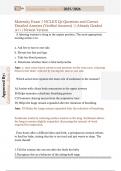
ATI Skills Module 3.0: Intravenous Medication Administration Pre/Post test| Exam Questions
and Answers| Latest Update Graded A+
A nurse is caring for a client who is receiving dextrose in 5% water with 20 mEq of potassium
chloride at 75 mL/hr. The provider has prescribed 1 g ceftriaxone IV. When preparing to
administer this medication by intermittent IV bolus, which of the following actions should the
nurse take first? Verify the medication's compatibility with the primary IV solution
A nurse is caring for a client who has a peripherally inserted central catheter (PICC) line. The
nurse should identify that which of the following information is true about this type of IV route?
A PICC line is a long catheter inserted through the veins of the antecubital fossa
A nurse is caring for a client who was admitted to the hospital for same day surgery and has a
new prescription for continuous IV therapy. Which of the following actions should the nurse
take when administering the IV therapy? Inspect the IV solution for fluid color, clarity, and
expiration date
A nurse is preparing to administer an IV medication to a client. The nurse should identify that
which of the following is a disadvantage of administering IV medications? IV medications are
irreversible
A nurse is caring for a client who is receiving 0.9% sodium chloride IV at 75 mL/hr through a
triple lumen central venous access device. The IV pump alarm sounds, indicating that there is
an occlusion. Which of the following actions should the nurse take first? Check the line at or
above the hub for kinked tubing that is creating a resistance to flow
A nurse is preparing to administer ceftriaxone 1 g in 100 mL IV over 30 min. The drip rate is 10
gtt/mL. The nurse should set the infusion rate to administer how many gtt/min? (Round the
answer to the nearest whole number. Use a leading zero if it applies. Do not use a trailing zero.)
33 gtt/min
and Answers| Latest Update Graded A+
A nurse is caring for a client who is receiving dextrose in 5% water with 20 mEq of potassium
chloride at 75 mL/hr. The provider has prescribed 1 g ceftriaxone IV. When preparing to
administer this medication by intermittent IV bolus, which of the following actions should the
nurse take first? Verify the medication's compatibility with the primary IV solution
A nurse is caring for a client who has a peripherally inserted central catheter (PICC) line. The
nurse should identify that which of the following information is true about this type of IV route?
A PICC line is a long catheter inserted through the veins of the antecubital fossa
A nurse is caring for a client who was admitted to the hospital for same day surgery and has a
new prescription for continuous IV therapy. Which of the following actions should the nurse
take when administering the IV therapy? Inspect the IV solution for fluid color, clarity, and
expiration date
A nurse is preparing to administer an IV medication to a client. The nurse should identify that
which of the following is a disadvantage of administering IV medications? IV medications are
irreversible
A nurse is caring for a client who is receiving 0.9% sodium chloride IV at 75 mL/hr through a
triple lumen central venous access device. The IV pump alarm sounds, indicating that there is
an occlusion. Which of the following actions should the nurse take first? Check the line at or
above the hub for kinked tubing that is creating a resistance to flow
A nurse is preparing to administer ceftriaxone 1 g in 100 mL IV over 30 min. The drip rate is 10
gtt/mL. The nurse should set the infusion rate to administer how many gtt/min? (Round the
answer to the nearest whole number. Use a leading zero if it applies. Do not use a trailing zero.)
33 gtt/min