BIO 101 Lab 1 Introduction to Science
Introduction to Science
Exercise 1: Data Interpretation
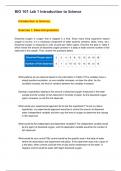
Dissolved oxygen is oxygen that is trapped in a fluid. Since many living organisms require
oxygen to survive, it is a necessary component of water systems (streams, lakes, rivers, etc.).
Dissolved oxygen is measured in units of parts per million (ppm). Examine the data in Table 4,
which shows the amount of dissolved oxygen present in a body of water and the number of fish
observed in the sample. Then, answer the questions below.
Dissolved Oxygen (ppm) 0 2 4 6 8 10 12 14 16 18
Number of Fish Observed 0 1 3 10 12 13 15 10 12 13
What patterns do you observe based on the information in Table 4? The variables have a
steady positive correlation, as one variable increases, so does the other. As the
variables increase, the level of variation between the variables increases.
Develop a hypothesis relating to the amount of dissolved oxygen measured in the water
sample and the number of fish observed in the body of water. As the dissolved oxygen
(ppm) increases, so will the fish observed.
What would your experimental approach be to test this hypothesis? To test my above
hypothesis, my experimental approach would be to control the amount of dissolved
water (independent variable) and then vary the level of oxygen to determine the change
in fish observed.
What would be the independent and dependent variables? The independent variable would
be the (ppm) of dissolved oxygen, and the dependent variable would be the number of
fish observed.
What would be your control? My control would be the specific area in the body of water
where the observation and experiment took place. If the experiment was over a span of-
a few days, other controls could be time of day and/or temperature of the water. A
negative control would be water with 0ppm dissolved oxygen
, Exercise 2: Testable Observations
Determine which of the observations below are testable. For those that are testable:
• Determine if the observation is qualitative or quantitative.
• Write a hypothesis and a null hypothesis.
• What would be your experimental approach?
• What are the dependent and independent variables?
• What are your controls - both positive and negative?
• How will you collect your data?
• How will you present your data (e.g., charts, graphs, types)?
• How will you analyze your data?
Observations
Scenario 1: A plant grows 3 cm faster per day when placed on a window sill than it does when
placed on a coffee table in the middle of the living room.
This observation is testable.
1. Determine if the observation is qualitative or quantitative
• The observation is quantitative.
2. Write a hypothesis and a null hypothesis.
• Hypothesis: The plant will grow faster when placed near light (on a windowsill than when
placed out of the sunlight (on a bookshelf in the middle of the living room).
• Null hypothesis: The plant will grow at the same speed regardless of the light
given/placement of the plant.
3. What is your experimental approach?
• The experimental approach we would take would be to plant an equal number of seeds
in three exact same pots. They would be treated the exact same (watered the same
amount, same room temperature), except one would be in the middle of the room on a
coffee table (no direct light), and one would be placed on a windowsill (near direct light)
and one would be placed in a dark room (i.e. a closet). We could then see if the
placement and light exposure influences the plant growth.
4. What are the dependent and independent variables?
• The independent variable is the placement of the plant; the dependent variable is the
inches of growth per plant.
5. What are your controls, both positive and negative?
• A positive control would be the plant in the light on the windowsill.
• A negative control would be the plant in the dark.
Introduction to Science
Exercise 1: Data Interpretation
Dissolved oxygen is oxygen that is trapped in a fluid. Since many living organisms require
oxygen to survive, it is a necessary component of water systems (streams, lakes, rivers, etc.).
Dissolved oxygen is measured in units of parts per million (ppm). Examine the data in Table 4,
which shows the amount of dissolved oxygen present in a body of water and the number of fish
observed in the sample. Then, answer the questions below.
Dissolved Oxygen (ppm) 0 2 4 6 8 10 12 14 16 18
Number of Fish Observed 0 1 3 10 12 13 15 10 12 13
What patterns do you observe based on the information in Table 4? The variables have a
steady positive correlation, as one variable increases, so does the other. As the
variables increase, the level of variation between the variables increases.
Develop a hypothesis relating to the amount of dissolved oxygen measured in the water
sample and the number of fish observed in the body of water. As the dissolved oxygen
(ppm) increases, so will the fish observed.
What would your experimental approach be to test this hypothesis? To test my above
hypothesis, my experimental approach would be to control the amount of dissolved
water (independent variable) and then vary the level of oxygen to determine the change
in fish observed.
What would be the independent and dependent variables? The independent variable would
be the (ppm) of dissolved oxygen, and the dependent variable would be the number of
fish observed.
What would be your control? My control would be the specific area in the body of water
where the observation and experiment took place. If the experiment was over a span of-
a few days, other controls could be time of day and/or temperature of the water. A
negative control would be water with 0ppm dissolved oxygen
, Exercise 2: Testable Observations
Determine which of the observations below are testable. For those that are testable:
• Determine if the observation is qualitative or quantitative.
• Write a hypothesis and a null hypothesis.
• What would be your experimental approach?
• What are the dependent and independent variables?
• What are your controls - both positive and negative?
• How will you collect your data?
• How will you present your data (e.g., charts, graphs, types)?
• How will you analyze your data?
Observations
Scenario 1: A plant grows 3 cm faster per day when placed on a window sill than it does when
placed on a coffee table in the middle of the living room.
This observation is testable.
1. Determine if the observation is qualitative or quantitative
• The observation is quantitative.
2. Write a hypothesis and a null hypothesis.
• Hypothesis: The plant will grow faster when placed near light (on a windowsill than when
placed out of the sunlight (on a bookshelf in the middle of the living room).
• Null hypothesis: The plant will grow at the same speed regardless of the light
given/placement of the plant.
3. What is your experimental approach?
• The experimental approach we would take would be to plant an equal number of seeds
in three exact same pots. They would be treated the exact same (watered the same
amount, same room temperature), except one would be in the middle of the room on a
coffee table (no direct light), and one would be placed on a windowsill (near direct light)
and one would be placed in a dark room (i.e. a closet). We could then see if the
placement and light exposure influences the plant growth.
4. What are the dependent and independent variables?
• The independent variable is the placement of the plant; the dependent variable is the
inches of growth per plant.
5. What are your controls, both positive and negative?
• A positive control would be the plant in the light on the windowsill.
• A negative control would be the plant in the dark.