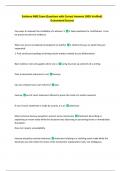
Evidence MBE Exam Questions with Correct Answers 100% Verified|
Guaranteed Success
Five ways to impeach the credibility of a witness: 5 5. Bad reputation for truthfulness. It can
be proven by extrinsic evidence
When are jurors considered incompetent to testify? 1. Before the jury on which they are
impaneled
2. Post verdict proceedings involving certain matters related to jury deliberations
Best evidence rule only applies when one is trying to prove up contents of a writing
Prior inconsistent statement is not hearsay
Can you impeach your own witness? yess
hearsay out of court statement offered to prove the truth of a matter asserted
If out of court statement is made by a party, it is an admission
Most common hearsay exception: present sense impression Statement describing or
explaining an event made while the declarant was observing or perceiving event or immediately
thereafter.
Does not require unavailability.
hearsay exception excited utterance statement relating to a startling event made while the
declarant was still under the stress of the excitement. Explanation mark, not ambiguous.
, statement concerning mental or physical condition ...
statement made for purposes of medical diagnosis or treatment (HS exception) An out of
court statement about the nature of an injury or medical condition made to medical personnel
is admissible but only if it relates to medical diagnosis or treatment.
business records (HS exceptions) admits into evidence records that are kept in the ordinary
course of business, the record must have been made by a person who has a duty to make the
record as part of his employment.
Declarant must have personal knowledge of fact stated in the record or the declarant must
have received the information from someone with personal knowledge who transmitted it in
the ordinary course of their business.
Former testimony (HS exception) 1. Witness must be unavailable at time of trial
dying declarations (HS exception) 1. Witness must be unavailable at time of trial
statement against interest (HS Exception) 1. Witness must be unavailable at time of trial
non-hearsay statements which are allowed in for the truth of the matter asserted but
requires that declarant be testifying at the trial or hearing and be subject to cross.
Example:
admissions
Prior sworn inconsistent statements
Prior consistent statements
Prior identifications
Guaranteed Success
Five ways to impeach the credibility of a witness: 5 5. Bad reputation for truthfulness. It can
be proven by extrinsic evidence
When are jurors considered incompetent to testify? 1. Before the jury on which they are
impaneled
2. Post verdict proceedings involving certain matters related to jury deliberations
Best evidence rule only applies when one is trying to prove up contents of a writing
Prior inconsistent statement is not hearsay
Can you impeach your own witness? yess
hearsay out of court statement offered to prove the truth of a matter asserted
If out of court statement is made by a party, it is an admission
Most common hearsay exception: present sense impression Statement describing or
explaining an event made while the declarant was observing or perceiving event or immediately
thereafter.
Does not require unavailability.
hearsay exception excited utterance statement relating to a startling event made while the
declarant was still under the stress of the excitement. Explanation mark, not ambiguous.
, statement concerning mental or physical condition ...
statement made for purposes of medical diagnosis or treatment (HS exception) An out of
court statement about the nature of an injury or medical condition made to medical personnel
is admissible but only if it relates to medical diagnosis or treatment.
business records (HS exceptions) admits into evidence records that are kept in the ordinary
course of business, the record must have been made by a person who has a duty to make the
record as part of his employment.
Declarant must have personal knowledge of fact stated in the record or the declarant must
have received the information from someone with personal knowledge who transmitted it in
the ordinary course of their business.
Former testimony (HS exception) 1. Witness must be unavailable at time of trial
dying declarations (HS exception) 1. Witness must be unavailable at time of trial
statement against interest (HS Exception) 1. Witness must be unavailable at time of trial
non-hearsay statements which are allowed in for the truth of the matter asserted but
requires that declarant be testifying at the trial or hearing and be subject to cross.
Example:
admissions
Prior sworn inconsistent statements
Prior consistent statements
Prior identifications