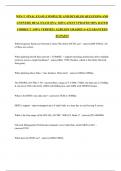
SCALED AGILE FRAMEWORK (SAFE)-LEADING SAFE
CERTIFICATION EXAM 2025 LATEST EXAM QUESTIONS AND
CORRECT ANSWERS AGRADE
SAFe Lean-Agile Principle #1 - Take an economic view - (ANSWER)highlights the key role of
economics in successful solution development. This article describes the primary aspects of
taking an economic view, delivering early and often, and understanding other economic trade-off
restrictions.
Economic framework decision rules - (ANSWER)a set of decision rules aligning everyone to
the mission and its financial constraints. That includes budget considerations driven by the
program portfolio, as well as trade-offs that affect a particular solution. In this context, portfolio
fiduciaries can delegate decision authority to others, knowing that those decisions will align with
the agreed-to economic guidelines.
Three elements of the primary purpose of the economic framework - (ANSWER)The primary
purpose of the economic framework is to support effective, fast decision-making within the
bounds of the larger economic picture. In turn, that requires three things: •An understanding of
the rules for decision-making; •The current local context; •Relevant decision-making authority
Epic Funding and Governance - (ANSWER)Empowered funding requires the parallel
responsibility to communicate any investments that are unexpected. This is the primary purpose
of the Portfolio Kanban System. Each epic requires a Lean business case and an explicit approval
process (see the Epic article and the Lean portfolio governance section of the Lean Portfolio
Management article).
Decentralized Economic Decision-Making - (ANSWER)Empowered funding requires the
parallel responsibility to communicate any investments that are unexpected. This is the primary
purpose of the Portfolio Kanban System. Each epic requires a Lean business case and an explicit
approval process (see the Epic article and the Lean portfolio governance section of the Lean
Portfolio Management article).
,Job Sequencing Based on Cost of Delay - (ANSWER)Every significant program has a host of
new backlog Features and Capabilities, just waiting to be implemented to increase the
effectiveness of the solution. But SAFe is a flow-based system, whose economics are optimized
by job-sequencing rather than theoretical job return on investment, or worse, first-come, first-
served job selection. Picking the right next job is where the greatest economic benefit lies.
Enabling Job Sequencing - (ANSWER)This is enabled by the Program and Solution Kanban
systems and the Program and Solution Backlog holding areas. Jobs are pulled into
implementation based on Weighted Shortest Job First (WSJF), using job size as the proxy for the
job duration.
Practices Provide the Form. People Make the Decisions - (ANSWER)Lean-Agile Leaders
continually apply these constructs and educate others in their use. This way, responsible
decision-making happens throughout the development organization, bringing the full economic
benefits of Lean-Agile development to the enterprise.
Agile Architecture - (ANSWER)Agile Architecture is a set of values and practices that support
the active evolution of the design and architecture of a system while implementing new system
capabilities
Agile Release Train (ART) - (ANSWER)The Agile Release Train (ART) is a long-lived team of
Agile teams, which, along with other stakeholders, develops and delivers solutions
incrementally, using a series of fixed-length Iterations within a Program Increment (PI) timebox.
The ART aligns teams to a common business and technology mission.
Agile Team - (ANSWER)The SAFe Agile Team is a cross-functional group of 5 to 10 people
who have the ability and authority to define, build, and test some element of Solution value—all
in a short Iteration timebox. Specifically, the SAFe Agile Team incorporates the DevTeam,
Scrum Master, and Product Owner roles.
Architectural Runway - (ANSWER)The Architectural Runway consists of the existing code,
components, and technical infrastructure needed to implement near-term features without
excessive redesign and delay.
, Built-In Quality - (ANSWER)Built-In Quality practices ensure that each Solution element, at
every increment, meets appropriate quality standards throughout development.
Business Owners - (ANSWER)Business Owners are a small group of stakeholders who have
the primary business and technical responsibility for governance, compliance, and return on
investment (ROI) for a Solution developed by an Agile Release Train (ART). They are key
stakeholders on the ART who must evaluate fitness for use and actively participate in certain
ART events.
CapEx and OpEx - (ANSWER)Capital Expenses (CapEx) and Operating Expenses (OpEx)
describe Lean-Agile financial accounting practices in a Value Stream budget. In some cases,
CapEx may include capitalized labor associated with the development of intangible assets—such
as software, intellectual property, and patents.
Capabilities - (ANSWER)A Capability is a higher-level solution behavior that typically spans
multiple ARTs. Capabilities are sized and split into multiple features to facilitate their
implementation in a single PI.
Communities of Practice (CoPs) - (ANSWER)Communities of Practice (CoPs) are organized
groups of people who have a common interest in a specific technical or business domain. They
collaborate regularly to share information, improve their skills, and actively work on advancing
the general knowledge of the domain.
Compliance - (ANSWER)Compliance refers to a strategy and a set of activities and artifacts
that allow teams to apply Lean-Agile development methods to build systems that have the
highest possible quality, while simultaneously assuring they meet any regulatory, industry, or
other relevant standards.
Continuous Delivery Pipeline - (ANSWER)The Continuous Delivery (CD) Pipeline (also
referred to as 'pipeline') represents the workflows, activities, and automation needed to provide a
continuous release of value to the end user.
CERTIFICATION EXAM 2025 LATEST EXAM QUESTIONS AND
CORRECT ANSWERS AGRADE
SAFe Lean-Agile Principle #1 - Take an economic view - (ANSWER)highlights the key role of
economics in successful solution development. This article describes the primary aspects of
taking an economic view, delivering early and often, and understanding other economic trade-off
restrictions.
Economic framework decision rules - (ANSWER)a set of decision rules aligning everyone to
the mission and its financial constraints. That includes budget considerations driven by the
program portfolio, as well as trade-offs that affect a particular solution. In this context, portfolio
fiduciaries can delegate decision authority to others, knowing that those decisions will align with
the agreed-to economic guidelines.
Three elements of the primary purpose of the economic framework - (ANSWER)The primary
purpose of the economic framework is to support effective, fast decision-making within the
bounds of the larger economic picture. In turn, that requires three things: •An understanding of
the rules for decision-making; •The current local context; •Relevant decision-making authority
Epic Funding and Governance - (ANSWER)Empowered funding requires the parallel
responsibility to communicate any investments that are unexpected. This is the primary purpose
of the Portfolio Kanban System. Each epic requires a Lean business case and an explicit approval
process (see the Epic article and the Lean portfolio governance section of the Lean Portfolio
Management article).
Decentralized Economic Decision-Making - (ANSWER)Empowered funding requires the
parallel responsibility to communicate any investments that are unexpected. This is the primary
purpose of the Portfolio Kanban System. Each epic requires a Lean business case and an explicit
approval process (see the Epic article and the Lean portfolio governance section of the Lean
Portfolio Management article).
,Job Sequencing Based on Cost of Delay - (ANSWER)Every significant program has a host of
new backlog Features and Capabilities, just waiting to be implemented to increase the
effectiveness of the solution. But SAFe is a flow-based system, whose economics are optimized
by job-sequencing rather than theoretical job return on investment, or worse, first-come, first-
served job selection. Picking the right next job is where the greatest economic benefit lies.
Enabling Job Sequencing - (ANSWER)This is enabled by the Program and Solution Kanban
systems and the Program and Solution Backlog holding areas. Jobs are pulled into
implementation based on Weighted Shortest Job First (WSJF), using job size as the proxy for the
job duration.
Practices Provide the Form. People Make the Decisions - (ANSWER)Lean-Agile Leaders
continually apply these constructs and educate others in their use. This way, responsible
decision-making happens throughout the development organization, bringing the full economic
benefits of Lean-Agile development to the enterprise.
Agile Architecture - (ANSWER)Agile Architecture is a set of values and practices that support
the active evolution of the design and architecture of a system while implementing new system
capabilities
Agile Release Train (ART) - (ANSWER)The Agile Release Train (ART) is a long-lived team of
Agile teams, which, along with other stakeholders, develops and delivers solutions
incrementally, using a series of fixed-length Iterations within a Program Increment (PI) timebox.
The ART aligns teams to a common business and technology mission.
Agile Team - (ANSWER)The SAFe Agile Team is a cross-functional group of 5 to 10 people
who have the ability and authority to define, build, and test some element of Solution value—all
in a short Iteration timebox. Specifically, the SAFe Agile Team incorporates the DevTeam,
Scrum Master, and Product Owner roles.
Architectural Runway - (ANSWER)The Architectural Runway consists of the existing code,
components, and technical infrastructure needed to implement near-term features without
excessive redesign and delay.
, Built-In Quality - (ANSWER)Built-In Quality practices ensure that each Solution element, at
every increment, meets appropriate quality standards throughout development.
Business Owners - (ANSWER)Business Owners are a small group of stakeholders who have
the primary business and technical responsibility for governance, compliance, and return on
investment (ROI) for a Solution developed by an Agile Release Train (ART). They are key
stakeholders on the ART who must evaluate fitness for use and actively participate in certain
ART events.
CapEx and OpEx - (ANSWER)Capital Expenses (CapEx) and Operating Expenses (OpEx)
describe Lean-Agile financial accounting practices in a Value Stream budget. In some cases,
CapEx may include capitalized labor associated with the development of intangible assets—such
as software, intellectual property, and patents.
Capabilities - (ANSWER)A Capability is a higher-level solution behavior that typically spans
multiple ARTs. Capabilities are sized and split into multiple features to facilitate their
implementation in a single PI.
Communities of Practice (CoPs) - (ANSWER)Communities of Practice (CoPs) are organized
groups of people who have a common interest in a specific technical or business domain. They
collaborate regularly to share information, improve their skills, and actively work on advancing
the general knowledge of the domain.
Compliance - (ANSWER)Compliance refers to a strategy and a set of activities and artifacts
that allow teams to apply Lean-Agile development methods to build systems that have the
highest possible quality, while simultaneously assuring they meet any regulatory, industry, or
other relevant standards.
Continuous Delivery Pipeline - (ANSWER)The Continuous Delivery (CD) Pipeline (also
referred to as 'pipeline') represents the workflows, activities, and automation needed to provide a
continuous release of value to the end user.