

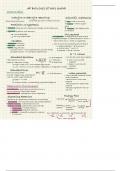
AP BIOLOGY STUDY GUIDE
Science skills
Inductive vs deductive reasoning Scientific statements
↓ ↓
Pattern based conclusions Using what you know to make conclusions ① clam =what is occurring
② evidence = data to support
Prediction vs hypothesis claim
&
Prediction: statement that something will happen @ end of experiment ③ reasoning =ties together claim
⑨
Hypothesis: prediction and reasoning and evidence
↳ Must be falsifiable Chi-squared
- can only support/reject & null hypothesis -no difference btwn observed and
acceptede if accepted, no relationship btw IV and D V
Variables
*
Below critical value = accept null hypothesis
*
Independent-changing Tests it results are impacted by external factors
&
& dependent = measured ↳ Degree of freedom = # of outcomes -I
*
Control-stays the same Critical value → use 0.0 5
↳ positive control = shows expected result of tested variable ↳ Expected = total #/ outcomes
- negative control = no change/no expected result
R^2 Values
Standard deviation n= # of categories ⑤ How far data varies from treadline
*
Helps determine outliers S=x- X= I data point
-
↳ lower= less accurate)
*
Ratio of 1 data point: average n 1 -
X= average mean confident
↳ High= wider curve - more variables effect results
↳ higher = more accurate
& Low = thinner- not much variation /dependent on independent variable
confident
↳ highest=1
Standard Error
*
Shows accuracy of data ' SE n= # of data points Water potential
& more SE - bigger range, small data set Way to describe movement of water
*
less SE- small range, big data set
- Graph = +/-2SE
·across membrane
more solute= lower water
↳ If there's overlap= no statistically significant difference potential
- more pressure= higher water
Responses to Environment potential
↳ pressure potential= force on
&
Innate behaviors- genetically controlled and occur w/ cell wall
out prior training ( flight, fight, freeze)
&
Learned behaviors - developed as a result of experience
Signaling Behaviors Energy Flow
*
Signaling-for reproductive success and survival fitness Individual -
> Population Community
- ]
&
aposematism- warning traits used to discourage predetation (species) (mult. species)
Batesian mimicry - looks harmful but isn't
&
~
Mulerian mimicry- looks harmful and is harmful biosphere - biome Ecosystem
4 Positive taxis = towards stimulus (planet) (aquatic, (living)
3 Negative taxis away from stimulus
terrestrial)
& kinesis = nonspecific movement in response
Sun --Producers 1 consumers + 2nd consumers + etc
to a stimulus & W - -
100 % ↓ 10 % 1 % 0 . 1 %
90 % heat or work
, Water cycle Nitrogen cycle
Transpiration from plants Nitrogen gas
- > -
Condensation dentrification Nitrogen fixation
>
-
- ↓
&
Evaporation
from oceans, Organic
Nitrates, nitrites
lakes, streams nitrogen
Precipitation &
& X
Surface runoff
Nitrification
(by bacteria)
↓
Ammonification
Ammonium &
Groundwater & -
Carbon Cycle Phosphorus Cycle
> Co 2 in atmosphere Trapped in ground Plants (used to
7
Burning fossil ↑ (as rocks) make DNA)
fuels Cellular respiration3( Photosynthesis I
(plants, algae, Cyanobacteria) ↑
Higher level V
consumers Animals eat the
Animals 2
M
2 plants (use to build
Decomposition Primary consumers 2 decompose
nuclei's acids)
·
W
Waste, death ~
Decomposers 4
Phosphates in soil
(soil microbes) 3 Detritus
v
Precipitated Phosphates in solution
[
phosphates
(solid)
Oligotrophic vs Eutrophic Bodies of Water
&
Olgiotrophie- low nutrient levels, good light penetration, high dissolved o2, deep, low algae growth
⑨
Eutrophic- high nutrient levels, poor light penetration, low dissolved o2, high algae growth
↳> When too much N, algea thrives, blocking sunlight so bottom of lakes die, releasing carbon into air
Species living in eutrophic adapt to needing less o2
↳Over the years, all lakes go from oligotrophic to eutrophic
Population Dynamics and Growth Rates
*
Factors that limit growth: predators, natural disasters, resources
*
Population distribution:
I
clumped-even distribution of resources, individuals clumped together
uniform- competing against one another for resources and space, organisms evenly spaced
↳ random-individuals don't interact wa one another; Unpredictable distribution
*
Carrying capacity- max number of individuals that can be sustained in a particular habitat due to a finite
amount of resources and space
Density dependent - food, water, mates, space, competition, predators, parasites
↳ Density independent- climate, natural disasters, sunlight
Types of Growth
1) environmental growth - no carrying capacity
2) logistical growth- population size limited by carrying capacity
↳ as population size inc, rate of reproduction dec
3) exponential growth- population has access to abundance of resources and mates
extrinsic factors Will eventually balance this out
↳ (ex: invasive species)
, &
R-selection- organisms exhibit high rates of reproduction and occur in variable environments in which
population densities fluctuate below K
↳ opportunistic species; exponential growth
#
K-selection - organisms live and reproduce around K and are sensitive to population density
↳ logistical growth
Community interactions
1) mutualism (+,+)
2) commensalism (+, 0)
7 Cost of competition
3) parasitism (+, -) &
Competitive exclusion principle - lose-lose situation
4) predation (+,-)
↳ when organisms compete one will outcompete the other
5) herbivory (+, -)
and one will go extinct; even for the winner, carrying
6) competition (-,-)
capacity will decrease
organisms only occupy 1 , niche &
Niche partitioning - when habitats overlap, diff species
to avoid comp. at all costs
play diff roles in environment - preventing CEP
3 ontogenetic niche partitioning - species changes its
niche during development ( tadpoles → frogs)
Keystone Species—Species that has a disproportionate effect on its community
& If a keystone species declines, its decline can have a negative effect on the rest of the community
↳ Ex: starfish are a predator that keep their environment from being overrun by zebra mussels and when they
are absent, zebra mussels outcompete other organisms
Ecological Succession -transition in species composition over time; sequence of community changes
after a disturbance
&
Primary sucession-begins in a lifeless area where soil has not formed might take thousands of years to form
smallest shrub; cont. Until reaching climax community
&
Secondary sucession- disturbance clears land but soil remains; takes decades to get back to original eosystem
Biodiversity
&
A measure of the number of different species in a defined area
- the more biodiversity in a system, the more likely it is to maintain its health and success in the face of
disruption N= number of organisms in all species
Diversity index = 1-G(2 n = number of organisms in a particular species
The Chemistry of Life
Periodic Table
*
6 elements are the building blocks of all molecules
1) carbon 4) sulfur
Most 2) nitrogen 5) phosphorus
electronegative 3) oxygen 6) hydrogen
& Trace elements- those required by organisms in minute quantities
⑨
Electronegativity- the affinity elements have for elections
↳the more electronegative an atom is the more strongly it pulls shared e- towards itself
Bond Types
1) covalent bond - sharing a pair of valence electrons btw 2 atoms
&very strong bond
&
Nonpolar covalent bond - atoms share e- equally
&
Polar covalent bond - one atom is more electronegative so they don't share e- equally
↳ Unequal sharing causes a partial + or - charge for each atom or molecule
Science skills
Inductive vs deductive reasoning Scientific statements
↓ ↓
Pattern based conclusions Using what you know to make conclusions ① clam =what is occurring
② evidence = data to support
Prediction vs hypothesis claim
&
Prediction: statement that something will happen @ end of experiment ③ reasoning =ties together claim
⑨
Hypothesis: prediction and reasoning and evidence
↳ Must be falsifiable Chi-squared
- can only support/reject & null hypothesis -no difference btwn observed and
acceptede if accepted, no relationship btw IV and D V
Variables
*
Below critical value = accept null hypothesis
*
Independent-changing Tests it results are impacted by external factors
&
& dependent = measured ↳ Degree of freedom = # of outcomes -I
*
Control-stays the same Critical value → use 0.0 5
↳ positive control = shows expected result of tested variable ↳ Expected = total #/ outcomes
- negative control = no change/no expected result
R^2 Values
Standard deviation n= # of categories ⑤ How far data varies from treadline
*
Helps determine outliers S=x- X= I data point
-
↳ lower= less accurate)
*
Ratio of 1 data point: average n 1 -
X= average mean confident
↳ High= wider curve - more variables effect results
↳ higher = more accurate
& Low = thinner- not much variation /dependent on independent variable
confident
↳ highest=1
Standard Error
*
Shows accuracy of data ' SE n= # of data points Water potential
& more SE - bigger range, small data set Way to describe movement of water
*
less SE- small range, big data set
- Graph = +/-2SE
·across membrane
more solute= lower water
↳ If there's overlap= no statistically significant difference potential
- more pressure= higher water
Responses to Environment potential
↳ pressure potential= force on
&
Innate behaviors- genetically controlled and occur w/ cell wall
out prior training ( flight, fight, freeze)
&
Learned behaviors - developed as a result of experience
Signaling Behaviors Energy Flow
*
Signaling-for reproductive success and survival fitness Individual -
> Population Community
- ]
&
aposematism- warning traits used to discourage predetation (species) (mult. species)
Batesian mimicry - looks harmful but isn't
&
~
Mulerian mimicry- looks harmful and is harmful biosphere - biome Ecosystem
4 Positive taxis = towards stimulus (planet) (aquatic, (living)
3 Negative taxis away from stimulus
terrestrial)
& kinesis = nonspecific movement in response
Sun --Producers 1 consumers + 2nd consumers + etc
to a stimulus & W - -
100 % ↓ 10 % 1 % 0 . 1 %
90 % heat or work
, Water cycle Nitrogen cycle
Transpiration from plants Nitrogen gas
- > -
Condensation dentrification Nitrogen fixation
>
-
- ↓
&
Evaporation
from oceans, Organic
Nitrates, nitrites
lakes, streams nitrogen
Precipitation &
& X
Surface runoff
Nitrification
(by bacteria)
↓
Ammonification
Ammonium &
Groundwater & -
Carbon Cycle Phosphorus Cycle
> Co 2 in atmosphere Trapped in ground Plants (used to
7
Burning fossil ↑ (as rocks) make DNA)
fuels Cellular respiration3( Photosynthesis I
(plants, algae, Cyanobacteria) ↑
Higher level V
consumers Animals eat the
Animals 2
M
2 plants (use to build
Decomposition Primary consumers 2 decompose
nuclei's acids)
·
W
Waste, death ~
Decomposers 4
Phosphates in soil
(soil microbes) 3 Detritus
v
Precipitated Phosphates in solution
[
phosphates
(solid)
Oligotrophic vs Eutrophic Bodies of Water
&
Olgiotrophie- low nutrient levels, good light penetration, high dissolved o2, deep, low algae growth
⑨
Eutrophic- high nutrient levels, poor light penetration, low dissolved o2, high algae growth
↳> When too much N, algea thrives, blocking sunlight so bottom of lakes die, releasing carbon into air
Species living in eutrophic adapt to needing less o2
↳Over the years, all lakes go from oligotrophic to eutrophic
Population Dynamics and Growth Rates
*
Factors that limit growth: predators, natural disasters, resources
*
Population distribution:
I
clumped-even distribution of resources, individuals clumped together
uniform- competing against one another for resources and space, organisms evenly spaced
↳ random-individuals don't interact wa one another; Unpredictable distribution
*
Carrying capacity- max number of individuals that can be sustained in a particular habitat due to a finite
amount of resources and space
Density dependent - food, water, mates, space, competition, predators, parasites
↳ Density independent- climate, natural disasters, sunlight
Types of Growth
1) environmental growth - no carrying capacity
2) logistical growth- population size limited by carrying capacity
↳ as population size inc, rate of reproduction dec
3) exponential growth- population has access to abundance of resources and mates
extrinsic factors Will eventually balance this out
↳ (ex: invasive species)
, &
R-selection- organisms exhibit high rates of reproduction and occur in variable environments in which
population densities fluctuate below K
↳ opportunistic species; exponential growth
#
K-selection - organisms live and reproduce around K and are sensitive to population density
↳ logistical growth
Community interactions
1) mutualism (+,+)
2) commensalism (+, 0)
7 Cost of competition
3) parasitism (+, -) &
Competitive exclusion principle - lose-lose situation
4) predation (+,-)
↳ when organisms compete one will outcompete the other
5) herbivory (+, -)
and one will go extinct; even for the winner, carrying
6) competition (-,-)
capacity will decrease
organisms only occupy 1 , niche &
Niche partitioning - when habitats overlap, diff species
to avoid comp. at all costs
play diff roles in environment - preventing CEP
3 ontogenetic niche partitioning - species changes its
niche during development ( tadpoles → frogs)
Keystone Species—Species that has a disproportionate effect on its community
& If a keystone species declines, its decline can have a negative effect on the rest of the community
↳ Ex: starfish are a predator that keep their environment from being overrun by zebra mussels and when they
are absent, zebra mussels outcompete other organisms
Ecological Succession -transition in species composition over time; sequence of community changes
after a disturbance
&
Primary sucession-begins in a lifeless area where soil has not formed might take thousands of years to form
smallest shrub; cont. Until reaching climax community
&
Secondary sucession- disturbance clears land but soil remains; takes decades to get back to original eosystem
Biodiversity
&
A measure of the number of different species in a defined area
- the more biodiversity in a system, the more likely it is to maintain its health and success in the face of
disruption N= number of organisms in all species
Diversity index = 1-G(2 n = number of organisms in a particular species
The Chemistry of Life
Periodic Table
*
6 elements are the building blocks of all molecules
1) carbon 4) sulfur
Most 2) nitrogen 5) phosphorus
electronegative 3) oxygen 6) hydrogen
& Trace elements- those required by organisms in minute quantities
⑨
Electronegativity- the affinity elements have for elections
↳the more electronegative an atom is the more strongly it pulls shared e- towards itself
Bond Types
1) covalent bond - sharing a pair of valence electrons btw 2 atoms
&very strong bond
&
Nonpolar covalent bond - atoms share e- equally
&
Polar covalent bond - one atom is more electronegative so they don't share e- equally
↳ Unequal sharing causes a partial + or - charge for each atom or molecule


