©THESTAR 2025 ALL RIGHTS RESERVED
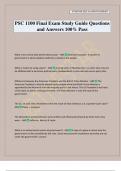
PSC 1100 Final Exam Study Guide Questions
and Answers 100% Pass
What is the central idea behind democracy? - ANS Rule by the people - A system of
government in which political authority is vested in the people
What is meant by swing voters? - ANS A swing voter or floating voter is a voter who may not
be affiliated with a particular political party (Independent) or who will vote across party lines
Difference between the American President and the British Prime Minister - ANS The
American President is directly elected by the people while the British Prime Minister is
appointed by the Monarch from the majority party in the House. The US President is the head
of the State as well as of the government. The Prime Minister is only the head of the
government.
The 13, 14, and 15th amendment were the result of what infamous U.S. Supreme Court Case? -
ANS Plessy v. Ferguson
The Declaration and Constitution were written and influenced primarily by three men; they
were: - ANS Jefferson, Morris, & Locke
What is an authoritarian system of government? - ANS A type of regime in which only the
government is fully controlled by the ruler. Social and economic institutions exist that are not
under the government's control
, ©THESTAR 2025 ALL RIGHTS RESERVED
The "necessary and proper clause" deals with what power? - ANS Intended to allow Congress
to decide whether, when and how to legislate for "carrying into execution" the powers of
another branch, and at the same time intended to respect and reinforce the principle of
separation of powers.
Concurrent powers means? - ANS Powers held jointly by the national and state governments
What is the difference between a parliamentary system of government and a presidential
system of government? - ANS The main difference between a parliamentary and presidential
system of government is that in a presidential system, the president is separate from the
legislative body, but in a parliamentary system, the chief executive, such as a prime minister, is
part of the legislative body, or parliament.
The definition of FEDERALISM we have adopted, memorized, embraced, and sanctioned, for the
purpose of this class is: - ANS Noncentralized system of government
The cornerstone of FEDERALISM is based on what amendment? - ANS 10th amendment
The fourteenth amendment contains two prudential clauses, they are: - ANS they are:
immunities clause and the due process clause
Andrew Jackson - ANS Democratic Party
Alexander Hamilton - ANS Federalist Party
Thomas Jefferson - ANS Democratic-Republican Party
Henry Clay - ANS Whig Party
PSC 1100 Final Exam Study Guide Questions
and Answers 100% Pass
What is the central idea behind democracy? - ANS Rule by the people - A system of
government in which political authority is vested in the people
What is meant by swing voters? - ANS A swing voter or floating voter is a voter who may not
be affiliated with a particular political party (Independent) or who will vote across party lines
Difference between the American President and the British Prime Minister - ANS The
American President is directly elected by the people while the British Prime Minister is
appointed by the Monarch from the majority party in the House. The US President is the head
of the State as well as of the government. The Prime Minister is only the head of the
government.
The 13, 14, and 15th amendment were the result of what infamous U.S. Supreme Court Case? -
ANS Plessy v. Ferguson
The Declaration and Constitution were written and influenced primarily by three men; they
were: - ANS Jefferson, Morris, & Locke
What is an authoritarian system of government? - ANS A type of regime in which only the
government is fully controlled by the ruler. Social and economic institutions exist that are not
under the government's control
, ©THESTAR 2025 ALL RIGHTS RESERVED
The "necessary and proper clause" deals with what power? - ANS Intended to allow Congress
to decide whether, when and how to legislate for "carrying into execution" the powers of
another branch, and at the same time intended to respect and reinforce the principle of
separation of powers.
Concurrent powers means? - ANS Powers held jointly by the national and state governments
What is the difference between a parliamentary system of government and a presidential
system of government? - ANS The main difference between a parliamentary and presidential
system of government is that in a presidential system, the president is separate from the
legislative body, but in a parliamentary system, the chief executive, such as a prime minister, is
part of the legislative body, or parliament.
The definition of FEDERALISM we have adopted, memorized, embraced, and sanctioned, for the
purpose of this class is: - ANS Noncentralized system of government
The cornerstone of FEDERALISM is based on what amendment? - ANS 10th amendment
The fourteenth amendment contains two prudential clauses, they are: - ANS they are:
immunities clause and the due process clause
Andrew Jackson - ANS Democratic Party
Alexander Hamilton - ANS Federalist Party
Thomas Jefferson - ANS Democratic-Republican Party
Henry Clay - ANS Whig Party