Different types of tests
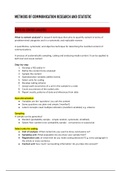
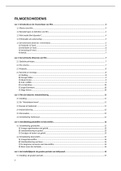
1. One-simple t-test
2. Chi-square test
3. Pearson Product Moment Correlation
4. Simple regression
5. Independent samples t-test
6. Paired samples t-test
7. Factor analysis
8. Reliability analysis
9. Multiple regression analysis
10. One-way ANOVA
One-sample t-test
- Goal: to check a hypothetical value of one variable.
- Hypotheses:
o H0 = The population mean is equal to (hypothetical value, based on sample mean)
o H1 = The population mean is not equal to (hypothetical value, based on sample
mean)
- How: Analyze > compare means > one-sample t-test > fill in a variable and a test-value
- Interpret:
o Mean difference: effect size, Cohen’s d (0.2 = small, 0.5 = medium, 0.8 = large).
o Standard deviation: squareroot of variance (average dispersion)
o Mean: average score
o Sig. (2-tailed): how big the chance is that this value was found if the null
hypothesis were true. If it is significant, the null hypothesis should be rejected. If
not, it should be retained
o 95% Confidence Interval of the Difference: interval compared to Test Value.
Always follow this formula: test-value + lower bound (the same for upper bound)
- Assumption: normal distributed data
- Additional notes: determine critical value in list of t-distribution (df = N – 1)
- Report: An one-simple t-test showed that the average level of [variable] is (not)
significantly lower/higher than [test-value] (M = . SD = ), t(df) = . p < or > or = , d =,
95% CI [ ]. We found support for the alternative hypothesis / we reject the null
, hypothesis / the null hypothesis is retained.
1. One-simple t-test
2. Chi-square test
3. Pearson Product Moment Correlation
4. Simple regression
5. Independent samples t-test
6. Paired samples t-test
7. Factor analysis
8. Reliability analysis
9. Multiple regression analysis
10. One-way ANOVA
One-sample t-test
- Goal: to check a hypothetical value of one variable.
- Hypotheses:
o H0 = The population mean is equal to (hypothetical value, based on sample mean)
o H1 = The population mean is not equal to (hypothetical value, based on sample
mean)
- How: Analyze > compare means > one-sample t-test > fill in a variable and a test-value
- Interpret:
o Mean difference: effect size, Cohen’s d (0.2 = small, 0.5 = medium, 0.8 = large).
o Standard deviation: squareroot of variance (average dispersion)
o Mean: average score
o Sig. (2-tailed): how big the chance is that this value was found if the null
hypothesis were true. If it is significant, the null hypothesis should be rejected. If
not, it should be retained
o 95% Confidence Interval of the Difference: interval compared to Test Value.
Always follow this formula: test-value + lower bound (the same for upper bound)
- Assumption: normal distributed data
- Additional notes: determine critical value in list of t-distribution (df = N – 1)
- Report: An one-simple t-test showed that the average level of [variable] is (not)
significantly lower/higher than [test-value] (M = . SD = ), t(df) = . p < or > or = , d =,
95% CI [ ]. We found support for the alternative hypothesis / we reject the null
, hypothesis / the null hypothesis is retained.