Lecture 1
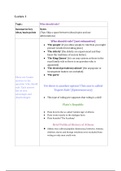
Topic: Who should rule?
Summarize key Notes
ideas/main points (Tips: Skip a space between ideas/topics and use
abbreviations)
Who should rule? [not exhaustive]
● ‘The people’ [if you allow people to rule than you might
prevent revolts from taking place]
● ‘The elderly’ [the elderly are experienced and they
know the traditions of society better]
● ‘The King/Queen’ [it is an easy system as those in the
royal family rule so there is no question who is
appointed]
● ‘The elected president/cabinet’ [the unpopular or
incompetent leaders are excluded]
● ‘The party’
There are 5 main
answers to the
question ‘who should
rule.’ Each answer
Yet there is another option! This one is called
has its own ‘Expert Rule’ [Epistemocracy]
advantages and
disadvantages. ● This type of ruling pre-supposes that ruling is a skill
Plato’s Republic
● Plato lived in the so-called ‘Golden Age’ of Athens
● Plato wrote mostly in the dialogue form
● Plato founded ‘The Academy’
Brief Political History of Athens
● Athens was a direct/popular democracy; however, women,
children, slaves and foreign residents were excluded from
voting so only men could vote
, ● Elections were held in which people were able to speak freely
and vote freely; however, there was still ‘vote buying’ and
other forms of unfair competition.
○ The Athenian [direct] democracy should not be
romanticized
● Athens also had a council that was comprised of 500 men who
took urgent decisions (e.g. going to war)
○ The people that were part of this council were chosen
by lot (Athens had 12 districts and people were
chosen from here by lot)
○ It was more difficult for the poorer people of society
to afford to take a year off work and devote their time
to working for this council so they received a small
subsidy
The Ship of State [Analogy]
It is possible to make ● 1. Democracy leads to dissensus
10 important claims ○ The principle of ‘adaptive preferences’ applies here
from the ‘Ship of State which means that if people have the opportunity to
Analogy’ rule then they will want to have power and have a say
in what they are doing
○ Value pluralism: the existence of incompatible or
conflicting values
● 2. Self rule generates overconfidence in each of us
● 3. Citizens do not have the knowledge/expertise
● 4. The masses deny the fact that political expertise is needed
in the first place
● 5. The people threaten to kill those who show superior
intellectual superiority
● 6. Everyone in society wants to rule and be in charge and this
leads to murderous conflict
● 7. The masses incite revolutions and they steal property
● 8. When the masses are in control there is too much fun and
work does not get done properly
● 9. Instead of stating rational arguments, politicians are likely
to use populism to appeal to the masses and get them on their
side
● 10. The ‘ordinary’ people of society believe that these
‘populist’ leaders are skilled even though they are not
,There are 4 main ● 1. When is someone qualified to lead and what kind of
theoretical problems qualifications would they need?
with ‘Epistemocracy’ ● 2. Who gets to decide what these qualifications are and who
monitors that these qualifications are actually being used?
● 3. The legitimacy problem is that even if criteria one and two
are met, this still does not mean that the political leaders will
be accepted by the masses
● 4. It is difficult to fully know and trust that a leader will rule
fairly
Aristotle’s Passage: “Sortition/Lottery”
● Aristotle is NOT a big fan of democracy and he alludes to the
idea in this passage that democracy is founded on an
illegitimate logic:
○ Elections were not held in the modern ‘democratic’
fashion of today but rather they were held by those in
the aristocracy [people with wealth/property]
● The modern democratic idea is different from the ancient
democratic idea
○ The MODERN democratic idea is that elections should
be held fairly
○ The ANCIENT democratic idea is that everyone should
be allowed to rule and participate politically [because
everyone is equal in absolute terms]
■ However, the problem with this is that it is
difficult to give everyone an equal say and
allow everyone to participate fairly and
therefore there is a lottery system in place
● Polity = city
There are several
problems with a Problems with ‘lottery/sortition’ [today]
system of ● 1. Because a system of lottery randomly selects people it can
‘lottery/sortition’ happen that the people that are selected are inexperienced
legislators
● 2. There is a statistical problem. The aim of a government is to
represent the population and if people are chosen by means
of sortition then it may happen that the assembly that has
been chosen does no represent the underlying population at
all
, What is Political Theory?
● Politics: involves more than one person, involves decision
making over collective ends and it is where power is
Topic: Who should rule?
Summarize key Notes
ideas/main points (Tips: Skip a space between ideas/topics and use
abbreviations)
Who should rule? [not exhaustive]
● ‘The people’ [if you allow people to rule than you might
prevent revolts from taking place]
● ‘The elderly’ [the elderly are experienced and they
know the traditions of society better]
● ‘The King/Queen’ [it is an easy system as those in the
royal family rule so there is no question who is
appointed]
● ‘The elected president/cabinet’ [the unpopular or
incompetent leaders are excluded]
● ‘The party’
There are 5 main
answers to the
question ‘who should
rule.’ Each answer
Yet there is another option! This one is called
has its own ‘Expert Rule’ [Epistemocracy]
advantages and
disadvantages. ● This type of ruling pre-supposes that ruling is a skill
Plato’s Republic
● Plato lived in the so-called ‘Golden Age’ of Athens
● Plato wrote mostly in the dialogue form
● Plato founded ‘The Academy’
Brief Political History of Athens
● Athens was a direct/popular democracy; however, women,
children, slaves and foreign residents were excluded from
voting so only men could vote
, ● Elections were held in which people were able to speak freely
and vote freely; however, there was still ‘vote buying’ and
other forms of unfair competition.
○ The Athenian [direct] democracy should not be
romanticized
● Athens also had a council that was comprised of 500 men who
took urgent decisions (e.g. going to war)
○ The people that were part of this council were chosen
by lot (Athens had 12 districts and people were
chosen from here by lot)
○ It was more difficult for the poorer people of society
to afford to take a year off work and devote their time
to working for this council so they received a small
subsidy
The Ship of State [Analogy]
It is possible to make ● 1. Democracy leads to dissensus
10 important claims ○ The principle of ‘adaptive preferences’ applies here
from the ‘Ship of State which means that if people have the opportunity to
Analogy’ rule then they will want to have power and have a say
in what they are doing
○ Value pluralism: the existence of incompatible or
conflicting values
● 2. Self rule generates overconfidence in each of us
● 3. Citizens do not have the knowledge/expertise
● 4. The masses deny the fact that political expertise is needed
in the first place
● 5. The people threaten to kill those who show superior
intellectual superiority
● 6. Everyone in society wants to rule and be in charge and this
leads to murderous conflict
● 7. The masses incite revolutions and they steal property
● 8. When the masses are in control there is too much fun and
work does not get done properly
● 9. Instead of stating rational arguments, politicians are likely
to use populism to appeal to the masses and get them on their
side
● 10. The ‘ordinary’ people of society believe that these
‘populist’ leaders are skilled even though they are not
,There are 4 main ● 1. When is someone qualified to lead and what kind of
theoretical problems qualifications would they need?
with ‘Epistemocracy’ ● 2. Who gets to decide what these qualifications are and who
monitors that these qualifications are actually being used?
● 3. The legitimacy problem is that even if criteria one and two
are met, this still does not mean that the political leaders will
be accepted by the masses
● 4. It is difficult to fully know and trust that a leader will rule
fairly
Aristotle’s Passage: “Sortition/Lottery”
● Aristotle is NOT a big fan of democracy and he alludes to the
idea in this passage that democracy is founded on an
illegitimate logic:
○ Elections were not held in the modern ‘democratic’
fashion of today but rather they were held by those in
the aristocracy [people with wealth/property]
● The modern democratic idea is different from the ancient
democratic idea
○ The MODERN democratic idea is that elections should
be held fairly
○ The ANCIENT democratic idea is that everyone should
be allowed to rule and participate politically [because
everyone is equal in absolute terms]
■ However, the problem with this is that it is
difficult to give everyone an equal say and
allow everyone to participate fairly and
therefore there is a lottery system in place
● Polity = city
There are several
problems with a Problems with ‘lottery/sortition’ [today]
system of ● 1. Because a system of lottery randomly selects people it can
‘lottery/sortition’ happen that the people that are selected are inexperienced
legislators
● 2. There is a statistical problem. The aim of a government is to
represent the population and if people are chosen by means
of sortition then it may happen that the assembly that has
been chosen does no represent the underlying population at
all
, What is Political Theory?
● Politics: involves more than one person, involves decision
making over collective ends and it is where power is