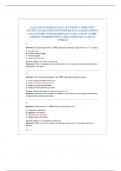
,AED3701 Assignment 2 2025 (Unique Number:
761142) ;100 % TRUSTED workings, Expert Solved,
Explanations and Solutions.
Assured excellence
QUESTION 1 [10 marks] 1.1 1.2 What is the primary purpose
of assessment planning? A) To give learners homework B) C)
D) To prepare report cards To improve teaching and learning
processes To promote learners to the next grade The National
Protocol for Assessment (NPA) Grades R–12 standardises
which of the following? A) B) C) D) School times Curriculum
content Recording and reporting processes Textbook distribution
4 AED3701/ASS02/2025 5 1.3 According to the NPPPPR,
assessments must be aligned with _____. A) learners' interests
B) grade and subject-specific requirements C) extracurricular
activities D) daily homework tasks 1.4 What are the four steps in
the assessment process, as per the Section 4 policy? A)
Planning, teaching, learning, grading B) Generating evidence,
evaluating evidence, recording findings, using information C)
Studying, revising, taking tests, receiving feedback D) Setting
tests, marking, grading, and reporting 1.5 Which of the
following is an example of an assessment instrument? A)
Textbook B) Lesson plan C) Rubric D) Red pen 1.6 The Policy
on Screening, Identification, Assessment, and Support (SIAS)
helps in _____. A) developing teaching material B) managing
learners' personal issues C) screening and supporting learners
with disabilities D) assigning school tasks 1.7 Diagnostic
assessment results are used to _____. A) improve report card
grades B) identify barriers to learning C) change the school
curriculum AED3701/ASS02/2025 6 D) test the teacher’s
knowledge 1.8 The principle of sufficiency in assessments
ensures that _____. A) the test includes enough content from the
, syllabus B) all learners receive extra time C) the test is difficult
enough to challenge learners D) only the best learners are
assessed 1.9 Moderation of assessments ensures that _____. A)
assessments are reviewed for fairness, validity, and reliability B)
assessments are not too easy C) learners are given extra credit
D) assessments are conducted in groups 1.10 The role of ICT in
assessment includes _____. A) allowing learners to take breaks
during assessments B) providing digital tools to create, submit,
and receive feedback on assessments C) replacing traditional
teaching methods D) limiting teacher-learner interaction (10)
QUESTION 1 [10 marks]:
1.1 What is the primary purpose of assessment planning?
C) To improve teaching and learning processes
1.2 The National Protocol for Assessment (NPA) Grades R–12
standardises which of the following?
C) Recording and reporting processes
1.3 According to the NPPPPR, assessments must be aligned
with _____.
B) Grade and subject-specific requirements
1.4 What are the four steps in the assessment process, as per the
Section 4 policy?
B) Generating evidence, evaluating evidence, recording
findings, using information
1.5 Which of the following is an example of an assessment
instrument?
C) Rubric
761142) ;100 % TRUSTED workings, Expert Solved,
Explanations and Solutions.
Assured excellence
QUESTION 1 [10 marks] 1.1 1.2 What is the primary purpose
of assessment planning? A) To give learners homework B) C)
D) To prepare report cards To improve teaching and learning
processes To promote learners to the next grade The National
Protocol for Assessment (NPA) Grades R–12 standardises
which of the following? A) B) C) D) School times Curriculum
content Recording and reporting processes Textbook distribution
4 AED3701/ASS02/2025 5 1.3 According to the NPPPPR,
assessments must be aligned with _____. A) learners' interests
B) grade and subject-specific requirements C) extracurricular
activities D) daily homework tasks 1.4 What are the four steps in
the assessment process, as per the Section 4 policy? A)
Planning, teaching, learning, grading B) Generating evidence,
evaluating evidence, recording findings, using information C)
Studying, revising, taking tests, receiving feedback D) Setting
tests, marking, grading, and reporting 1.5 Which of the
following is an example of an assessment instrument? A)
Textbook B) Lesson plan C) Rubric D) Red pen 1.6 The Policy
on Screening, Identification, Assessment, and Support (SIAS)
helps in _____. A) developing teaching material B) managing
learners' personal issues C) screening and supporting learners
with disabilities D) assigning school tasks 1.7 Diagnostic
assessment results are used to _____. A) improve report card
grades B) identify barriers to learning C) change the school
curriculum AED3701/ASS02/2025 6 D) test the teacher’s
knowledge 1.8 The principle of sufficiency in assessments
ensures that _____. A) the test includes enough content from the
, syllabus B) all learners receive extra time C) the test is difficult
enough to challenge learners D) only the best learners are
assessed 1.9 Moderation of assessments ensures that _____. A)
assessments are reviewed for fairness, validity, and reliability B)
assessments are not too easy C) learners are given extra credit
D) assessments are conducted in groups 1.10 The role of ICT in
assessment includes _____. A) allowing learners to take breaks
during assessments B) providing digital tools to create, submit,
and receive feedback on assessments C) replacing traditional
teaching methods D) limiting teacher-learner interaction (10)
QUESTION 1 [10 marks]:
1.1 What is the primary purpose of assessment planning?
C) To improve teaching and learning processes
1.2 The National Protocol for Assessment (NPA) Grades R–12
standardises which of the following?
C) Recording and reporting processes
1.3 According to the NPPPPR, assessments must be aligned
with _____.
B) Grade and subject-specific requirements
1.4 What are the four steps in the assessment process, as per the
Section 4 policy?
B) Generating evidence, evaluating evidence, recording
findings, using information
1.5 Which of the following is an example of an assessment
instrument?
C) Rubric