
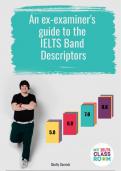
An ex-examiner's
guide to the
IELTS Band
Descriptors
Shelly Cornick
, An Ex-Examiner's Guide to the IELTS Band Descriptors: Contents
Table Of Contents
Introduction 3
What are the band descriptors? 6
IELTS tests two di erent types of skills 7
The Public Band Descriptors 8
Task Response 10
Not addressing the question fully 11
Not having a clear and consistent position 14
Not extending ideas enough 15
Using fake statistics as an example 16
Over-generalising 18
5 Most Common Task Response Errors: Summary 20
Coherence and Cohesion 23
No clear topic sentence in a paragraph 24
Poor use of transition signals 26
Poor progression in a paragraph 28
Unclear referencing 30
Parts of the essay cannot be understood 31
Top 5 IELTS Coherence & Cohesion Errors: Summary 32
Lexical Resource 35
www.myieltsclassroom.com
Page 2
, Introduction: An Ex-Examiner's Guide to the IELTS Band Descriptors
The Five Most Common Lexical Resource Errors 37
Poor paraphrasing/Over-paraphrasing 37
Focusing on one word instead of collocations 38
Dependent prepositions 39
Changing transition signals/opinion language 40
Spelling Errors 41
Top 5 Lexical Resource Errors: Summary 43
Grammatical Range and Accuracy 46
No evidence of C1+ sentence structures 49
Not having a wide enough range of sentences 51
Not enough error-free sentences 53
Having sentences that contain too many clauses 58
Poor punctuation 59
Top 5 Grammatical Range & Accuracy Errors: Summary 62
Final Advice 63
My IELTS Classroom 64
Introduction
Hey! The amount of information available online about IELTS has exploded in recent years.
When I started making the lessons for My IELTS Classroom back in 2015, there were only a
handful of IELTS teachers with YouTube channels and websites, but now there are literally
thousands. But, with everybody online claiming that they are an IELTS “expert”, how can you
tell the good lessons from the bad?
As an ex-IELTS examiner, I see materials posted on Facebook and YouTube every day that
would do more to damage a student’s score than improve it. I can tell in an instant if a
teacher has genuine experience preparing students for the exam, or if they are simply
trying to cash in on the fact that IELTS is so life-changing that students are often desperate
to pass.
www.myieltsclassroom.com
Page 3
, Introduction: An Ex-Examiner's Guide to the IELTS Band Descriptors
Worse, much of the information online seems to contradict itself, which leaves students
asking the same questions again and again:
Where do I need to put my opinion in a Discuss Both Sides essay? In every part of the
essay
Do I need to cover the other view in an agree/disagree essay? Only if you want more
than a 7.0
Can I use fake statistics in my example? No!
How many ideas do I need in my paragraphs? It depends on the question
Can I start a sentence with “Firstly”? Of course you can!
If you are a student who feels constantly confused by all this information, then I want you to
know that you are not alone. I have got a Master of Applied Linguistics and have been
teaching English for almost 20 years and even I'm confused! So, let's make something very
clear from the beginning of this book:
There is no "right" way to write an IELTS essay
I am serious. When you become an examiner, you are not given a magic piece of paper with
all of the “expected” organisation for every essay. You are not told the “right” way to write
an introduction, or the “wrong” way to conclude an essay. And you are de nitely not told
which transition signals are “good” and “bad”.
What you learn at examiner training
This might come as a surprise but all you are taught at examiner training is how to do ONE
thing and ONE thing only:
To apply the IELTS band descriptors correctly
www.myieltsclassroom.com
Page 4
guide to the
IELTS Band
Descriptors
Shelly Cornick
, An Ex-Examiner's Guide to the IELTS Band Descriptors: Contents
Table Of Contents
Introduction 3
What are the band descriptors? 6
IELTS tests two di erent types of skills 7
The Public Band Descriptors 8
Task Response 10
Not addressing the question fully 11
Not having a clear and consistent position 14
Not extending ideas enough 15
Using fake statistics as an example 16
Over-generalising 18
5 Most Common Task Response Errors: Summary 20
Coherence and Cohesion 23
No clear topic sentence in a paragraph 24
Poor use of transition signals 26
Poor progression in a paragraph 28
Unclear referencing 30
Parts of the essay cannot be understood 31
Top 5 IELTS Coherence & Cohesion Errors: Summary 32
Lexical Resource 35
www.myieltsclassroom.com
Page 2
, Introduction: An Ex-Examiner's Guide to the IELTS Band Descriptors
The Five Most Common Lexical Resource Errors 37
Poor paraphrasing/Over-paraphrasing 37
Focusing on one word instead of collocations 38
Dependent prepositions 39
Changing transition signals/opinion language 40
Spelling Errors 41
Top 5 Lexical Resource Errors: Summary 43
Grammatical Range and Accuracy 46
No evidence of C1+ sentence structures 49
Not having a wide enough range of sentences 51
Not enough error-free sentences 53
Having sentences that contain too many clauses 58
Poor punctuation 59
Top 5 Grammatical Range & Accuracy Errors: Summary 62
Final Advice 63
My IELTS Classroom 64
Introduction
Hey! The amount of information available online about IELTS has exploded in recent years.
When I started making the lessons for My IELTS Classroom back in 2015, there were only a
handful of IELTS teachers with YouTube channels and websites, but now there are literally
thousands. But, with everybody online claiming that they are an IELTS “expert”, how can you
tell the good lessons from the bad?
As an ex-IELTS examiner, I see materials posted on Facebook and YouTube every day that
would do more to damage a student’s score than improve it. I can tell in an instant if a
teacher has genuine experience preparing students for the exam, or if they are simply
trying to cash in on the fact that IELTS is so life-changing that students are often desperate
to pass.
www.myieltsclassroom.com
Page 3
, Introduction: An Ex-Examiner's Guide to the IELTS Band Descriptors
Worse, much of the information online seems to contradict itself, which leaves students
asking the same questions again and again:
Where do I need to put my opinion in a Discuss Both Sides essay? In every part of the
essay
Do I need to cover the other view in an agree/disagree essay? Only if you want more
than a 7.0
Can I use fake statistics in my example? No!
How many ideas do I need in my paragraphs? It depends on the question
Can I start a sentence with “Firstly”? Of course you can!
If you are a student who feels constantly confused by all this information, then I want you to
know that you are not alone. I have got a Master of Applied Linguistics and have been
teaching English for almost 20 years and even I'm confused! So, let's make something very
clear from the beginning of this book:
There is no "right" way to write an IELTS essay
I am serious. When you become an examiner, you are not given a magic piece of paper with
all of the “expected” organisation for every essay. You are not told the “right” way to write
an introduction, or the “wrong” way to conclude an essay. And you are de nitely not told
which transition signals are “good” and “bad”.
What you learn at examiner training
This might come as a surprise but all you are taught at examiner training is how to do ONE
thing and ONE thing only:
To apply the IELTS band descriptors correctly
www.myieltsclassroom.com
Page 4


