

WRITE ME AT
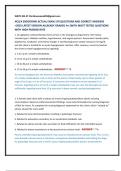
NCLEX ENDOCRINE ACTUAL EXAM 170 QUESTIONS AND CORRECT ANSWERS
=2025 LATEST VERSION ALLREADY GRADED A+ [WITH MOST TESTED QUESTIONS
WITH HIGH PASSING RATE
1. An agitated, confused female client arrives in the emergency department. Her history
includes type 1 diabetes mellitus, hypertension, and angina pectoris. Assessment reveals pallor,
diaphoresis, headache, and intense hunger. A stat blood glucose sample measures 42 mg/dl,
and the client is treated for an acute hypoglycemic reaction. After recovery, nurse Lily teaches
the client to treat hypoglycemia by ingesting:
a. 2 to 5 g of a simple carbohydrate.
b. 10 to 15 g of a simple carbohydrate.
c. 18 to 20 g of a simple carbohydrate.
d. 25 to 30 g of a simple carbohydrate. - ANSWER****B.
To reverse hypoglycemia, the American Diabetes Association recommends ingesting 10 to 15 g
of a simple carbohydrate, such as three to five pieces of hard candy, two to three packets of
sugar (4 to 6 tsp), or 4 oz of fruit juice. If necessary, this treatment can be repeated in 15
minutes. Ingesting only 2 to 5 g of a simple carbohydrate may not raise the blood glucose level
sufficiently. Ingesting more than 15 g may raise it above normal, causing hyperglycemia.
2. A female adult client with a history of chronic hyperparathyroidism admits to being
noncompliant. Based on initial assessment findings, nurse Julia formulates the nursing diagnosis
of Risk for injury. To complete the nursing diagnosis statement for this client, which "related-to"
phrase should the nurse add?
a. Related to bone demineralization resulting in pathologic fractures
b. Related to exhaustion secondary to an accelerated metabolic rate
c. Related to edema and dry skin secondary to fluid infiltration into the interstitial spaces
d. Related to tetany secondary to a decreased serum calcium level - ANSWER****A.
Poorly controlled hyperparathyroidism may cause an elevated serum calcium level. This, in turn,
may diminish calcium stores in the bone, causing bone demineralization and setting the stage
for pathologic fractures and a risk for injury. Hyperparathyroidism doesn't accelerate the
,metabolic rate. A decreased thyroid hormone level, not an increased parathyroid hormone
level, may cause edema and dry skin secondary to fluid infiltration into the interstitial spaces.
Hyperparathyroidism causes hypercalcemia, not hypocalcemia; therefore, it isn't associated
with tetany.
3. Nurse John is assigned to care for a postoperative male client who has diabetes mellitus.
During the assessment interview, the client reports that he's impotent and says he's concerned
about its effect on his marriage. In planning this client's care, the most appropriate intervention
would be to:
a. Encourage the client to ask questions about personal sexuality.
b. Provide time for privacy.
c. Provide support for the spouse or significant other.
d. Suggest referral to a sex counselor or other appropriate professional. - ANSWER****D.
The nurse should refer this client to a sex counselor or other professional. Making appropriate
referrals is a valid part of planning the client's care. The nurse doesn't normally provide sex
counseling.
4. During a class on exercise for diabetic clients, a female client asks the nurse educator how
often to exercise. The nurse educator advises the clients to exercise how often to meet the goals
of planned exercise?
a. At least once a week
b. At least three times a week
c. At least five times a week
d. Every day - ANSWER****B.
Diabetic clients must exercise at least three times a week to meet the goals of planned exercise
— lowering the blood glucose level, reducing or maintaining the proper weight, increasing the
serum high-density lipoprotein level, decreasing serum triglyceride levels, reducing blood
pressure, and minimizing stress. Exercising once a week wouldn't achieve these goals. Exercising
more than three times a week, although beneficial, would exceed the minimum requirement.
,5. Nurse Oliver should expect a client with hypothyroidism to report which health concerns?
a. Increased appetite and weight loss
b. Puffiness of the face and hands
c. Nervousness and tremors
d. Thyroid gland swelling - ANSWER****B.
Hypothyroidism (myxedema) causes facial puffiness, extremity edema, and weight gain. Signs
and symptoms of hyperthyroidism (Graves' disease) include an increased appetite, weight loss,
nervousness, tremors, and thyroid gland enlargement (goiter).
6. A female client with hypothyroidism (myxedema) is receiving levothyroxine (Synthroid), 25
mcg P.O. daily. Which finding should nurse Hans recognize as an adverse drug effect?
a. Dysuria
b. Leg cramps
c. Tachycardia
d. Blurred vision - ANSWER****C.
Levothyroxine, a synthetic thyroid hormone, is given to a client with hypothyroidism to simulate
the effects of thyroxine. Adverse effects of this agent include tachycardia. The other options
aren't associated with levothyroxine.
7. A 67-year-old male client has been complaining of sleeping more, increased urination,
anorexia, weakness, irritability, depression, and bone pain that interferes with her going
outdoors. Based on these assessment findings, nurse Richard would suspect which of the
following disorders?
a. Diabetes mellitus
b. Diabetes insipidus
c. Hypoparathyroidism
d. Hyperparathyroidism - ANSWER****D.
, Hyperparathyroidism is most common in older women and is characterized by bone pain and
weakness from excess parathyroid hormone (PTH). Clients also exhibit hypercaliuria-causing
polyuria. While clients with diabetes mellitus and diabetes insipidus also have polyuria, they
don't have bone pain and increased sleeping. Hypoparathyroidism is characterized by urinary
frequency rather than polyuria.
8. When caring for a male client with diabetes insipidus, nurse Juliet expects to administer:
a. vasopressin (Pitressin Synthetic).
b. furosemide (Lasix).
c. regular insulin.
d. 10% dextrose. - ANSWER****A.
Because diabetes insipidus results from decreased antidiuretic hormone (vasopressin)
production, the nurse should expect to administer synthetic vasopressin for hormone
replacement therapy. Furosemide, a diuretic, is contraindicated because a client with diabetes
insipidus experiences polyuria. Insulin and dextrose are used to treat diabetes mellitus and its
complications, not diabetes insipidus.
9. The nurse is aware that the following is the most common cause of hyperaldosteronism?
a. Excessive sodium intake
b. A pituitary adenoma
c. Deficient potassium intake
d. An adrenal adenoma - ANSWER****D.
An autonomous aldosterone-producing adenoma is the most common cause of
hyperaldosteronism. Hyperplasia is the second most frequent cause. Aldosterone secretion is
independent of sodium and potassium intake as well as of pituitary stimulation.
10. A male client with type 1 diabetes mellitus has a highly elevated glycosylated hemoglobin
(Hb) test result. In discussing the result with the client, nurse Sharmaine would be most
accurate in stating:
NCLEX ENDOCRINE ACTUAL EXAM 170 QUESTIONS AND CORRECT ANSWERS
=2025 LATEST VERSION ALLREADY GRADED A+ [WITH MOST TESTED QUESTIONS
WITH HIGH PASSING RATE
1. An agitated, confused female client arrives in the emergency department. Her history
includes type 1 diabetes mellitus, hypertension, and angina pectoris. Assessment reveals pallor,
diaphoresis, headache, and intense hunger. A stat blood glucose sample measures 42 mg/dl,
and the client is treated for an acute hypoglycemic reaction. After recovery, nurse Lily teaches
the client to treat hypoglycemia by ingesting:
a. 2 to 5 g of a simple carbohydrate.
b. 10 to 15 g of a simple carbohydrate.
c. 18 to 20 g of a simple carbohydrate.
d. 25 to 30 g of a simple carbohydrate. - ANSWER****B.
To reverse hypoglycemia, the American Diabetes Association recommends ingesting 10 to 15 g
of a simple carbohydrate, such as three to five pieces of hard candy, two to three packets of
sugar (4 to 6 tsp), or 4 oz of fruit juice. If necessary, this treatment can be repeated in 15
minutes. Ingesting only 2 to 5 g of a simple carbohydrate may not raise the blood glucose level
sufficiently. Ingesting more than 15 g may raise it above normal, causing hyperglycemia.
2. A female adult client with a history of chronic hyperparathyroidism admits to being
noncompliant. Based on initial assessment findings, nurse Julia formulates the nursing diagnosis
of Risk for injury. To complete the nursing diagnosis statement for this client, which "related-to"
phrase should the nurse add?
a. Related to bone demineralization resulting in pathologic fractures
b. Related to exhaustion secondary to an accelerated metabolic rate
c. Related to edema and dry skin secondary to fluid infiltration into the interstitial spaces
d. Related to tetany secondary to a decreased serum calcium level - ANSWER****A.
Poorly controlled hyperparathyroidism may cause an elevated serum calcium level. This, in turn,
may diminish calcium stores in the bone, causing bone demineralization and setting the stage
for pathologic fractures and a risk for injury. Hyperparathyroidism doesn't accelerate the
,metabolic rate. A decreased thyroid hormone level, not an increased parathyroid hormone
level, may cause edema and dry skin secondary to fluid infiltration into the interstitial spaces.
Hyperparathyroidism causes hypercalcemia, not hypocalcemia; therefore, it isn't associated
with tetany.
3. Nurse John is assigned to care for a postoperative male client who has diabetes mellitus.
During the assessment interview, the client reports that he's impotent and says he's concerned
about its effect on his marriage. In planning this client's care, the most appropriate intervention
would be to:
a. Encourage the client to ask questions about personal sexuality.
b. Provide time for privacy.
c. Provide support for the spouse or significant other.
d. Suggest referral to a sex counselor or other appropriate professional. - ANSWER****D.
The nurse should refer this client to a sex counselor or other professional. Making appropriate
referrals is a valid part of planning the client's care. The nurse doesn't normally provide sex
counseling.
4. During a class on exercise for diabetic clients, a female client asks the nurse educator how
often to exercise. The nurse educator advises the clients to exercise how often to meet the goals
of planned exercise?
a. At least once a week
b. At least three times a week
c. At least five times a week
d. Every day - ANSWER****B.
Diabetic clients must exercise at least three times a week to meet the goals of planned exercise
— lowering the blood glucose level, reducing or maintaining the proper weight, increasing the
serum high-density lipoprotein level, decreasing serum triglyceride levels, reducing blood
pressure, and minimizing stress. Exercising once a week wouldn't achieve these goals. Exercising
more than three times a week, although beneficial, would exceed the minimum requirement.
,5. Nurse Oliver should expect a client with hypothyroidism to report which health concerns?
a. Increased appetite and weight loss
b. Puffiness of the face and hands
c. Nervousness and tremors
d. Thyroid gland swelling - ANSWER****B.
Hypothyroidism (myxedema) causes facial puffiness, extremity edema, and weight gain. Signs
and symptoms of hyperthyroidism (Graves' disease) include an increased appetite, weight loss,
nervousness, tremors, and thyroid gland enlargement (goiter).
6. A female client with hypothyroidism (myxedema) is receiving levothyroxine (Synthroid), 25
mcg P.O. daily. Which finding should nurse Hans recognize as an adverse drug effect?
a. Dysuria
b. Leg cramps
c. Tachycardia
d. Blurred vision - ANSWER****C.
Levothyroxine, a synthetic thyroid hormone, is given to a client with hypothyroidism to simulate
the effects of thyroxine. Adverse effects of this agent include tachycardia. The other options
aren't associated with levothyroxine.
7. A 67-year-old male client has been complaining of sleeping more, increased urination,
anorexia, weakness, irritability, depression, and bone pain that interferes with her going
outdoors. Based on these assessment findings, nurse Richard would suspect which of the
following disorders?
a. Diabetes mellitus
b. Diabetes insipidus
c. Hypoparathyroidism
d. Hyperparathyroidism - ANSWER****D.
, Hyperparathyroidism is most common in older women and is characterized by bone pain and
weakness from excess parathyroid hormone (PTH). Clients also exhibit hypercaliuria-causing
polyuria. While clients with diabetes mellitus and diabetes insipidus also have polyuria, they
don't have bone pain and increased sleeping. Hypoparathyroidism is characterized by urinary
frequency rather than polyuria.
8. When caring for a male client with diabetes insipidus, nurse Juliet expects to administer:
a. vasopressin (Pitressin Synthetic).
b. furosemide (Lasix).
c. regular insulin.
d. 10% dextrose. - ANSWER****A.
Because diabetes insipidus results from decreased antidiuretic hormone (vasopressin)
production, the nurse should expect to administer synthetic vasopressin for hormone
replacement therapy. Furosemide, a diuretic, is contraindicated because a client with diabetes
insipidus experiences polyuria. Insulin and dextrose are used to treat diabetes mellitus and its
complications, not diabetes insipidus.
9. The nurse is aware that the following is the most common cause of hyperaldosteronism?
a. Excessive sodium intake
b. A pituitary adenoma
c. Deficient potassium intake
d. An adrenal adenoma - ANSWER****D.
An autonomous aldosterone-producing adenoma is the most common cause of
hyperaldosteronism. Hyperplasia is the second most frequent cause. Aldosterone secretion is
independent of sodium and potassium intake as well as of pituitary stimulation.
10. A male client with type 1 diabetes mellitus has a highly elevated glycosylated hemoglobin
(Hb) test result. In discussing the result with the client, nurse Sharmaine would be most
accurate in stating:


