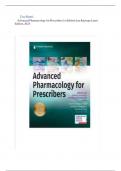
Test Bank:
f
Advanced Pharmacology for Prescribers 1st Edition Luu Kayingo Latest
f f f f f f f f
Edition, 2024
f f
, Table of Contents f f
Chapter 1: An Introduction to Evidence-Based Clinical Practice Guidelines .............................................. 3
f f f f f f f f
Chapter 2: Pharmacokinetics /Chapter3: Pharmacodynamics..................................................................... 13
f f f f
Chapter4: Pharmacogenetics and Pharmacogenomics ................................................................................ 25
f f f
Chapter 5: Pharmacology Across the Life Span .......................................................................................... 30
f f f f f f
Chapter 6: Drug-Therapy Prescribing in Special Populations..................................................................... 36
f f f f f f
Chapter 7: Drug Development and Approval.............................................................................................. 45
f f f f f
Chapter 8-Chapter 10: Foundations of Prescription Writing Chapter 9: ResponsibleControlled-Substance
f f f f f f f f f
Prescribing Chapter 10: Antibiotic Stewardship .......................................................................................... 51
f f f f f
Chapter 11: Applied Calculations for Prescribing ...................................................................................... 58
f f f f f
Chapter 12-: Promoting Adherence With Pharmacotherapy II: System-Specific and Patient-Focused
f f f f f f f f f
Prescribing Chapter 13: Pharmacotherapy for Ear, Nose, Mouth, andThroat Conditions /Chapter 14:
f f f f f f f f f f f f
Pharmacotherapy for Eye Conditions .......................................................................................................... 67
f f f f
Chapter 15: Pharmacotherapy for Skin Conditions..................................................................................... 74
f f f f f
Chapter 16: Pharmacotherapy for Neurologic Conditions .......................................................................... 81
f f f f f
Chapter 17: Pharmacotherapy for Cardiovascular Conditions ................................................................... 94
f f f f f
Chapter 18: Pharmacotherapy for Respiratory Conditions ....................................................................... 106
f f f f f
Chapter 19: Pharmacotherapy for Gastrointestinal Conditions and Conditions RequiringNutritional Support
f f f f f f f f f
................................................................................................................................................................... 117
Chapter 20: Pharmacotherapy for Genitourinary Conditions ................................................................... 128
f f f f f
Chapter 21: Pharmacotherapy for Renal, Acid–Base, Fluid, and Electrolyte Disorders .......................... 133
f f f f f f f f f
Chapter 22: Pharmacotherapy for Musculoskeletal and Rheumatologic Conditions ............................... 146
f f f f f f f
Chapter 23: Therapeutic Applications of Immunology and Vaccines ..................................................... 158
f f f f f f f
Chapter 24: Pharmacotherapy for Endocrine Disorders ........................................................................... 163
f f f f f
Chapter 25: Pharmacotherapy for Hematologic Disorders ....................................................................... 174
f f f f f
Chapter 26: Hematology/Oncology and Supportive Care for the Nononcologist..................................... 190
f f f f f f f f
Chapter 27: Pharmacotherapy Related to Women’s Health Conditions .................................................. 196
f f f f f f f
Chapter 28: Pharmacotherapy Related to Men’s Health Conditions ........................................................ 211
f f f f f f f
Chapter 29: Pharmacotherapy Related to Transgender Care .................................................................... 217
f f f f f f
Chapter 30: Antimicrobial Pharmacotherapy ............................................................................................ 224
f f f
Chapter 31: Antiretroviral Pharmacotherapy ............................................................................................ 235
f f f
Chapter 32: Psychopharmacology and Integrative Health: Combined Treatment ofPsychiatric and
f f f f f f f f f
Neurocognitive Conditions ........................................................................................................................ 247
f f
Chapter 33: Pharmacotherapy for Pain Management ............................................................................... 257
f f f f f
Chapter 34: Substance Use Disorder III: Health Promotion and Maintenance ......................................... 267
f f f f f f f f f
Chapter 35: Over-the-Counter Medications .............................................................................................. 283
f f f
Chapter 36: Pharmacotherapy for Obesity ................................................................................................ 291
f f f f
,Chapter 1: An Introduction to Evidence-Based Clinical Practice Guidelines
f f f f f f f f
MULTIPLE CHOICE f
• What is the primary purpose of the nursing assessment?
f f f f f f f f
A. Identifying underlying pathologic conditions f f f
B. Assisting the physician in identifying medical conditions f f f f f f
C. Determining the patients mental status f f f f
D. Exploring patient responses to health problems f f f f f
ANS: D f
A nursing assessment is done to identify the patients response to health
f f f f f f f f f f f
problems. During the nursing assessment phase, a comprehensive
f f f f f f f f
information base is developed through a physical examination, nursing
f f f f f f f f f
history, medication history, and professional observation. Identifying
f f f f f f f
underlying pathologic conditions and assisting the physician in identifying
f f f f f f f f f
medical conditions is not part of the nursing process. Determining the
f f f f f f f f f f f
patients mental status is one part of the nursing assessment, but it is
f f f f f f f f f f f f f
not the primary purpose.
f f f f
DIF: Cognitive Level: Comprehension
f f f
REF: dm 36 OBJ: 1 | 3 TOP: Nursing
f f f f f f f f f
Process Step: Assessment
f f f
MSC: NCLEX Client Needs Category: Health Promotion and Maintenance
f f f f f f f f
• What is the basis of the NANDA I taxonomy?
f f f f f f f f
A. Functional health patterns f f
B. Human response patterns f f
C. Basic human needs f f
D. Pathophysiologic needs f
ANS: B f
The NANDA I taxonomy identifies human response patterns.
f f f f f f f
Functional components of health patterns are limited to activity, fluid
f f f f f f f f f f
volume, nutrition, self care, and sensory perception. Basic human needs
f f f f f f f f f f
comprise less than merely health patterns. Pathophysiologic needs are
f f f f f f f f f
fnot part of the scope of NANDA I.
f f f f f f f
, DIF: Cognitive Level: Knowledge
f f f
REF: pp. 37-38 OBJ: 5 TOP:
f f f f f f
Nursing Process Step: Diagnosis
f f f
MSC: NCLEX Client Needs Category: Physiological Integrity
f f f f f f
• Which task is included in the assessment step of the nursing process?
f f f f f f f f f f f
A. Establishing patient goals/outcomes f f
B. Implementing the nursing care plan (NCP) f f f f f
C. Measuring goal/outcome achievement f f
D. Collecting and communicating data f f f
ANS: D f
Data are collected and communicated in the assessment phase of the nursing
f f f f f f f f f f f
process. Establishing goals is the function of planning.
f f f f f f f f
Implementing the NCP is the function of implementation. Measuring
f f f f f f f f
outcome achievement is the function of evaluation.
f f f f f f f
DIF: Cognitive Level: Comprehension
f f f
REF: dm 36 OBJ: 2 | 3 TOP: Nursing
f f f f f f f f f
Process Step: Assessment
f f f
MSC: NCLEX Client Needs Category: Health Promotion and Maintenance
f f f f f f f f
• Which statement regarding nursing diagnoses is accurate?
f f f f f f
a. Nursing diagnoses remain the same for as long as the disease is present. f f f f f f f f f f f f
b. Nursing diagnoses are written to identify disease states. f f f f f f f
c. Nursing diagnoses describe patient problems that nurses treat. f f f f f f f
d. Nursing diagnoses identify causes related to illness. f f f f f f
ANS: C f
Diagnostic statements identify problems a nurse is independently able to
f f f f f f f f f
treat within the scope of professional practice. Nursing diagnoses vary with
f f f f f f f f f f f
the changing condition of the patient. The response patterns are unique to
f f f f f f f f f f f f
the patient and are not disease specific. Nursing diagnoses describe the
f f f f f f f f f f f
patients human response pattern.
f f f f
DIF: Cognitive Level: Comprehension
f f f
f
Advanced Pharmacology for Prescribers 1st Edition Luu Kayingo Latest
f f f f f f f f
Edition, 2024
f f
, Table of Contents f f
Chapter 1: An Introduction to Evidence-Based Clinical Practice Guidelines .............................................. 3
f f f f f f f f
Chapter 2: Pharmacokinetics /Chapter3: Pharmacodynamics..................................................................... 13
f f f f
Chapter4: Pharmacogenetics and Pharmacogenomics ................................................................................ 25
f f f
Chapter 5: Pharmacology Across the Life Span .......................................................................................... 30
f f f f f f
Chapter 6: Drug-Therapy Prescribing in Special Populations..................................................................... 36
f f f f f f
Chapter 7: Drug Development and Approval.............................................................................................. 45
f f f f f
Chapter 8-Chapter 10: Foundations of Prescription Writing Chapter 9: ResponsibleControlled-Substance
f f f f f f f f f
Prescribing Chapter 10: Antibiotic Stewardship .......................................................................................... 51
f f f f f
Chapter 11: Applied Calculations for Prescribing ...................................................................................... 58
f f f f f
Chapter 12-: Promoting Adherence With Pharmacotherapy II: System-Specific and Patient-Focused
f f f f f f f f f
Prescribing Chapter 13: Pharmacotherapy for Ear, Nose, Mouth, andThroat Conditions /Chapter 14:
f f f f f f f f f f f f
Pharmacotherapy for Eye Conditions .......................................................................................................... 67
f f f f
Chapter 15: Pharmacotherapy for Skin Conditions..................................................................................... 74
f f f f f
Chapter 16: Pharmacotherapy for Neurologic Conditions .......................................................................... 81
f f f f f
Chapter 17: Pharmacotherapy for Cardiovascular Conditions ................................................................... 94
f f f f f
Chapter 18: Pharmacotherapy for Respiratory Conditions ....................................................................... 106
f f f f f
Chapter 19: Pharmacotherapy for Gastrointestinal Conditions and Conditions RequiringNutritional Support
f f f f f f f f f
................................................................................................................................................................... 117
Chapter 20: Pharmacotherapy for Genitourinary Conditions ................................................................... 128
f f f f f
Chapter 21: Pharmacotherapy for Renal, Acid–Base, Fluid, and Electrolyte Disorders .......................... 133
f f f f f f f f f
Chapter 22: Pharmacotherapy for Musculoskeletal and Rheumatologic Conditions ............................... 146
f f f f f f f
Chapter 23: Therapeutic Applications of Immunology and Vaccines ..................................................... 158
f f f f f f f
Chapter 24: Pharmacotherapy for Endocrine Disorders ........................................................................... 163
f f f f f
Chapter 25: Pharmacotherapy for Hematologic Disorders ....................................................................... 174
f f f f f
Chapter 26: Hematology/Oncology and Supportive Care for the Nononcologist..................................... 190
f f f f f f f f
Chapter 27: Pharmacotherapy Related to Women’s Health Conditions .................................................. 196
f f f f f f f
Chapter 28: Pharmacotherapy Related to Men’s Health Conditions ........................................................ 211
f f f f f f f
Chapter 29: Pharmacotherapy Related to Transgender Care .................................................................... 217
f f f f f f
Chapter 30: Antimicrobial Pharmacotherapy ............................................................................................ 224
f f f
Chapter 31: Antiretroviral Pharmacotherapy ............................................................................................ 235
f f f
Chapter 32: Psychopharmacology and Integrative Health: Combined Treatment ofPsychiatric and
f f f f f f f f f
Neurocognitive Conditions ........................................................................................................................ 247
f f
Chapter 33: Pharmacotherapy for Pain Management ............................................................................... 257
f f f f f
Chapter 34: Substance Use Disorder III: Health Promotion and Maintenance ......................................... 267
f f f f f f f f f
Chapter 35: Over-the-Counter Medications .............................................................................................. 283
f f f
Chapter 36: Pharmacotherapy for Obesity ................................................................................................ 291
f f f f
,Chapter 1: An Introduction to Evidence-Based Clinical Practice Guidelines
f f f f f f f f
MULTIPLE CHOICE f
• What is the primary purpose of the nursing assessment?
f f f f f f f f
A. Identifying underlying pathologic conditions f f f
B. Assisting the physician in identifying medical conditions f f f f f f
C. Determining the patients mental status f f f f
D. Exploring patient responses to health problems f f f f f
ANS: D f
A nursing assessment is done to identify the patients response to health
f f f f f f f f f f f
problems. During the nursing assessment phase, a comprehensive
f f f f f f f f
information base is developed through a physical examination, nursing
f f f f f f f f f
history, medication history, and professional observation. Identifying
f f f f f f f
underlying pathologic conditions and assisting the physician in identifying
f f f f f f f f f
medical conditions is not part of the nursing process. Determining the
f f f f f f f f f f f
patients mental status is one part of the nursing assessment, but it is
f f f f f f f f f f f f f
not the primary purpose.
f f f f
DIF: Cognitive Level: Comprehension
f f f
REF: dm 36 OBJ: 1 | 3 TOP: Nursing
f f f f f f f f f
Process Step: Assessment
f f f
MSC: NCLEX Client Needs Category: Health Promotion and Maintenance
f f f f f f f f
• What is the basis of the NANDA I taxonomy?
f f f f f f f f
A. Functional health patterns f f
B. Human response patterns f f
C. Basic human needs f f
D. Pathophysiologic needs f
ANS: B f
The NANDA I taxonomy identifies human response patterns.
f f f f f f f
Functional components of health patterns are limited to activity, fluid
f f f f f f f f f f
volume, nutrition, self care, and sensory perception. Basic human needs
f f f f f f f f f f
comprise less than merely health patterns. Pathophysiologic needs are
f f f f f f f f f
fnot part of the scope of NANDA I.
f f f f f f f
, DIF: Cognitive Level: Knowledge
f f f
REF: pp. 37-38 OBJ: 5 TOP:
f f f f f f
Nursing Process Step: Diagnosis
f f f
MSC: NCLEX Client Needs Category: Physiological Integrity
f f f f f f
• Which task is included in the assessment step of the nursing process?
f f f f f f f f f f f
A. Establishing patient goals/outcomes f f
B. Implementing the nursing care plan (NCP) f f f f f
C. Measuring goal/outcome achievement f f
D. Collecting and communicating data f f f
ANS: D f
Data are collected and communicated in the assessment phase of the nursing
f f f f f f f f f f f
process. Establishing goals is the function of planning.
f f f f f f f f
Implementing the NCP is the function of implementation. Measuring
f f f f f f f f
outcome achievement is the function of evaluation.
f f f f f f f
DIF: Cognitive Level: Comprehension
f f f
REF: dm 36 OBJ: 2 | 3 TOP: Nursing
f f f f f f f f f
Process Step: Assessment
f f f
MSC: NCLEX Client Needs Category: Health Promotion and Maintenance
f f f f f f f f
• Which statement regarding nursing diagnoses is accurate?
f f f f f f
a. Nursing diagnoses remain the same for as long as the disease is present. f f f f f f f f f f f f
b. Nursing diagnoses are written to identify disease states. f f f f f f f
c. Nursing diagnoses describe patient problems that nurses treat. f f f f f f f
d. Nursing diagnoses identify causes related to illness. f f f f f f
ANS: C f
Diagnostic statements identify problems a nurse is independently able to
f f f f f f f f f
treat within the scope of professional practice. Nursing diagnoses vary with
f f f f f f f f f f f
the changing condition of the patient. The response patterns are unique to
f f f f f f f f f f f f
the patient and are not disease specific. Nursing diagnoses describe the
f f f f f f f f f f f
patients human response pattern.
f f f f
DIF: Cognitive Level: Comprehension
f f f