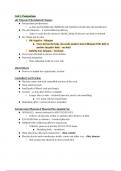
Unit 5: Postpartum
4th Trimester Physiological Changes
★ Puerperium (postpartum)
○ 42 days period following childbirth and expulsion of placenta and membranes
★ The 4th trimester – 6 weeks following delivery
○ Takes 6 weeks for the uterus to shrink, lining of uterus to go back to normal
★ Key things not to miss
○ Rh-Negative – Rhogam
■ Once she has the baby, she needs another shot of Rhogam if the baby is
positive (negative baby = no shot)
○ Rubella Non-Immune - Vaccinate
★ Uterus goes through a process of involution.
★ Maternal adaptation
○ Mom adjusting to life in a new role
After Delivery
★ Process is similar for vaginal and c section
Controlled Cord Traction
★ Placenta comes out with controlled traction of the cord
★ Mom asked to push
★ Small gush of blood, cord gets longer
★ Normal = 30 min after delivery (vaginal)
○ Longer than 30 min = retained placenta, need to do something
■ INC mom risk for hemorrhage
★ Immediate after c section (remove manually)
Normal, Intact Placenta & Placenta Plus Amniotic Sac
★ NORMALLY, uterus contracts to SPONTANEOUSLY
○ Delivery of placenta within 30 minutes after delivery of baby
★ If LONGER than 30 minutes = retained placenta
★ IMMEDIATELY following delivery of placenta
○ NORMAL process of uterine INVOLUTION begin
■ Shrinking back = involution
★ Shiny placenta with cord coming first = shiny schultz
★ Placenta leaves more membranes inside, comes out other way = dirty duncan
○ Side of placenta attached to uterus leads first
,Beginning of 4th Stage
★ TONE and FUNDAL LOCATION in relation to the umbilicus
○ Need to know for assessment
○ Tells us if its a normal process
○ Tone = how firm it is, if it's contracted, should be firm/hard
○ Umbilicus is the landmark
○ Every day after delivery, umbilicus will go down by 1cm
○ Uterus not midline = bladder is full
■ Could be full from epidural, overly-distended during labor (stretching
causes tone to come back slower)
Fundal Assessment & Massage
★ Cup the top of fundus with hand, put other hand in front of symphysis pubis
★ Massage = keep lower hand in place, massage with top hand (***hand placement)
From Delivery of Placenta thru 6 weeks (4th stage of Labor)
★ Immediate Postpartum Period- the first 2 hours
○ When the pts are most likely to have an early PP hemorrhage
★ PRIMARY FOCUS- HEMOSTASIS
○ Making sure mom isn't having too much bleeding
★ INVOLUTION and returning Mom’s body to pre-pregnant state
PPH: What causes it?
★ TONE- refers to LACK of uterine TONE after delivery- “hypotonic” “Boggy” “atony”
○ Risks - long labor, induced, pitocin = very tired uterus
○ Uterus is too tired to continue to contract
★ TISSUE- retained placenta related to any reason
★ TRAUMA- to the mother’s tissues in or around the birth canal
○ Laceration in cervix/vaginal wall/perineal area = can cause bleeding
★ THROMBIN – coagulopathy
○ Protective, high thrombin, able to clot
★ The criteria needed to define a “POSTPARTUM HEMORRHAGE can vary:
○ EBL of > 500ml if vaginal delivery
○ EBL of >1000 ml if c-section
■ Know the normal amount of blood loss!!!!!
■ Not all at one time, cumulative blood loss
■ Most pts can lose a lot of blood before they have S/S
, ★ ACOG- the American College of OB Gyns defined PPH as "Cumulative blood loss of
greater than or equal to 1,000 mL
★ or blood loss accompanied by signs or symptoms of hypovolemia within 24 hours after
delivery
○ All considered PP hemorrhage ^
RF for PPH
★ Anything that overstretched the uterus-like macrosomia, multiples, polyhydramnios,
high parity
○ Big baby, more than one baby, too much amniotic fluid in uterus
★ Infection in the uterus
○ Prolonged rupture of membranes
★ A very short (“precipitous”) labor or a prolonged labor
★ Induction or augmentation with Pitocin
○ Naturally produced oxytocin after delivery
○ Makes our uterus contract
○ Induced/augmentation = pitocin receptor sites are already full
★ An assisted delivery (use of vacuum or forceps)
★ Precious PPH
★ Maternal obesity and congenital anomalies
○ Abnormal uterus shape
Meds for uterine atony
★ PP hemorrhage leading COD
★ Be aware: policies/procedures where the nurse doesn't have to call the DOC to
implement them (don't have time to wait, need to start the meds without DOC order)
★ Need: IV, heparin lock, fluids ready/hanging
★ First med: Pitocin > methergine
Pitocin/Oxytocin to Reduce RF PPH
★ 20 units Oxytocin in 1 liter NS or LR
★ Initial bolus rate 1000 mL/hr bolus for 30 minutes (=10 units)
★ followed by a maintenance rate 125 mL/hr over 3.5 hrs (= remaining 10 units)
What Else?
★ Must know the other medications used to treat PP hemorrhage that are a part of the
Simulation Day
★ Methergine (HTN CI)
, ○ If BP is over 140/90 dont give this med
○ If the pt had pregnancy induced HTN or preeclampsia = DONT GIVE
★ Cytotec
○ Prostaglandin-based
○ Given PO, rectal/vaginally is most common
★ Hemabate
○ Given IM
○ Prostaglandin-based
○ CHART IN BOOK (KNOW CI)
Reproductive System & Associated Structures
★ Uterus
○ Involution = return of the uterus to a nonpregnant state following birth
■ Progresses rapidly
● Fundus descends 1 to 2 cm every 24 hours
● 2 weeks after delivery the uterus is no longer palpable (has
shrunk)
○ “Pt came in 2 weeks after delivery, fundus was palpated =
NOT NORMAL, TOO BIG, shouldn't be able to feel it”
○ What to do = US, methergine, WBC count, DNC (scrape
uterus)
● Returns to a nonpregnant state by 6 weeks
■ Subinvolution = failure of uterus to return to nonpregnant state
○ Contractions
■ After birth hemostasis achieved by compression of intramyometrial
blood vessels as uterine muscle contracts (makes the BVs not bleed)
■ Hormone oxytocin, released from pituitary gland, strengthens and
coordinates uterine contractions
■ First time moms = feel like cramping/slightly uncomfy
■ Multiple babies = more severe contractions, might need pain meds
○ Placental site
○ Lochia: Postbirth uterine discharge (bleeding after delivery)
■ Lets us know the placental site is healing normally
■ Once the pt moves from one stage to the next, you don't go back
● If you go back, there is a problem
■ Lochia not looking like it should, or having an odor = infection
■ Lochia rubra
● Blood and decidual and trophoblastic debris
4th Trimester Physiological Changes
★ Puerperium (postpartum)
○ 42 days period following childbirth and expulsion of placenta and membranes
★ The 4th trimester – 6 weeks following delivery
○ Takes 6 weeks for the uterus to shrink, lining of uterus to go back to normal
★ Key things not to miss
○ Rh-Negative – Rhogam
■ Once she has the baby, she needs another shot of Rhogam if the baby is
positive (negative baby = no shot)
○ Rubella Non-Immune - Vaccinate
★ Uterus goes through a process of involution.
★ Maternal adaptation
○ Mom adjusting to life in a new role
After Delivery
★ Process is similar for vaginal and c section
Controlled Cord Traction
★ Placenta comes out with controlled traction of the cord
★ Mom asked to push
★ Small gush of blood, cord gets longer
★ Normal = 30 min after delivery (vaginal)
○ Longer than 30 min = retained placenta, need to do something
■ INC mom risk for hemorrhage
★ Immediate after c section (remove manually)
Normal, Intact Placenta & Placenta Plus Amniotic Sac
★ NORMALLY, uterus contracts to SPONTANEOUSLY
○ Delivery of placenta within 30 minutes after delivery of baby
★ If LONGER than 30 minutes = retained placenta
★ IMMEDIATELY following delivery of placenta
○ NORMAL process of uterine INVOLUTION begin
■ Shrinking back = involution
★ Shiny placenta with cord coming first = shiny schultz
★ Placenta leaves more membranes inside, comes out other way = dirty duncan
○ Side of placenta attached to uterus leads first
,Beginning of 4th Stage
★ TONE and FUNDAL LOCATION in relation to the umbilicus
○ Need to know for assessment
○ Tells us if its a normal process
○ Tone = how firm it is, if it's contracted, should be firm/hard
○ Umbilicus is the landmark
○ Every day after delivery, umbilicus will go down by 1cm
○ Uterus not midline = bladder is full
■ Could be full from epidural, overly-distended during labor (stretching
causes tone to come back slower)
Fundal Assessment & Massage
★ Cup the top of fundus with hand, put other hand in front of symphysis pubis
★ Massage = keep lower hand in place, massage with top hand (***hand placement)
From Delivery of Placenta thru 6 weeks (4th stage of Labor)
★ Immediate Postpartum Period- the first 2 hours
○ When the pts are most likely to have an early PP hemorrhage
★ PRIMARY FOCUS- HEMOSTASIS
○ Making sure mom isn't having too much bleeding
★ INVOLUTION and returning Mom’s body to pre-pregnant state
PPH: What causes it?
★ TONE- refers to LACK of uterine TONE after delivery- “hypotonic” “Boggy” “atony”
○ Risks - long labor, induced, pitocin = very tired uterus
○ Uterus is too tired to continue to contract
★ TISSUE- retained placenta related to any reason
★ TRAUMA- to the mother’s tissues in or around the birth canal
○ Laceration in cervix/vaginal wall/perineal area = can cause bleeding
★ THROMBIN – coagulopathy
○ Protective, high thrombin, able to clot
★ The criteria needed to define a “POSTPARTUM HEMORRHAGE can vary:
○ EBL of > 500ml if vaginal delivery
○ EBL of >1000 ml if c-section
■ Know the normal amount of blood loss!!!!!
■ Not all at one time, cumulative blood loss
■ Most pts can lose a lot of blood before they have S/S
, ★ ACOG- the American College of OB Gyns defined PPH as "Cumulative blood loss of
greater than or equal to 1,000 mL
★ or blood loss accompanied by signs or symptoms of hypovolemia within 24 hours after
delivery
○ All considered PP hemorrhage ^
RF for PPH
★ Anything that overstretched the uterus-like macrosomia, multiples, polyhydramnios,
high parity
○ Big baby, more than one baby, too much amniotic fluid in uterus
★ Infection in the uterus
○ Prolonged rupture of membranes
★ A very short (“precipitous”) labor or a prolonged labor
★ Induction or augmentation with Pitocin
○ Naturally produced oxytocin after delivery
○ Makes our uterus contract
○ Induced/augmentation = pitocin receptor sites are already full
★ An assisted delivery (use of vacuum or forceps)
★ Precious PPH
★ Maternal obesity and congenital anomalies
○ Abnormal uterus shape
Meds for uterine atony
★ PP hemorrhage leading COD
★ Be aware: policies/procedures where the nurse doesn't have to call the DOC to
implement them (don't have time to wait, need to start the meds without DOC order)
★ Need: IV, heparin lock, fluids ready/hanging
★ First med: Pitocin > methergine
Pitocin/Oxytocin to Reduce RF PPH
★ 20 units Oxytocin in 1 liter NS or LR
★ Initial bolus rate 1000 mL/hr bolus for 30 minutes (=10 units)
★ followed by a maintenance rate 125 mL/hr over 3.5 hrs (= remaining 10 units)
What Else?
★ Must know the other medications used to treat PP hemorrhage that are a part of the
Simulation Day
★ Methergine (HTN CI)
, ○ If BP is over 140/90 dont give this med
○ If the pt had pregnancy induced HTN or preeclampsia = DONT GIVE
★ Cytotec
○ Prostaglandin-based
○ Given PO, rectal/vaginally is most common
★ Hemabate
○ Given IM
○ Prostaglandin-based
○ CHART IN BOOK (KNOW CI)
Reproductive System & Associated Structures
★ Uterus
○ Involution = return of the uterus to a nonpregnant state following birth
■ Progresses rapidly
● Fundus descends 1 to 2 cm every 24 hours
● 2 weeks after delivery the uterus is no longer palpable (has
shrunk)
○ “Pt came in 2 weeks after delivery, fundus was palpated =
NOT NORMAL, TOO BIG, shouldn't be able to feel it”
○ What to do = US, methergine, WBC count, DNC (scrape
uterus)
● Returns to a nonpregnant state by 6 weeks
■ Subinvolution = failure of uterus to return to nonpregnant state
○ Contractions
■ After birth hemostasis achieved by compression of intramyometrial
blood vessels as uterine muscle contracts (makes the BVs not bleed)
■ Hormone oxytocin, released from pituitary gland, strengthens and
coordinates uterine contractions
■ First time moms = feel like cramping/slightly uncomfy
■ Multiple babies = more severe contractions, might need pain meds
○ Placental site
○ Lochia: Postbirth uterine discharge (bleeding after delivery)
■ Lets us know the placental site is healing normally
■ Once the pt moves from one stage to the next, you don't go back
● If you go back, there is a problem
■ Lochia not looking like it should, or having an odor = infection
■ Lochia rubra
● Blood and decidual and trophoblastic debris