How to Compute Deviation Scores
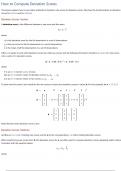
This lesson explains how to use matrix methods to transform raw scores to deviation scores. We show the transformation to deviation
scores for vectors and for matrices.
Deviation Scores: Vectors
A deviation score is the difference between a raw score and the mean.
d i = xi - x
where
di is the deviation score for the ith observation in a set of observations
xi is the raw score for the ith observation in a set of observations
x is the mean of all the observations in a set of observations
Often, it is easier to work with deviation scores than with raw scores. Use the following formula to transform a vector of n raw scores
into a vector of n deviation scores.
d = x - 1'x1 ( 1'1 )-1 = x - 1'x1 ( 1/n )
where
1 is an n x 1 column vector of ones
d is an n x 1 column vector of deviation scores: d1, d2, . . . , dn
x is an n x 1 column vector of raw scores: x1, x2, . . . , xn
To show how this works, let's transform the raw scores in vector x to deviation scores in vector d. For this example, let x' = [ 1 2 3 ].
d = x - 1' x 1 ( 1' 1 )-1
1 1 1 1
d = 2 - [111] 2 1 ( [111] 1 )-1
3 3 1 1
1 2 -1
d = 2 - 2 = 0
3 2 1
Note that the mean deviation score is zero.
Deviation Scores: Matrices
Let X be an r x c matrix holding raw scores; and let x be the corresponding r x c matrix holding deviation scores.
When transforming raw scores from X into deviation scores for x, we often want to compute deviation scores separately within column
consistent with the equation below.
xrc = Xrc - Xc
where
This lesson explains how to use matrix methods to transform raw scores to deviation scores. We show the transformation to deviation
scores for vectors and for matrices.
Deviation Scores: Vectors
A deviation score is the difference between a raw score and the mean.
d i = xi - x
where
di is the deviation score for the ith observation in a set of observations
xi is the raw score for the ith observation in a set of observations
x is the mean of all the observations in a set of observations
Often, it is easier to work with deviation scores than with raw scores. Use the following formula to transform a vector of n raw scores
into a vector of n deviation scores.
d = x - 1'x1 ( 1'1 )-1 = x - 1'x1 ( 1/n )
where
1 is an n x 1 column vector of ones
d is an n x 1 column vector of deviation scores: d1, d2, . . . , dn
x is an n x 1 column vector of raw scores: x1, x2, . . . , xn
To show how this works, let's transform the raw scores in vector x to deviation scores in vector d. For this example, let x' = [ 1 2 3 ].
d = x - 1' x 1 ( 1' 1 )-1
1 1 1 1
d = 2 - [111] 2 1 ( [111] 1 )-1
3 3 1 1
1 2 -1
d = 2 - 2 = 0
3 2 1
Note that the mean deviation score is zero.
Deviation Scores: Matrices
Let X be an r x c matrix holding raw scores; and let x be the corresponding r x c matrix holding deviation scores.
When transforming raw scores from X into deviation scores for x, we often want to compute deviation scores separately within column
consistent with the equation below.
xrc = Xrc - Xc
where