Matrix Inverse
This lesson defines the matrix inverse, and shows how to determine whether the inverse of a matrix exists.
Matrix Inversion
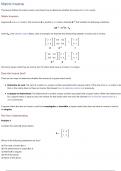
Suppose A is an n x n matrix. The inverse of A is another n x n matrix, denoted A-1, that satisfies the following conditions.
AA-1 = A-1A = In
where In is the identity matrix. Below, with an example, we illustrate the relationship between a matrix and its inverse.
2 1 0.8 -0.2 1 0
=
3 4 -0.6 0.4 0 1
A A-1 I
0.8 -0.2 2 1 1 0
=
-0.6 0.4 3 4 0 1
A-1 A I
Not every square matrix has an inverse; but if a matrix does have an inverse, it is unique.
Does the Inverse Exist?
There are two ways to determine whether the inverse of a square matrix exists.
Determine its rank. The rank of a matrix is a unique number associated with a square matrix. If the rank of an n x n matrix is les
than n, the matrix does not have an inverse. We showed how to determine matrix rank previously.
Compute its determinant. The determinant is another unique number associated with a square matrix. When the determinant
for a square matrix is equal to zero, the inverse for that matrix does not exist. We showed how to find the determinant of a
matrix previously.
A square matrix that has an inverse is said to be nonsingular or invertible; a square matrix that does not have an inverse is said to
be singular.
Test Your Understanding
Problem 1
Consider the matrix A, shown below.
2 4
A=
1 2
Which of the following statements are true?
(A) The rank of matrix A is 1.
(B) The determinant of matrix A is 0.
(C) Matrix A is singular.
(D) All of the above.
(E) None of the above.
This lesson defines the matrix inverse, and shows how to determine whether the inverse of a matrix exists.
Matrix Inversion
Suppose A is an n x n matrix. The inverse of A is another n x n matrix, denoted A-1, that satisfies the following conditions.
AA-1 = A-1A = In
where In is the identity matrix. Below, with an example, we illustrate the relationship between a matrix and its inverse.
2 1 0.8 -0.2 1 0
=
3 4 -0.6 0.4 0 1
A A-1 I
0.8 -0.2 2 1 1 0
=
-0.6 0.4 3 4 0 1
A-1 A I
Not every square matrix has an inverse; but if a matrix does have an inverse, it is unique.
Does the Inverse Exist?
There are two ways to determine whether the inverse of a square matrix exists.
Determine its rank. The rank of a matrix is a unique number associated with a square matrix. If the rank of an n x n matrix is les
than n, the matrix does not have an inverse. We showed how to determine matrix rank previously.
Compute its determinant. The determinant is another unique number associated with a square matrix. When the determinant
for a square matrix is equal to zero, the inverse for that matrix does not exist. We showed how to find the determinant of a
matrix previously.
A square matrix that has an inverse is said to be nonsingular or invertible; a square matrix that does not have an inverse is said to
be singular.
Test Your Understanding
Problem 1
Consider the matrix A, shown below.
2 4
A=
1 2
Which of the following statements are true?
(A) The rank of matrix A is 1.
(B) The determinant of matrix A is 0.
(C) Matrix A is singular.
(D) All of the above.
(E) None of the above.