Vector Multiplication
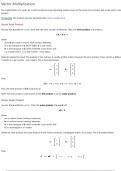
The multiplication of a vector by a vector produces some interesting results, known as the vector inner product and as the vector outer
product.
Prerequisite: This material assumes familiarity with matrix multiplication.
Vector Inner Product
Assume that a and b are vectors, each with the same number of elements. Then, the inner product of a and b is s.
a'b = b'a = s
where
a and b are column vectors, each having n elements,
a' is the transpose of a, which makes a' a row vector,
b' is the transpose of b, which makes b' a row vector, and
s is a scalar; that is, s is a real number - not a matrix.
Note this interesting result. The product of two matrices is usually another matrix. However, the inner product of two vectors is differen
It results in a real number - not a matrix. This is illustrated below.
1 4
a= 2 b= 5
3 6
Then,
a'b = 1*4 + 2*5 + 3*6 = 4 + 10 + 18 = 32
Thus, the inner product of a'b is equal to 32.
Note: The inner product is also known as the dot product or as the scalar product.
Vector Outer Product
Assume that a and b are vectors. Then, the outer product of a and b is C.
ab'= C
where
a is a column vector, having m elements,
b is a column vector, having n elements,
b' is the transpose of b, which makes b' a row vector, and
C is a rectangular m x n matrix
Unlike the inner product, the outer product of two vectors produces a rectangular matrix, not a scalar. This is illustrated below.
x
v
a= b= y
w
z
Then,
C = ab' = v*x v*y v*z
The multiplication of a vector by a vector produces some interesting results, known as the vector inner product and as the vector outer
product.
Prerequisite: This material assumes familiarity with matrix multiplication.
Vector Inner Product
Assume that a and b are vectors, each with the same number of elements. Then, the inner product of a and b is s.
a'b = b'a = s
where
a and b are column vectors, each having n elements,
a' is the transpose of a, which makes a' a row vector,
b' is the transpose of b, which makes b' a row vector, and
s is a scalar; that is, s is a real number - not a matrix.
Note this interesting result. The product of two matrices is usually another matrix. However, the inner product of two vectors is differen
It results in a real number - not a matrix. This is illustrated below.
1 4
a= 2 b= 5
3 6
Then,
a'b = 1*4 + 2*5 + 3*6 = 4 + 10 + 18 = 32
Thus, the inner product of a'b is equal to 32.
Note: The inner product is also known as the dot product or as the scalar product.
Vector Outer Product
Assume that a and b are vectors. Then, the outer product of a and b is C.
ab'= C
where
a is a column vector, having m elements,
b is a column vector, having n elements,
b' is the transpose of b, which makes b' a row vector, and
C is a rectangular m x n matrix
Unlike the inner product, the outer product of two vectors produces a rectangular matrix, not a scalar. This is illustrated below.
x
v
a= b= y
w
z
Then,
C = ab' = v*x v*y v*z