

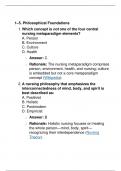
1–5. Philosophical Foundations
1. Which concept is not one of the four central
nursing metaparadigm elements?
A. Person
B. Environment
C. Culture
D. Health
o Answer: C
o Rationale: The nursing metaparadigm comprises
person, environment, health, and nursing; culture
is embedded but not a core metaparadigm
concept (Wikipedia).
2. A nursing philosophy that emphasizes the
interconnectedness of mind, body, and spirit is
best described as:
A. Positivist
B. Holistic
C. Postmodern
D. Empiricist
o Answer: B
o Rationale: Holistic nursing focuses on healing
the whole person—mind, body, spirit—
recognizing their interdependence (Nursing
Theory).
,3. Which philosophical stance holds that knowledge
arises primarily from sensory experience?
A. Rationalism
B. Empiricism
C. Constructivism
D. Existentialism
o Answer: B
o Rationale: Empiricism posits that all knowledge
is derived from sensory experience and
observation (Wikipedia).
4. Watson’s Human Caring Theory is grounded in
what overarching philosophical view?
A. Phenomenology
B. Pragmatism
C. Humanism
D. Logical positivism
o Answer: C
o Rationale: Watson’s theory emphasizes
humanism and the human-to-human caring
relationship as central to nursing (Wikipedia).
5. The belief that the nurse’s role is to manipulate
the patient’s environment to facilitate recovery
originates with:
A. Dorothea Orem
B. Virginia Henderson
, C. Florence Nightingale
D. Sister Callista Roy
o Answer: C
o Rationale: Nightingale’s Environmental Theory
holds that adjusting environmental factors like
cleanliness and light promotes healing (Nursing
Theory).
6–9. Nightingale’s Environmental Theory
6. Nightingale identified which of the following least
as an environmental factor affecting health?
A. Pure water
B. Effective drainage
C. Spiritual rituals
D. Direct sunlight
o Answer: C
o Rationale: Nightingale’s core factors were air,
water, drainage, cleanliness, and light; spiritual
rituals were not explicitly included (Wikipedia).
7. According to Nightingale, poor sanitation
primarily contributes to:
A. Psychological distress
B. Communicable disease spread
C. Nutritional deficiency
D. Genetic disorders
1. Which concept is not one of the four central
nursing metaparadigm elements?
A. Person
B. Environment
C. Culture
D. Health
o Answer: C
o Rationale: The nursing metaparadigm comprises
person, environment, health, and nursing; culture
is embedded but not a core metaparadigm
concept (Wikipedia).
2. A nursing philosophy that emphasizes the
interconnectedness of mind, body, and spirit is
best described as:
A. Positivist
B. Holistic
C. Postmodern
D. Empiricist
o Answer: B
o Rationale: Holistic nursing focuses on healing
the whole person—mind, body, spirit—
recognizing their interdependence (Nursing
Theory).
,3. Which philosophical stance holds that knowledge
arises primarily from sensory experience?
A. Rationalism
B. Empiricism
C. Constructivism
D. Existentialism
o Answer: B
o Rationale: Empiricism posits that all knowledge
is derived from sensory experience and
observation (Wikipedia).
4. Watson’s Human Caring Theory is grounded in
what overarching philosophical view?
A. Phenomenology
B. Pragmatism
C. Humanism
D. Logical positivism
o Answer: C
o Rationale: Watson’s theory emphasizes
humanism and the human-to-human caring
relationship as central to nursing (Wikipedia).
5. The belief that the nurse’s role is to manipulate
the patient’s environment to facilitate recovery
originates with:
A. Dorothea Orem
B. Virginia Henderson
, C. Florence Nightingale
D. Sister Callista Roy
o Answer: C
o Rationale: Nightingale’s Environmental Theory
holds that adjusting environmental factors like
cleanliness and light promotes healing (Nursing
Theory).
6–9. Nightingale’s Environmental Theory
6. Nightingale identified which of the following least
as an environmental factor affecting health?
A. Pure water
B. Effective drainage
C. Spiritual rituals
D. Direct sunlight
o Answer: C
o Rationale: Nightingale’s core factors were air,
water, drainage, cleanliness, and light; spiritual
rituals were not explicitly included (Wikipedia).
7. According to Nightingale, poor sanitation
primarily contributes to:
A. Psychological distress
B. Communicable disease spread
C. Nutritional deficiency
D. Genetic disorders


