

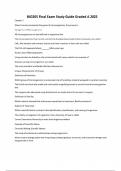
BIO205 Final Exam Study Guide Graded A 2025
Chapter 1 BIO205 Final Exam Study Guide Graded A 2025 When humans manipulate the genes of microorganisms, the process is Categories of Microorganisms All microorganisms are best defined as organisms that The microorganisms that recycle nutrients by breaking down dead matter and wastes are called Cells, like bacteria and archaea, that do not have a nucleus in their cells are called The first cells appeared about billion years ago. Human Use of Microorganisms Using microbes to detoxify a site contaminated with heavy metals is an example of Disease-causing microorganisms are called The most prevalent worldwide infectious diseases are Unique Characteristic of Viruses Definition of Helminths Which group of microorganisms is composed only of hereditary material wrapped in a protein covering The Dutch merchant who made and used quality magnifying lenses to see and record microorganisms was The surgeon who advocated using disinfectants on hands and in the air prior to surgery Definition of Sterility Which scientist showed that anthrax was caused by the bacterium, Bacillus anthracis? Aspects of Taxonomy Which scientific field is involved in the identification, classification, and naming of organisms The orderly arrangement of organisms into a hierarchy of taxa is called Correct Taxonomic Hierarchy in order from largest to smallest Example of Scientific Name Correctly Writing Scientific Names The study of evolutionary relationships among organisms is Which area of biology states that living things undergo gradual, structural, and functional changes over long periods of time The scientist(s) who proposed organisms be assigned to one of three domains A scientist studying helminths is working with bacteria (T/F) Many chronic conditions are found to be associated with microbial agents (T/F) The term sterile means free of all life forms (T/F) Members of the same species share many more characteristics compared to those shared by members of the same kingdom (T/F) Once an organism is assigned to a particular taxonomic hierarchy, it is permanent and cannot be revised (T/F) The names of the three domains are: Bacteria, Protista, and Eukarya (Eukaryota). (T/F) One distinguishing characteristic of the archaebacteria is that they live in extreme environments (T/F) Microbes have been found existing in salty, acidic lakes.(T/F) Organic chemicals always have a basic framework of the element bonded to other atoms. Most biochemical macromolecules are polymers, which are chains of Examples of monosaccharides Examples of Lipids The lipid group that serves as energy storage molecules is The lipid group that is the major component of cell membranes is Characteristics of Enzymes Which amino acid contains sulfur atoms that form covalent disulfide bonds in its tertiary structure What type of bonds are formed between adjacent amino acids The alpha helix is a type of protein structure One nucleotide contains ATP is best described as You are trying to identify a chemical that consists of adenine, ribose, and three phosphates. What is this chemical Purines and pyrimidines are components in the building block units of all Examples of Pyrimidines During protein synthesis, RNA is made as a copy of a gene from DNA Characteristics shared by all cells include The purine always binds with the pyrimidine in DNA and RNA. All proteins are enzymes (T/F) Nucleic acids have primary, secondary, tertiary, and quaternary levels of organization. (T/F) The Nobel Prize was awarded to Kary Mullis in 1993 for inventing what technique to amplify and subsequently analyze DNA The term used to describe the broad field of science that involves human manipulation of microbes for use in industrial processes is Most microorganisms that are found in and on humans do not cause harm and can sometimes benefit the host (T/F) The Dutch linen merchant ground glass lenses to detailed specifications so that he was able to develop a microscope for observing and describing living microscopic animalcules. term that describes the formal system of identifying, arranging, and naming organisms correct way to denote the binomial name of a microorganism Early Approaches to Classification: When classifying organisms, early taxonomists did NOT rely on Chapter 3 The two functions of bacterial appendages are Examples of Bacterial Appendages A flagellum is anchored into the bacterial cell envelope by its term that refers to the presence of flagella over the cell surface The term that refers to the presence of a tuft of flagella emerging from the same site The term that refers to flagella at both poles Chemotaxis refers to the ability to What three components comprise the flagellum, extending from the cytoplasm to the exterior of the cell Movement of a cell toward a chemical stimulus is The short, numerous appendages used by some bacterial cells for adhering to surfaces are called The transfer of genes during bacterial conjugation involves rigid, tubular appendages called Which structure protects bacteria from being phagocytized by white blood cells The outcome of the Gram stain is based on differences in the cell's correct procedure for Gram staining The cell can be composed of three layers: the cytoplasmic membrane, the cell wall, and the outer membrane. During the Gram stain, cells decolorize when the alcohol is applied Peptidoglycan is a unique macromolecule found in bacterial A bacterial cell wall that has primarily peptidoglycan with small amounts of teichoic acid and lipoteichoic acid is The stain is used to stain and differentiate Mycobacterium and Nocardia from other bacteria The enzyme , found in tears and saliva, can hydrolyze the bonds in the glycan chains of certain bacterial cell wall Lysozyme is most effective against What actions pertain to endotoxin The site for most ATP synthesis in bacterial cells is the Outer Membrane characteristics Definitions of Various Bacterial Internal Structures: Ribosomes - Inclusions - Nucleoid - Cytoplasm - The chemical components of ribosomes are proteins and Endospore characteristics Bacterial endospores are not produced by which type of bacteria Two major structures that allow bacteria to adhere to surfaces are Spirochetes are able to move due to Archaea do not have the typical peptidoglycan structure found in bacterial cell walls (T/F) Pili used for conjugation are only found on gram-negative bacteria. (T/F) The slime layer provides bacteria greater pathogenicity as compared to the capsule (T/F) If during the Gram stain procedure, the bacterial cells were viewed immediately after crystal violet was applied, gram-positive cells would be purple but gram-negative cells would be colorless. (T/F) Iodine is the decolorizer in the Gram stain. (T/F) The cell envelope of gram-positive bacteria has two layers: a thick cell wall and the cell membrane. (T/F) Gram-negative bacteria do not have peptidoglycan in their cell walls. (T/F) Bacteria in the genus Mycoplasma and bacteria called L-forms lack cell walls (T/F) Both gram-positive and gram-negative cells have outer membranes (T/F) The cell envelope or its parts can interact with human tissue and cause disease (T/F) Some bacteria have a cytoskeleton of protein polymers to help maintain their shape. (T/F) Endospores of certain bacterial species can enter tissues in the human body, germinate, and cause an infectious disease. (T/F) Boiling water (100°C) can normally destroy endospores. (T/F) Lipopolysaccharide is an important cell envelope component of which type of bacteria bacterial appendage that enables bacteria to stick to one another, to inanimate surfaces, and to host cells During bacterial conjugation, DNA can be transferred through a from the donor to the recipient cell. The movement of bacteria toward or away from a chemical stimulus is A unicellular microorganism was recovered from a hot spring (95°C) in Wyoming. The cells lack a nucleus, have a cell wall that lacks peptidoglycan, and have 70S ribosomes. Analysis of the plasma membrane reveals that the lipids contain long-chained branched hydrocarbons with ether linkages. Please choose the group in which this organism would be classified Chapter 4 Cilia are structures for motility found primarily in which type of microorganism There are nine peripheral pairs and one central pair of found inside eukaryotic flagella and cilia Cell walls are not usually found in which type of organism The eukaryotic cell's glycocalyx is composed mostly of Functions of the Eukaryotic Glycocalyx Chitin is a chemical component of the cell walls of which type of organism The eukaryote cell membrane is composed of The site for ribosomal RNA synthesis is When a eukaryotic cell is not undergoing mitosis, the DNA and its associated proteins appear as a visible network of dark fibers called Histones are The passageways in the nuclear envelope for movement of substances to and from the nucleus and cytoplasm are called nuclear The cell's series of tunnel-like membranes functioning in transport and storage are the An organelle that is a stack of flattened, membranous sacs and functions to receive, modify, and package proteins for cell secretion is Protists with contractile vacuoles use them for what purpose A(n) originates from the Golgi apparatus as one type of vesicle that contains a variety of enzymes for intracellular digestion Which organelle contains cristae where enzymes and electron carriers for aerobic respiration are found Which organelle is found in algae but not found in protozoa or fungi The size of a eukaryotic cell ribosome is Cytoskeleton characteristics In eukaryotic cells, ribosomes have two locations: scattered in the and on the surface of the . Functions of the Cytoskeleton Filamentous fungi are called When buds remain attached, they form a chain of yeast cells called Fungi that grow as yeast at one temperature but will grow as mold at another temperature are called Characteristics of Fungi The long, threadlike branching cells of molds are called Most fungi obtain nutrients from dead plants and animals. These fungi are called The woven, intertwining mass of hyphae that makes up the body of a mold is a Fungal infections are known as and can be acquired from environmental or clinical sources During unfavorable growth conditions, many protozoa can convert to a resistant, dormant stage called The motile, feeding stage of protozoa is called The group of protozoa that have flagella are the The group of protozoa that have gliding motility are The group of protozoa that use pseudopodia to move are the Fungal and Protozan Infections: Giardia — causes intestinal distress; transmitted by feces in drinking water Histoplasma — fungus that causes Ohio Valley fever Trichomonas — sexually transmitted vaginal infection Naegleria — amoeba that causes brain infection Protozoan endoplasm contains Function of Protozoan Cysts Examples of Helminths Larvae and eggs are developmental forms of Adulthood and mating of helminths occur in which host Larval development of helminths occurs in which host Parasitic worms have a highly developed Human System Affected by Helminths system. After returning from a trip to Africa, Tom begins to feel very tired and weak. He has severe anemia. A blood smear reveals a protozoan is present in his blood. The health care provider tells Tom he has malaria. What could be the causative agent of his disease The eukaryotic cell membrane is a bilayer of sterols. (T/F) The cell wall of fungi and algae are chemically identical to the bacterial cell wall. (T/F) The nuclear envelope is a single layer. (T/F) Rough endoplasmic reticulum is studded with ribosomes. (T/F) Eukaryotic mitochondria have their own 70S ribosomes and circular DNA (T/F) Algae are classified into divisions based principally on their type of motility. (T/F) Infections caused by fungi are called mycoses. (T/F) All fungi have hyphae. (T/F) In humans, fungi can only infect the skin (T/F) All fungi cause some kind of disease in plants and animals. (T/F) Fungi can reproduce both sexually and asexually. (T/F) Which fiber of the cytoskeleton is a hollow tube that is also a component of flagella and the spindle fibers that form during mitosis Nutritional Requirements of microorganisms: Saprobe - obtain nutrients from Parasite - obtain nutrients from Heterotroph – unable to best description of the role of mitochondria Long, threadlike fungal cells are called , and an intertwined mass of these cells is called a . The three structures utilized for locomotion by protozoa are flagella, cilia, and The two major types of helminths based on body type are the , which include the tapeworms, and the , which are also known as nematodes. Chapter 5 Characteristics of Viruses Who developed a rabies vaccine by separating bacteria from virus using a filter Host cells of viruses include Size of Viruses: viruses cannot be seen in a Virus capsids are made from subunits called Helical and icosahedral are terms used to describe the shapes of a virus A(n) is the protein shell around the nucleic acid core of a virus. One of the principal capsid shapes is a 20-sided figure with 12 evenly spaced corners referred to as a(n) capsid. A naked virus has only a Typical Capsid Shapes Description of Viral Envelopes Viral spikes The core of every virus particle always contains Features associated with every virus Viral nucleic acids include Viruses acquire envelopes around their nucleocapsids during In general, most DNA viruses multiply in the host cell's , while most RNA viruses multiply in the host cell's . Host range is limited by types of cytopathic effects Viruses attach to their hosts via Viral tissue specificities are called The process of dissolving the envelope and capsid to release the viral nucleic acid is Mammalian viruses capable of starting tumors are Persistent viruses that can reactivate periodically are New, nonenveloped virus release occurs by What structures are used by bacteriophages to attach to host cell receptors Characteristics of Prophages Viruses that cause infection resulting in alternating periods of activity with symptoms and inactivity without symptoms are called Uncoating of viral nucleic acid Lysogeny refers to Viruses that infect bacteria are specifically called During lysogeny, an inactive prophage state occurs when the viral DNA is inserted into the What type of phage enters an inactive prophage stage The activation of a prophage is called When a bacterium acquires a trait from its temperate phage, it is called Infectious protein particles are called Infectious naked strands of RNA that affect plants are called Creutzfeldt-Jacob disease is wo noncellular agents, smaller than viruses, are the infectious proteins called and the infectious RNA strands called . When a virus enters a host cell, the viral genes redirect the genetic and metabolic activities of the host cell. (T/F) Viruses are used to produce vaccines for prevention of certain viral infections. (T/F) Viruses are ultramicroscopic because they range in size from 2 mm to 450 mm. (T/F) A fully formed virus that can cause an infection in a host cell is called a virion. (T/F) Spikes are glycoproteins projecting outward from the surface of some viruses and may be used for attachment to a host cell. (T/F) Prophages can be activated into viral replication and enter the lytic cycle (T/F) Viruses are the most common cause of acute infections that do not result in hospitalization. (T/F) The adeno-associated virus (AAV) is a prion (T/F) Viruses are simple, noncellular, and lack ribosomes. (T/F) Viruses mutate and some have not been discovered (T/F) Viruses are not filterable. (T/F) Viruses are unable to multiply outside of a host cell (T/F) Rather than to argue that a virus is “alive,” it is preferred to say a virus is Viruses are usually in size, and their structure is best viewed through the use of microscopy. Term that describes a virus that has a membranous outer covering over its capsid, partially derived from a host cell. how are cytopathic effects are detected term that describes a bacteriophage infection in which the bacteriophage DNA is inserted into the host cell DNA as a prophage, and the infected bacteria can continue to grow and divide. the number that best estimates the annual number of human viral infections worldwide why are viruses described as “filterable.” the term that describes a bacteriophage infection in which the host bacteria are lysed and killed by the infection Chapter 9 Which microbial forms have the highest resistance to physical and chemical controls The process that destroys or removes all microorganisms and microbial forms including bacterial endospores on inanimate objects The process of using a cleansing technique to mechanically remove and reduce microorganisms and debris to safe levels The use of a physical or chemical process to destroy vegetative pathogen The use of chemical agents directly on exposed body surfaces to destroy or inhibit vegetative pathogens is The easiest microbial forms to kill or inhibit are The method of removing vegetative microbial life forms from inanimate objects is The method of removing vegetative life forms from living surfaces is The removal of all life forms from inanimate objects is A cleansing method that mechanically removes microbes and other debris to reduce contamination is Rate of Microbial Death: Cells in a culture die at a rate. Microbial death occurs when there is Targets of Antimicrobial Agents - which components of the organism Some microbial control agents are able to cell proteins by breaking bonds that maintain the native state (three-dimensional configuration) of the proteins. Physical agents for controlling microbial growth include Sterilization is achieved by what method Effectiveness of Dry Heat – more or less efficient than moist heat? The most efficient sterilizing conditions in a steam autoclave are The shortest time required to kill all the microbes in a sample at a specified temperature is called The lowest temperature needed to kill all microbes in 10 minutes is Placing organisms at 4oC is Pasteurization . heat is more rapidly effective and efficient compared to heat. A method for sterilizing milk, called treatment, uses 134°C for 1 to 2 seconds What instrument is most effective for pressure-temperature sterilization Vials of microorganisms that undergo the freeze-drying process called will remain preserved and viable for years Removal of moisture by dehydration is called radiation excites atoms to a higher energy state within molecules such as DNA that then leads to the formation of pyrimidine dimers Which control method would not be a suitable choice for killing Mycobacterium in a capped culture tube forms of radiation in order from the most penetrating to the least penetrating is a control method that removes microorganisms rather than inhibiting or killing them Factors That Affect Germicidal Activity The chemical agent that produces highly toxic and reactive free radicals is Hydrogen peroxide can be what to organisms Heavy metals work by Ethylene oxide is Which acids are used to destroy or inhibit microbial cells in food In lab, inoculating loops are sterilized using Microbicidal agents are sterilants. (T/F) Bacteristatic agents kill bacterial cells. (T/F) Prions require more extensive methods of sterilization than are needed for bacterial endospores (T/F) The presence of organic matter such as saliva and pus can interfere with the actions of disinfectants. (T/F) When a control agent targets the metabolic processes of microbial cells, active younger cells typically die more rapidly than older cells. (T/F) A microorganism that is not motile and has stopped metabolizing could be considered dead (T/F) Most microbial contaminants of food are killed at freezing temperatures (T/F) Pasteurization will make milk sterile. (T/F) Pasteurization does not kill endospores or thermoduric microbes. (T/F) Ionizing radiation is more effective than nonionizing radiation in killing microbes (T/F) Chlorine compounds remain stable and effective in the presence of excess organic matter. (T/F) Alcohols are more effective at inactivating enveloped viruses than naked viruses. (T/F) Hydrogen peroxide can be used to sterilize instruments such as endoscopes. (T/F) Soaps and detergents are very effective as sterilants. (T/F) Pseudomonas is resistant to soaps. (T/F) Ethylene oxide is a sterilizing gas. (T/F) Analine dyes, like crystal violet, have antimicrobial activity particularly against gram-positive bacteria and some fungi. (T/F) Aldehyde-based compounds, while effective sterilants, can be unstable and costly to use (T/F) What type of microorganism is least resistant to chemical and physical control measures Regarding use of heat to control microbial growth, dry heat at lower temperatures is as effective as moist heat at the same temperature (T/F) The shortest length of time required to kill all test microbes at a specified temperature is the thermal death whereas the lowest temperature required to kill all microbes in a sample within 10 minutes is the thermal death . the major disadvantage of both cold and desiccation in terms of microbial control is the most disadvantageous characteristic of phenolics the method used to sterilize a loop before and after inoculating a culture in the laboratory Substances that are naturally produced by certain microorganisms that can inhibit or destroy other microorganisms are called Antimicrobials that are effective against a wide variety of microbial types are termed Genera That Make Antibiotics: Antibiotics are derived from Important characteristics of antimicrobial drugs include The use of a drug to prevent a person at risk of an imminent infection is called The use of any chemical in the treatment, relief, or prophylaxis of a disease is called
Document information
- Uploaded on
- May 6, 2025
- Number of pages
- 28
- Written in
- 2024/2025
- Type
- Exam (elaborations)
- Contains
- Questions & answers


