NR606 Midterm Exam Study Guide 2025
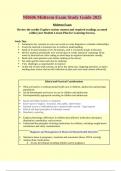
Midterm Exam
Review the weekly Explore section content and required readings as noted
within your Student Lesson Plan for Learning Success.
Study Tips:
Summarize key concepts in your own words or create diagrams to visualize relationships.
Teach the material to someone else to reinforce understanding.
Study in focused sessions of 25–50 minutes, with 5–10-minute breaks in between.
Review material periodically over several days or weeks instead of cramming. Write
notes by hand and use color coding or mind maps to organize information visually.
Read each exam question twice before looking at the answer
Set aside specific times each day for studying.
View challenges as opportunities to improve.
At the end of each study session, jot down key takeaways, lingering questions, or topics
needing more review and use this reflection to plan your next study session effectively
Ethical and Practical Considerations
What are barriers to seeking mental health care in children, adolescents and perinatal
populations
Social determinants and access to care in children and adolescents
Developmentally appropriate teaching in children and adolescents
Racial and ethnic barriers to treatment
Know types of stigma: structural, self, public, intervention
Parental access to child/adolescent’s mental health records – legal aspects
Ethical and legal principles of informed consent
Mandatory reporting
Explore physiologic differences in children that influence medication absorption,
distribution, metabolism, and excretion.
Understand the principles of dosing medications for children, including weight-based
calculations and safety considerations.
Diagnosis and Management of Maternal Mental Health Disorders
Substance abuse in pregnancy, treatment and assessment (know CIWA scoring)
Antipsychotic medications:
o Across the lifespan including children and in pregnancy
Midterm Exam
Review the weekly Explore section content and required readings as noted
within your Student Lesson Plan for Learning Success.
Study Tips:
Summarize key concepts in your own words or create diagrams to visualize relationships.
Teach the material to someone else to reinforce understanding.
Study in focused sessions of 25–50 minutes, with 5–10-minute breaks in between.
Review material periodically over several days or weeks instead of cramming. Write
notes by hand and use color coding or mind maps to organize information visually.
Read each exam question twice before looking at the answer
Set aside specific times each day for studying.
View challenges as opportunities to improve.
At the end of each study session, jot down key takeaways, lingering questions, or topics
needing more review and use this reflection to plan your next study session effectively
Ethical and Practical Considerations
What are barriers to seeking mental health care in children, adolescents and perinatal
populations
Social determinants and access to care in children and adolescents
Developmentally appropriate teaching in children and adolescents
Racial and ethnic barriers to treatment
Know types of stigma: structural, self, public, intervention
Parental access to child/adolescent’s mental health records – legal aspects
Ethical and legal principles of informed consent
Mandatory reporting
Explore physiologic differences in children that influence medication absorption,
distribution, metabolism, and excretion.
Understand the principles of dosing medications for children, including weight-based
calculations and safety considerations.
Diagnosis and Management of Maternal Mental Health Disorders
Substance abuse in pregnancy, treatment and assessment (know CIWA scoring)
Antipsychotic medications:
o Across the lifespan including children and in pregnancy